First Class vs Private Jet vs Jet Card vs Fractional Ownership: The Executive Travel ROI Decision Guide for CFOs (2026)
Published: May 9, 2026 | Read time: 16 minutes | Format: Executive travel decision guide (CFO & finance team)
📋 Who this page is for
✔️ CFOs and finance teams setting or defending the executive travel budget
✔️ CHROs and HR leaders designing executive compensation and travel benefits
✔️ CEO offices and executive assistants running the day-to-day policy
✔️ Founder-CEOs making the call themselves
The four options — first class, charter, jet card, fractional — get compared on the same ROI framework so the right choice for your company becomes clear.
→ ACK Executive Travel Consulting (Wonjin Choi 📞 +82-10-7723-3177)
First Class vs Private Jet vs Jet Card vs Fractional Ownership: The Executive Travel ROI Decision Guide for CFOs (2026)
Annual aviation spend for a single executive can run anywhere from $40,000 to $500,000 depending on which option the company picks — a 10x spread on the same person doing roughly the same job. And yet most corporate decision-makers have never compared these four options on the same scoreboard. First class is “a known line item.” Charter is “for special occasions.” Jet card is “something I’ve heard of.” Fractional ownership is “what I saw in a movie.” Each option lives in its own mental category, which is exactly why companies end up with the wrong fit.
This guide forces all four onto a single framework. Five axes — annual cost, time value, price predictability, availability, capital burden — applied identically to first class, on-demand charter, jet card, and fractional ownership. Then break-even analysis at 5, 10, 25, and 50 trips per year so the line in the sand is obvious. Pricing in USD throughout, with KRW reference points where they help.
The data behind this guide comes from over a thousand executive charter quotes I’ve personally handled across three vantage points: managing operations at Korean Air’s business jet division, running the corporate aviation account at Samsung Electronics, and serving as the Victor × Air Charter Service Korea agent. Air Charter Korea (ACK) built this matrix because finance teams kept asking the same question — “Which option fits us?” — and there wasn’t a clean answer published in this market.
⚡ Free executive aviation policy consulting
Share your last-12-months executive travel pattern under NDA. Get a four-option simulation report tailored to your company.
📧 contact@aircharterkorea.com | 📞 Wonjin Choi +82-10-7723-3177
→ Request the free consultation
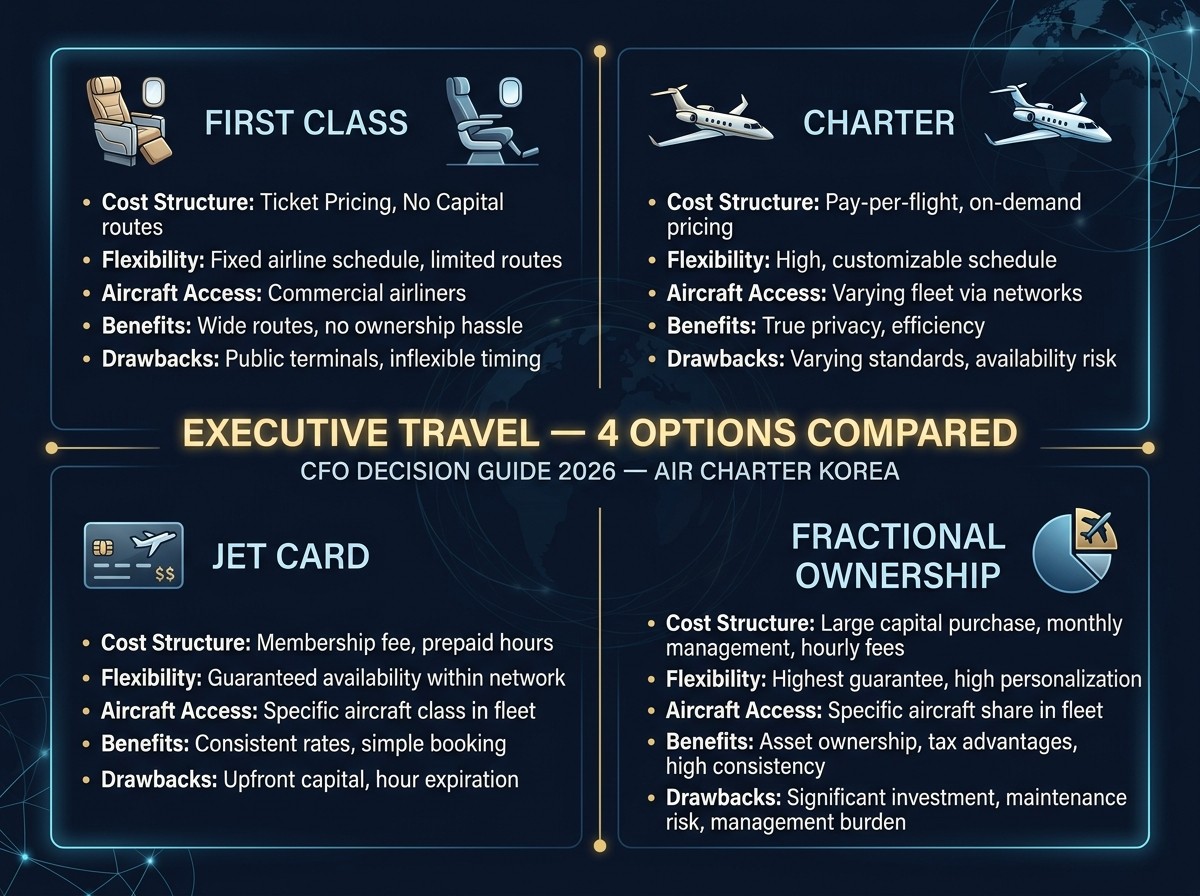
1. The Four Options — Single-Page Summary
Option | Upfront Cost | Per-Trip Cost | Best Fit Usage |
|---|---|---|---|
① First class (commercial) | None | $3,800–$11,500 round-trip | Under 5 trips/year |
② On-demand charter | None | $15K–$50K one-way | 5–25 trips/year, varied routes |
③ Jet card (25/50/100 hours) | $150K–$1.5M pre-purchased | Locked hourly rate | 25–100 hours/year, repeat routes |
④ Fractional ownership | $1.5M–$10M+ share | Monthly mgmt + per-hour ops | 100–400 hours/year, global |
In one line: the lower the usage, the more first class makes sense; the higher the usage, the further you move down the list. With one important Korean-market caveat — option ④ is functionally unavailable under domestic aviation law, so Korean equivalents are (a) whole-aircraft ownership and (b) Aircraft Management with charter offset. We’ll get to those.
2. Option ① First Class — The Most Familiar, and the Most Expensive on Time
The real cost structure
Korean Air ICN–LAX first class round-trip runs about $11,500. ICN–LHR around $9,000. ICN–HND about $1,900–$3,000. On the surface, this is by far the cheapest option. The real cost isn’t the ticket price, though — it’s time.
Step | First Class | Private Jet |
|---|---|---|
Airport arrival → security cleared | ~120 min (2-hour pre-flight) | ~15 min |
Boarding → takeoff | ~60 min | ~5 min |
Landing → cleared immigration | ~60–90 min | ~10 min (CIQ in 5) |
Actual flight | Same | Same or shorter (direct) |
Airport + terminal time (round-trip) | ~5–6 hours | ~30–45 minutes |
Roughly 4–5 hours saved per round-trip. Apply your executive’s loaded hourly cost — call it $1,000/hour for senior executives, $3,000–5,000/hour for C-suite — and the math shifts quickly. One trip recovers $4,000–$25,000 of executive time. That’s the comparison number that matters when CFOs evaluate this against the charter line item.
When first class is the right answer
Under 5 trips per year — charter break-even doesn’t materialize.
Highly varied routing (different city every time) — repositioning costs ruin charter economics.
Major routes with abundant first-class direct service (ICN–LAX, ICN–LHR, etc.).
Cost discipline outweighs time value (mid-level executive policy).
3. Option ② On-Demand Private Jet Charter — The Most Flexible Option
Cost structure
No upfront commitment, no membership fee, no minimum hours. You pay per trip — hourly rate plus repositioning plus ancillaries. Route pricing from Seoul:
Route | One-Way (USD) | Round-Trip Package |
|---|---|---|
Gimpo → Tokyo | $15K–$30K | $28K–$50K |
Gimpo → Shanghai | $26K–$48K | $48K–$80K |
Incheon → Singapore | $60K–$115K | $95K–$170K |
Incheon → London | $138K–$450K | $220K–$680K |
Incheon → LA | $230K–$380K | $360K–$580K |
Pricing detail: Charter Price Comparison Guide. The full 17-line-item cost breakdown: Cost Breakdown Guide.
What charter delivers
Flexibility. Pick your route, dates, time, aircraft type. Change destination if the deal changes.
No capital tied up. Zero deposit, no membership. Pay only for what you fly.
Discount levers stay open. Empty leg flights at 50–90% off, last-minute slots at 30–60% off. Detail: Empty Leg & Last-Minute Guide.
Right-sized aircraft each trip. VLJ for the short hop, BBJ for the team move.
When charter is the right answer
5 to 25 trips per year, varied routes, flexibility valued over price predictability. About 70% of Korean conglomerate executive travel falls in this bucket. If your route mix shifts quarter to quarter, charter is the rational choice.
4. Option ③ Jet Card — Pre-Purchase Hours, Lock the Rate
How jet cards work
A jet card is a pre-purchase of 25, 50, or 100 hours of flight time at a locked hourly rate. NetJets Card, FlexJet, Magellan Jets, and Wheels Up are the U.S. archetypes. ACK introduced the 25-hour entry-level model to the Korean market.
Tier | Pre-Purchase (Midsize jet) | Effective Hourly Rate | Validity |
|---|---|---|---|
25-hour Card | $150K–$200K | $6,000–$8,000 | 12–24 months |
50-hour Card | $280K–$380K | $5,600–$7,600 | 24 months |
100-hour Card | $540K–$720K | $5,400–$7,200 | 24–36 months |
What jet cards deliver
Price predictability. Hourly rate locked. No fuel exposure, no peak-season swings.
Guaranteed availability. Aircraft availability with 24–48 hours’ notice (Magellan model).
Pre-paid accounting. Lump-sum capitalized, no quarter-to-quarter expense volatility.
Consistent fleet and crew. Branded experience (the VistaJet Program model).
The trade-offs
Capital lockup. $150K to $1.5M deposited up front. Refund mechanics on unused hours are usually restrictive.
Geographic limits. Many cards are region-locked (Asia or North America); global coverage costs more.
No empty leg discounts. Locked rate means you can’t access the 50–90% off opportunities.
When a jet card is the right answer
25 to 100 hours per year, repeating route patterns, finance team prioritizing predictability and availability over flexibility. The U.S. market has consistently rated the Magellan 25-hour Founder’s Club card as the entry standard; ACK adapted that model for Korea.

5. Option ④ Fractional Ownership — Asset Plus Partial Use
How fractional works (NetJets model)
Buy 1/16, 1/8, or 1/4 of a specific aircraft and get the proportional flight time per year (~50, ~100, or ~200 hours). NetJets — owned by Berkshire Hathaway, more than 1,000 aircraft — is the gold standard, with FlexJet and FlyExclusive as the major U.S. alternatives.
Share | Acquisition (Midsize jet) | Monthly Mgmt Fee | Annual Hours |
|---|---|---|---|
1/16 (~50hr) | $1.5M–$2.5M | $15K–$25K | ~50 |
1/8 (~100hr) | $3M–$5M | $30K–$50K | ~100 |
1/4 (~200hr) | $6M–$10M | $60K–$100K | ~200 |
Why fractional doesn’t fit Korea cleanly
Under Korean aviation law, the U.S.-style fractional model is essentially unavailable. Domestically registered aircraft must have either a single owner or a certified air operator on the registration; multiple share-holders splitting flight time conflicts with the air-operator definition under the Aviation Business Act. The Korean equivalents:
Whole-aircraft ownership. Single-owner ownership of one aircraft. Korean Air’s BizJet program is structured this way — initiation around $500K plus hourly operating costs. Right answer for executives flying 100+ hours globally per year.
Aircraft Management. Privately owned jet enrolled in a charter pool to recoup costs through third-party charters when the owner isn’t using it (Luxaviation and ExecuJet are the global benchmarks). Owner gets priority use plus partial cost recovery.
U.S.-registered fractional. Use NetJets or FlexJet U.S.-registered aircraft for global routings. Best fit for legs going through the U.S.; less applicable for Korea-domestic departures.
6. Break-Even Analysis — Annual Frequency Decides It
The number every CFO actually wants — “which option does our company belong in?” Four scenarios, run as if Korea-Japan, Korea-Southeast Asia, and Korea-North America each represent roughly a third of the executive’s travel mix.
Scenario ① 5 trips per year (mid-cap mid-tier executive)
Option | Annual Cost (USD) |
|---|---|
① First class | ~$50K (5 round-trips) |
② Charter (mixed routes) | ~$200K–$300K |
③ 25-hour Card | ~$150K–$200K (pre-paid) |
④ Fractional | $200K+ (low utilization, inefficient) |
Recommendation: ① first class as the default, with ② charter for one-off occasions where time matters. Time-value math favors ②, but if cost discipline is the operating principle, ①.
Scenario ② 10 trips per year (typical Korean conglomerate executive)
Option | Annual Cost (USD) |
|---|---|
① First class | ~$100K |
② Charter (round-trip packages) | ~$350K–$500K |
③ 25-hour Card (~50 hours used) | ~$300K–$400K |
Recommendation: ② charter for flexibility, or ③ 25-hour card for predictability. Once executive time value is in the model, both ② and ③ beat ① on ROI.
Scenario ③ 25 trips per year (CEO with active international remit)
Option | Annual Cost (USD) |
|---|---|
① First class | ~$250K (plus 100+ hours of executive time burned) |
② Charter | ~$700K–$1M |
③ 50-hour Card | ~$300K–$400K (with availability guarantee) |
Recommendation: ③ 50-hour card. Wins on price predictability, availability, and effective hourly rate. With C-suite time-value math, this is the cleanest ROI in the matrix.
Scenario ④ 50+ trips per year (global group chairman)
Option | Annual Cost (USD) |
|---|---|
① First class | ~$500K (impractical at this volume) |
② Charter | ~$1.5M–$2M |
③ 100-hour Card | ~$540K–$720K (only covers ~100 of the ~150+ hours needed) |
④ Whole-aircraft / fractional | $3M–$10M acquisition + annual operating |
Recommendation: ④ whole-aircraft (Korean-registered) or a hybrid ④+③ depending on global mix. Aircraft as an asset locks substantial capital, so finance and tax counsel are essential before signing.
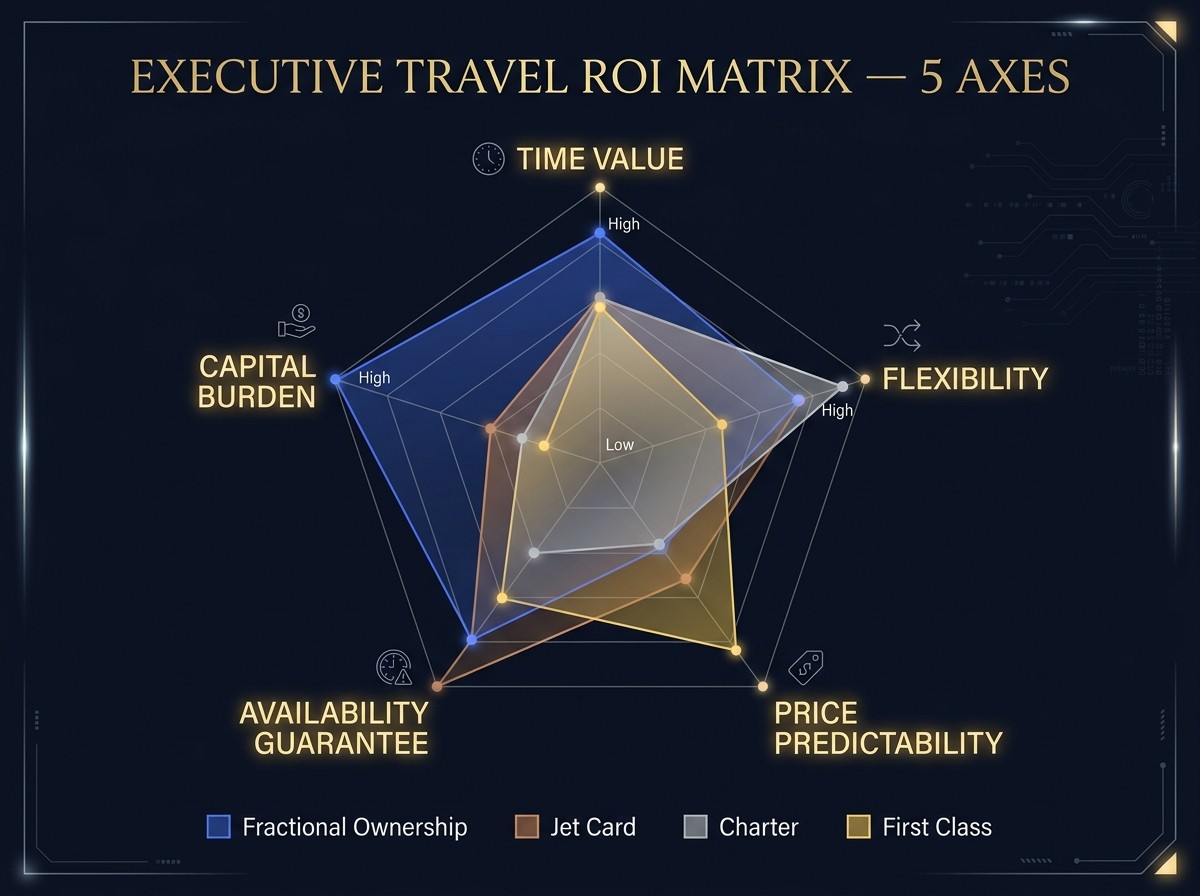
7. ROI Matrix — All Four Options on Five Axes
Axis | First Class | Charter | Jet Card | Fractional |
|---|---|---|---|---|
Time value | ★★ | ★★★★★ | ★★★★★ | ★★★★★ |
Flexibility | ★★ | ★★★★★ | ★★★ | ★★ |
Price predictability | ★★★★ | ★★ | ★★★★★ | ★★★★ |
Availability guarantee | ★★★ (peak season weak) | ★★★★ (varies) | ★★★★★ (24–48hr notice) | ★★★★★ (immediate) |
Capital burden | ★★★★★ (none) | ★★★★★ (none) | ★★★ ($150K–$1.5M) | ★ ($1M–$10M+) |
No option dominates across all axes. The right answer depends on your company’s specific mix of usage frequency, route patterns, capital availability, and predictability preference.
8. Tax Treatment — What CFOs Need to Know
Corporate deductibility
A charter contract under the company’s name is deductible as a business travel expense, subject to three conditions: (1) the trip serves a documentable business purpose, (2) any executive personal use is carved out separately, and (3) pricing is reasonable relative to market rates so the deduction isn’t disallowed under unreasonable-related-party-transactions rules.
Imputed compensation for personal use
When an executive uses the aircraft for family or personal travel, the personal portion needs to be either reimbursed back to the company or treated as imputed compensation (similar in structure to the U.S. SIFL framework). The standard methods: (a) market value of an equivalent first-class commercial ticket for non-business attendees, or (b) flight-time-allocated cost, added to the executive’s compensation.
Documentation that audit-proofs the policy
Trip authorization (destination, purpose, duration)
Meeting evidence (minutes, contracts, event materials)
Passenger manifest with relationship to business
Charter contract, flight log, payment records
Important: Tax treatment varies by jurisdiction and corporate structure, and your accounting firm needs to sign off on the framework before it’s locked in. ACK provides every source document needed for that conversation and works directly with your tax counsel where useful.
9. The ACK Executive Travel Consulting Process (Free)
Step 1 — Pattern review (one meeting)
Share last-12-months executive travel data — routes, headcount, trip frequency, length of stay — under NDA. ACK builds the simulation.
Step 2 — Four-option simulation report (within one week)
A 30–50 page custom PDF: first class, charter, jet card, and fractional modeled against your actual data, with annual cost, time-value translation, tax treatment, and ROI side by side.
Step 3 — Review with accounting and legal
The recommended option is run past your accounting firm and legal team. Tax efficiency, accounting treatment, and alignment with executive compensation policy all checked.
Step 4 — Pilot run (3–6 months)
Selected option runs as a pilot. Monthly review of usage data, cost, and executive feedback. Adjustments before full rollout.
Step 5 — Full deployment + annual review
Policy goes live. Annual review on the same framework — usage patterns drift, and the right option drifts with them.
Related: Membership vs. Charter Cost Analysis | Multi-City Business Itineraries
10. + Add-On to Any Option: Incheon VIP Escort
First class, charter, jet card, fractional — whichever option an executive flies on, the Incheon ground experience is the same friction. BestTurn VIP Airport Escort handles that piece. Particularly valuable for first-class travelers who don’t have the FBO buffer that charter clients enjoy: BestTurn cuts immigration and customs to about five minutes from arrival to car door.
Service: Arrival, departure, transit VIP escort + chauffeured ground transfer
Pricing: From USD 250, 50% surcharge late-night (22:00–06:00)
Contact: Steve, Escort Lead 📞 +82-10-3721-2853 / service@bestturnaround.com
11. Frequently Asked Questions from CFOs and Finance Teams
Q: How do I quantify executive time value?
Two common methods: (a) loaded hourly compensation — total package divided by working hours, often $200–$500/hour for senior executives, or (b) decision-value imputation — what the executive’s hour is worth in revenue or strategic decisions, often $1,000–$5,000+/hour for C-suite. Most finance teams use (a) for the floor and (b) as the upside case. Four hours saved per trip × 12 trips × $1,000/hour = $48,000 of recovered time annually.
Q: Can we lock in jet card pricing without committing capital upfront?
ACK’s Corporate Charter Program offers exactly that — pre-negotiated hourly rates without the pre-paid card structure. No upfront capital, payment per trip, but locked rates for the contract period.
Q: We don’t yet know our true usage pattern — how do we start?
Run year one on ② on-demand charter to capture real usage data. Year two, evaluate jet card or fractional based on actuals. ACK structures the year-one data so the year-two decision is straightforward.
Q: Can a Korea-based company sign up for NetJets?
Yes — Korean residents and corporations can purchase NetJets or FlexJet shares for U.S.-registered aircraft. Best for U.S.-routed travel; less applicable for Korea-domestic departures. ACK can introduce the U.S. teams directly.
Q: What if the policy needs to cover multiple executives, not just one?
Corporate Charter Program — multi-user shared access. ACK structures usage caps, priority rules, and billing allocation per your internal policy.
Q: How do I prepare a board-deck version of the analysis?
ACK delivers the simulation report in a board-ready format. Four-option comparison, five-year cumulative cost projection, time-value translation, tax treatment — all included as a board exhibit.
📞 Free executive aviation policy consulting — 4-option simulation report
Corporate consulting: ACK — Request a Quote | Wonjin Choi 📞 +82-10-7723-3177 | contact@aircharterkorea.com
Incheon VIP escort: BestTurn VIP Escort | Steve 📞 +82-10-3721-2853 | service@bestturnaround.com
🔗 ACK LinkedIn | Wonjin Choi LinkedIn
NDA up front · Free simulation report · Accounting firm collaboration · Board-ready deliverables
Conclusion: Executive Travel Is a Time Asset, Not Just a Travel Expense
Treat executive travel as an expense and first class wins on raw cost. Treat it as a time asset and charter, jet card, or fractional all start to make sense depending on volume. Which framing is correct? It depends on how your company values executive time. The fact that roughly 70% of global companies above $100M in revenue have moved at least part of their executive travel to charter or jet card programs tells you what side of the equation most CFOs landed on once they ran the numbers.
Korean companies are converging toward the same conclusion. Samsung Electronics divested its in-house business jets in 2015 and shifted to charter. Hyundai introduced an executive charter program. Korean entertainment groups have moved global tour logistics to dedicated charter. Same decision, different industries — and what they share is that they ran the analysis instead of treating the question as a status conversation.
ACK’s executive travel consulting exists to put that analysis in finance teams’ hands. Share your data under NDA and you’ll have the four-option simulation report inside a week — no obligation, no upfront cost. In the air: Air Charter Korea. On the ground at Incheon: BestTurn. Both pieces of executive travel, one decision framework.
Executive travel — treat it as a time asset, and the math becomes obvious.

✍️ About the Author
Wonjin Choi | Former Korean Air Business Jet Operations Manager · Former Samsung Electronics Business Jet Account Manager
Victor × Air Charter Service Korea Agent
Founder, Air Charter Korea
This guide draws on official service information from Air Charter Korea, NetJets, FlexJet, Magellan Jets, and VistaJet’s published market data, and Korean charter market pricing data current as of May 2026. All pricing reflects market reference ranges. Actual quotes vary by route, dates, and aircraft availability. Tax treatment requires consultation with your accounting firm.