The Definitive Guide to Private Jet Charter in South Korea (2026)
The Definitive Guide to Private Jet Charter in South Korea (2026)
Everything you need to know about chartering a private jet from South Korea — real pricing by route, aircraft categories compared, FBO terminals at Gimpo and Incheon, empty leg deals, and a step-by-step booking walkthrough.
Why South Korea's Private Aviation Market Is Having a Moment
For decades, private jets in South Korea were the domain of a handful of chaebol families and their corporate empires. That's changing fast.
Post-pandemic travel patterns, a booming K-pop industry with global touring demands, and a new generation of tech founders who value time over status have all converged to push private aviation into the mainstream conversation. The global business jet market now exceeds $35 billion, and South Korea — despite its relatively small geographic footprint — is one of the fastest-growing demand centers in the Asia-Pacific region.
The competitive landscape tells the story. Domestic players like VONAER, BLUESHIFT, and Korean Air's BizJet division are now going head-to-head with global heavyweights such as VistaJet, Air Charter Service, and PJS Group, all of which have established Korean-language operations or local offices in Seoul.
Yet for all the momentum, reliable, detailed information about actually booking a private flight from South Korea remains surprisingly hard to find. Most operator websites offer little more than a contact form and a few glamour shots.
This guide fills that gap. Whether you're a first-timer exploring the idea or a seasoned flyer looking for a better deal, here's everything you need to know about private jet charter from Seoul — with real numbers, honest caveats, and the kind of operational detail that actually helps you make a decision.
Private Jet, Charter, Business Jet — What's the Difference?
The terminology can be confusing, especially across languages. In Korean, the words 전용기 (jeon-yong-gi), 전세기 (jeon-se-gi), and 프라이빗 제트 are used almost interchangeably. In English, the distinctions matter:
Private jet refers to an aircraft owned outright by an individual or corporation for exclusive use. In South Korea, fewer than a few dozen entities own their own jets — Korean Air, SK Group, and Hyundai among them.
Charter (or charter jet) is what most people actually use: renting an aircraft and crew on a per-trip basis, without owning anything. This is the model that's growing fastest in Korea.
Business jet is the broader category name for small-to-midsize aircraft designed for corporate and VIP travel — everything from a four-seat HondaJet to a 19-passenger Gulfstream G700.
Throughout this guide, we use "private jet charter" to cover the full spectrum. If you're flying private out of Korea, chances are you're chartering.
Aircraft Categories Compared: Which Jet Fits Your Mission?
Choosing the right aircraft comes down to three variables: how far you're going, how many people are coming, and what you're willing to spend. Here's how the six main categories stack up for flights departing South Korea.
Very Light Jets (VLJ)
Typical aircraft: HondaJet Elite, Cirrus Vision Jet, Cessna Citation M2 Passengers: 4–6 Range: ~1,500–2,500 km Best for: Gimpo to Jeju, Seoul to Osaka, domestic hops The pitch: The most affordable entry point into private flying. These compact jets are ideal for short domestic runs or quick jumps to nearby Japanese cities. Cabin space is tight — think premium SUV, not living room — but for sub-two-hour flights, it's more than enough.
Light Jets
Typical aircraft: Embraer Phenom 300E, Cessna Citation CJ3+, Pilatus PC-24 Passengers: 6–8 Range: ~3,000–3,700 km Best for: Seoul to Tokyo, Shanghai, Taipei The pitch: The workhorse of Northeast Asian business aviation. Light jets offer the best balance of speed, cabin comfort, and operating cost for the region's most common routes. The Phenom 300E, in particular, has become a favorite among Korean charter operators for its reliability and range.
Midsize Jets
Typical aircraft: Cessna Citation Latitude, Hawker 800XP, Learjet 60XR Passengers: 7–9 Range: ~4,000–5,500 km Best for: Seoul to Bangkok, Singapore (with reserves), Guam The pitch: This is where you get a stand-up cabin — meaning you can actually walk upright through the aisle. Midsize jets are the sweet spot for Southeast Asian routes, offering enough range to reach most of the region's major cities nonstop while keeping costs well below heavy-jet territory.
Super Midsize Jets
Typical aircraft: Bombardier Challenger 350, Gulfstream G280, Citation Longitude Passengers: 8–12 Range: ~5,500–6,700 km Best for: Seoul to India, parts of the Middle East, northern Australia (with a fuel stop) The pitch: Super mids deliver heavy-jet cabin space at a midsize price point. The Challenger 350 is arguably the most popular business jet in the world right now, and for good reason — it can handle most of Korea's medium-to-long-haul routes without the per-hour cost of a Gulfstream G650.
Heavy / Long-Range Jets
Typical aircraft: Gulfstream G650ER, Bombardier Global 7500, Dassault Falcon 8X Passengers: 12–19 Range: ~10,000–14,000 km Best for: Seoul to London (nonstop), Seoul to LA (nonstop), Seoul to Dubai (nonstop) The pitch: The flagship category. These aircraft can cross oceans without refueling and feature full-flat beds, onboard showers (on some Global 7500 configurations), and multi-zone cabins that rival boutique hotel suites. Korean Air operates a G650ER and a Boeing BBJ in this segment. If you're flying Seoul to Europe or the U.S. West Coast and want to arrive rested, this is the only option.
VIP Airliners
Typical aircraft: Boeing BBJ (737-based), Airbus ACJ319/320, Boeing 757 VIP Passengers: 20–100+ Range: 10,000 km+ Best for: K-pop world tours, government delegations, large corporate group moves The pitch: When you need to move dozens of people in style — think BTS on tour or a presidential advance team — VIP airliners are the answer. PJS Group, which has a Korean office, operates Boeing 757s in both VIP and three-class configurations specifically for this market.
What Does a Private Jet Actually Cost from Seoul?
Let's talk numbers. Pricing in private aviation is notoriously opaque, and Korea-origin flights tend to run higher than comparable routes in Europe or North America due to the limited number of locally based aircraft. Most charters require repositioning a jet from elsewhere in Asia, and that positioning cost gets baked into your quote.
That said, here are realistic 2026 price ranges based on current market conditions.
Domestic Routes (Gimpo ↔ Jeju)
Aircraft Category | One-Way Estimate | Flight Time |
|---|---|---|
Very Light Jet | $6,000–$11,000 | ~50 min |
Light Jet | $9,000–$15,000 | ~50 min |
Midsize Jet | $13,000–$22,000 | ~50 min |
Short-Haul International (Seoul ↔ Tokyo/Osaka)
Aircraft Category | One-Way Estimate | Flight Time |
|---|---|---|
Light Jet | $18,000–$30,000 | ~2 hrs |
Midsize Jet | $26,000–$40,000 | ~2 hrs |
Heavy Jet | $45,000–$75,000 | ~2 hrs |
Medium and Long-Haul International
Route | Aircraft | One-Way Estimate | Flight Time |
|---|---|---|---|
Seoul ↔ Singapore | Super Mid / Heavy | $60,000–$110,000 | ~6 hrs |
Seoul ↔ Dubai | Heavy | $110,000–$220,000 | ~9 hrs |
Seoul ↔ London | Heavy (G650ER class) | $220,000–$440,000 | ~12 hrs |
Seoul ↔ Los Angeles | Heavy (Global 7500 class) | $300,000–$520,000 | ~11 hrs |
Cost-saving note: These are one-way figures. Round-trip bookings eliminate the repositioning fee, which can reduce total cost by 20–40%.
What's Included in the Quote
A standard charter quote typically covers aircraft rental (billed by flight hour), crew costs, fuel, landing and handling fees, and basic insurance. Items often billed separately include international overflight permits, catering, ground transportation, in-flight Wi-Fi, and any special requests.
Empty Legs: How to Fly Private at Up to 90% Off
If the prices above made you wince, empty legs are worth understanding.
How Empty Legs Work
When a private jet completes a one-way charter and needs to fly back to its base — or reposition to its next pickup — it flies that leg without passengers. Operators would rather sell those seats at a steep discount than eat the full cost of a dead-head flight. Discounts typically range from 50% to 90% off standard charter rates.
Where to Find Empty Legs from Korea
The Korean empty-leg market is still thin compared to the U.S. or Europe, but it's growing. Here's where to look:
VONAER runs a newsletter that regularly features Korea-origin empty leg deals, including some eye-catching promotions at 70–90% off.
Air Charter Service Korea taps into its global network to surface empty legs involving Korean airports.
BLUESHIFT occasionally packages empty legs into promotional "special private jet" offerings on its platform.
Global platforms like VistaJet and Victor list Korea-related empty legs sporadically — worth checking if your dates are flexible.
The Catch
Empty legs come with real trade-offs. Your schedule is dictated by the original booking, not your preferences. If that booking changes, your empty leg can be canceled with little notice. Route options are limited to whatever's available, and most deals are one-way only. This is a tool for the flexible traveler, not the executive with a locked calendar.
South Korea's Private Aviation Infrastructure: Airports and FBOs
Gimpo International Airport (RKSS) — The Hub
Gimpo is where Korean private aviation lives. Located just 16 km from central Seoul — roughly 25 minutes by car in normal traffic — it's the go-to departure point for both domestic and short-haul international private flights.
Seoul Gimpo Business Aviation Center (SGBAC)
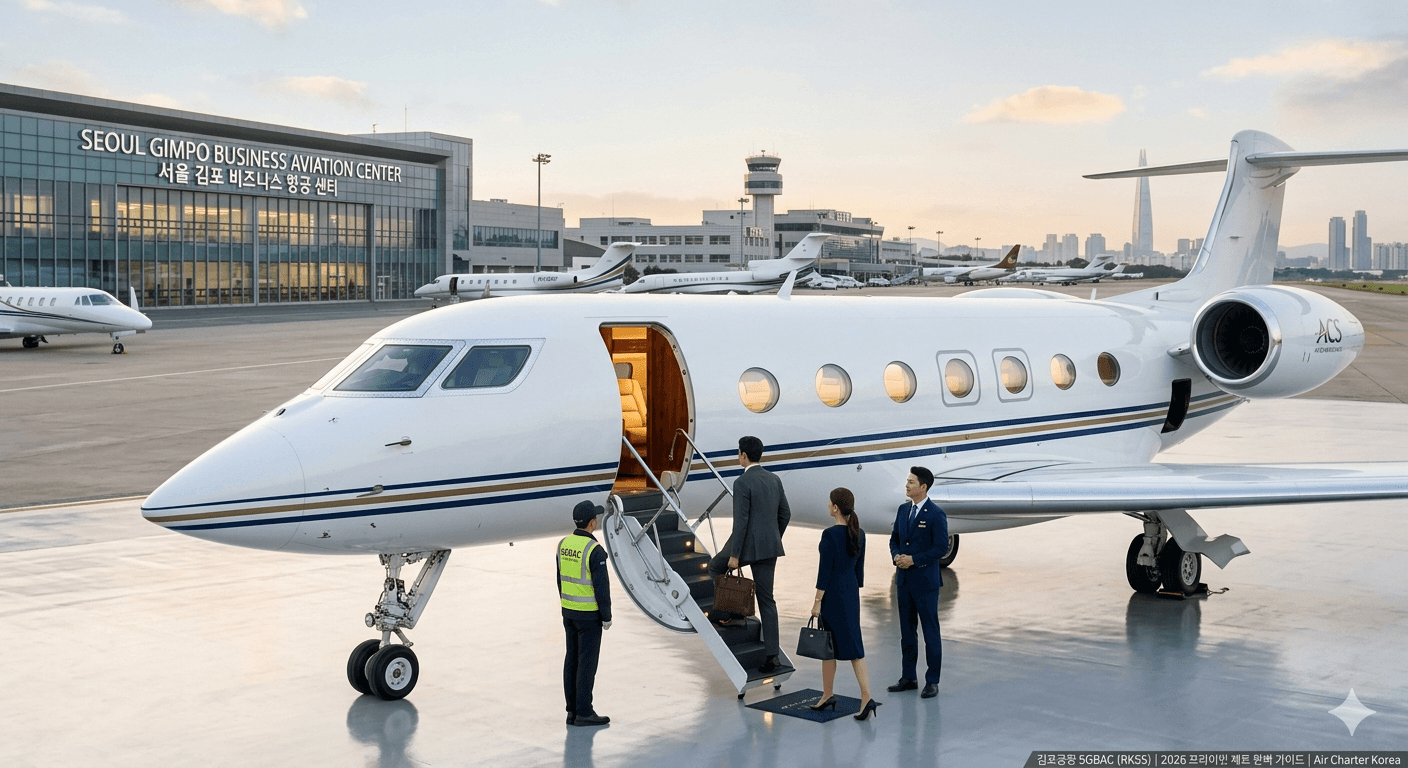
The SGBAC is South Korea's first and only purpose-built business aviation terminal. Think of it as the private version of an airport terminal: dedicated customs, immigration, and quarantine (CIQ) processing; VIP lounges; crew rest areas; and briefing rooms. The experience is nothing like the commercial terminal — you park your car at the door, walk through a brief security check, and board your aircraft within minutes.
Two FBO operators share the facility:
Avjet Asia was the first FBO in South Korea and remains the market leader. Headquartered at Gimpo with branch offices at Incheon (RKSI) and Jeju (RKPC), Avjet provides full-service FBO operations, ground handling, aircraft maintenance, and charter brokerage. The company is a member of NBAA, ASBAA, and the AirElite Network — credentialing that matters when international operators are deciding where to send their aircraft.
UBjet Aviation is the second FBO at Gimpo, offering a comprehensive suite of trip support services: ground handling, flight operations, permit processing, fuel coordination, catering, and door-to-door concierge service. UBjet also maintains an office at Incheon Airport's concourse, making it a useful partner for operators running both Gimpo and Incheon legs.
Incheon International Airport (RKSI) — The Long-Haul Gateway
For intercontinental flights, Incheon is typically the departure airport — its longer runways and 24-hour operations accommodate the larger aircraft used on routes to Europe, the Middle East, and the Americas. Dedicated business aviation infrastructure is more limited than at Gimpo, but Avjet Asia and UBjet Aviation both have Incheon operations to handle arrivals and departures.
Jeju International Airport (RKPC) — Leisure Destination
Jeju is the most common domestic destination for private flights out of Gimpo, driven by golf trips, resort stays, and the island's growing reputation as a luxury getaway. Avjet Asia's Jeju branch provides ground services.
Other Airports
Yangyang, Gimhae (Busan), and Muan airports can all accommodate private jet operations, but none have dedicated FBO facilities — ground handling must be arranged separately.
How to Book a Private Jet from South Korea: A Five-Step Walkthrough
Step 1: Define Your Requirements
Before you contact anyone, nail down the basics: travel dates (and whether they're flexible), departure and destination airports, number of passengers, any special needs (catering preferences, pets, medical equipment, oversized luggage), and your budget range. The more specific you are upfront, the faster and more accurate your quotes will be.
Step 2: Request Quotes from Multiple Sources
The Korean market has enough players now that comparison shopping is both possible and advisable. Your main options:
Domestic charter brokers: VONAER, BLUESHIFT, PJS Korea, ZetCab Global brokers with Korean offices: Air Charter Service Korea Direct from operators: VistaJet (membership required), Korean Air BizJet FBO-based charter desks: Avjet Asia, UBjet Aviation
Request quotes from at least two or three sources. Pricing can vary significantly depending on which aircraft each broker has access to.
Step 3: Evaluate the Quotes
A proper quote should specify the aircraft type and age, the operator's safety certifications (look for ARG/US, Wyvern, or IS-BAO ratings), what's included versus billed separately, the cancellation and change policy, and whether repositioning costs are factored in. Don't just compare the bottom-line number — a cheaper quote with a weaker operator or restrictive cancellation terms may not be the better deal.
Step 4: Sign and Pay
Once you've chosen, you'll sign a charter agreement and submit payment. Wire transfer is standard in Korea; some brokers accept credit cards. Jet card and membership programs work on a prepaid-hours model — you buy a block of flight time upfront at a fixed hourly rate.
Step 5: Show Up and Fly
On departure day at Gimpo SGBAC, arrive 15 minutes before your flight for domestic routes, 30 minutes for international. That's it. Dedicated CIQ processing means no long security lines, no gate changes, no boarding groups. You'll walk from your car to your aircraft in minutes.
Membership vs. On-Demand Charter: Which Model Makes Sense?
On-Demand Charter
You book each flight individually, getting fresh quotes every time. There's no upfront commitment and no obligation to fly again.
Works best for: Infrequent flyers (fewer than five trips per year) or travelers whose routes and schedules vary widely. Maximum flexibility, but you're subject to market pricing and aircraft availability on any given day.
Jet Cards
You prepay for a block of flight hours — typically 25 hours or more — at a fixed hourly rate for a specific aircraft category. When you need a flight, you call in and the operator guarantees availability, usually with 24–48 hours' notice.
Works best for: Regular travelers flying 25–100 hours per year who want price predictability and guaranteed access without the commitment of a full membership. Options available in Korea include Air Charter Service's Empyrean Card, PJS Group's Jet Card, and VistaJet's VJ25 program.
Full Membership Programs
Long-term contracts with dedicated fleet access, personalized cabin service, and the highest level of availability and consistency.
Works best for: Ultra-high-net-worth individuals or large corporations flying 100+ hours annually. VistaJet's Program membership and Korean Air's BizJet membership are the two primary options accessible from Korea.
Five Things You Need to Know About the Korean Market
Regulatory Complexity
South Korea's proximity to the DMZ and its tightly controlled airspace mean that flight permits, overflight clearances, and slot allocations require careful advance planning. Working with an experienced broker or FBO isn't optional — it's essential.
Limited Domestic Fleet
Fewer than 15 business jets are registered in South Korea. That means most charters involve positioning an aircraft from elsewhere in Asia — Hong Kong, Singapore, or mainland China being common bases. This repositioning cost is the single biggest reason why Korea-origin charters run more expensive than equivalent flights in the West.
The Russian Airspace Variable
For European routes, whether an aircraft can transit Russian airspace dramatically affects both flight time and cost. As of 2025, select operators — VONAER among them — have introduced private jet services that route through Russian airspace, potentially shaving hours off the Seoul-to-Europe journey. This is a fast-evolving situation; ask your broker about current options.
Seasonal Demand Spikes
Korean private jet demand peaks around Lunar New Year and Chuseok (major family holidays with resort travel demand), golf season (April through June, September through November — Jeju, Japan, and Southeast Asia golf trips), K-pop world tour seasons (large-scale group moves for artists and crew), and the core business travel windows of Q1 and Q4. During peak periods, aircraft availability tightens. Book at least two to four weeks ahead.
The eVTOL Horizon
South Korea is positioning itself as a global leader in urban air mobility. VONAER has partnered with UK-based Sora to develop a 30-seat eVTOL aircraft, and several Korean startups are building out vertiport infrastructure. When UAM goes live — most forecasts point to 2028 or beyond — the time cost of getting from central Seoul to Gimpo or Incheon will collapse, making private aviation meaningfully more accessible.
Frequently Asked Questions
How far in advance do I need to book?
For on-demand charter, 24–48 hours is the minimum for domestic flights. International routes should be booked one to two weeks out to allow time for overflight permits and landing slots. Jet card and membership holders can often book with as little as 12–24 hours' notice.
Can I bring my pet?
Yes. Most private jets allow pets in the cabin — no carrier required on many aircraft. For international flights, check destination-country quarantine and documentation requirements well in advance.
Are there baggage limits?
There's no checked-bag fee, but there are physical limits based on the aircraft's cargo hold. Golf bags, ski equipment, and other oversized items are generally fine. Flag anything unusual when you book.
Is there Wi-Fi on board?
Most modern jets offer satellite-based Wi-Fi. Older aircraft and some very light jets may not. Confirm when reviewing your quote.
How early do I need to arrive at the airport?
At Gimpo SGBAC: 15 minutes before departure for domestic flights, 30 minutes for international. That's one of the biggest quality-of-life advantages of flying private — no two-hour pre-departure buffer.
Can I split the cost with other passengers?
Yes, and this model is gaining traction. Seat-sharing on empty legs and group-buy charter deals can bring per-person costs down to the $7,000–$15,000 range on select routes. Ask your broker what's available.
Are there taxes on top of the charter price?
International departures from Korea are generally VAT-exempt. Domestic flights may be subject to value-added tax. Your quote should clarify the tax treatment.
How Korea's Major Private Jet Operators Compare
Operator | Type | Strengths | Core Services |
|---|---|---|---|
Korean Air BizJet | Airline-operated | Owns G650ER and BBJ; only Korean airline with self-operated private fleet | Membership, charter |
Air Charter Service Korea | Global broker (Korean office) | 30+ year track record; offices in 40+ countries | Charter, Empyrean Jet Card, empty legs |
VONAER | Korean startup | Russian airspace routing; eVTOL partnerships; active newsletter | Charter, empty legs, XR in-flight experiences |
BLUESHIFT | Luxury travel curation | Private jet + destination packaging; Aman Resorts partnership | Curated journeys, bespoke travel, jet charter |
PJS Korea | Global broker (Korean office) | Largest North American fleet network; 5,000+ annual flights; carbon-neutral | Corporate charter, sports team travel, jet card |
VistaJet | Global operator | 300+ owned aircraft; truly global membership | Program, VJ25, Corporate memberships |
Avjet Asia | FBO / charter | Korea's first FBO; Gimpo, Incheon, Jeju coverage | FBO services, ground handling, maintenance, charter |
UBjet Aviation | FBO / charter | Comprehensive trip support at Gimpo; Incheon presence | FBO, handling, concierge, charter consulting |
When Does Chartering a Private Jet Actually Make Financial Sense?
Private aviation isn't just a luxury purchase — there are scenarios where it's a genuinely rational economic decision.
When time has a quantifiable cost. If a CEO needs to hold meetings in Seoul, Tokyo, and Shanghai in a single day, commercial aviation makes it impossible. A private jet makes it routine. Calculate the executive's hourly value and the math often works out.
When the commercial route doesn't exist. No direct flight between two mid-tier cities? A private charter eliminates the connection, the layover, and the lost half-day.
When the group is large enough. Get eight to twelve people on a midsize or super-midsize jet and the per-person cost starts approaching — or undercutting — business-class airfare on the same route.
When privacy is non-negotiable. Confidential business discussions, high-profile celebrity movements, sensitive diplomatic travel — there's no commercial equivalent to a sealed cabin with a crew bound by NDA.
When it's a medical emergency. Air ambulance services operate on a fundamentally different value proposition: speed saves lives. The cost becomes irrelevant when the alternative is waiting for the next commercial flight.
The Bottom Line
South Korea's private aviation market is no longer a niche curiosity — it's a maturing industry with real infrastructure, credible operators, and a growing base of demand. The biggest remaining barrier isn't cost (though that's still significant); it's information. Too many potential customers don't know what's available, what it costs, or how to get started.
This guide is designed to fix that. Whether you're pricing out your first charter or comparing jet card programs for your company's Q1 travel, the information above should give you a working foundation.
If you're ready to move forward, request a complimentary quote. Our team will match your itinerary and budget with the right aircraft, operator, and pricing structure — no obligation, no pressure.