Korean Air Business Jet Price vs Charter vs Personal Ownership 2026: The Three-Option Comparison for Korean HNW Buyers
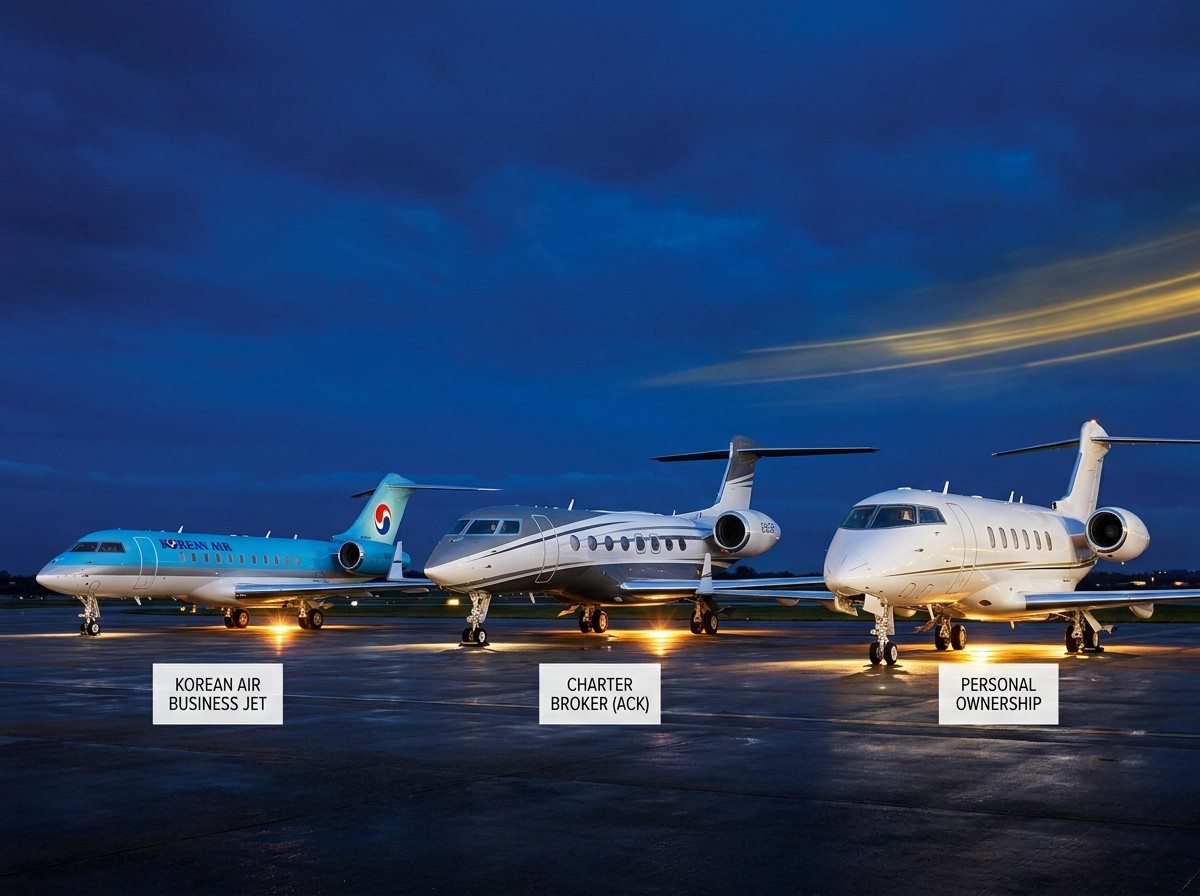
Published: May 19, 2026 | Read time: 17 minutes | Format: Three-option comparison guide for Korean HNW buyers
📊 This page is for:
✔️ Executives and HNW buyers evaluating Korean carrier business jet options
✔️ Anyone weighing "carrier business jet vs charter broker — which is the rational choice?"
✔️ HNW individuals doing the 6–12 month evaluation on personal aircraft ownership
✔️ Buyers looking for the right aircraft marketplace to source listings
This is the integrated three-option comparison — analyzed with the same data set across all three.
→ Three-option advisory (Wonjin Choi 📞 +82-10-7723-3177)
Korean Air Business Jet Price vs Charter vs Personal Ownership 2026: The Three-Option Comparison for Korean HNW Buyers
The buyer evaluating private aviation in the Korean market usually walks in with the same three questions: "Korean Air runs a business jet operation — what does that cost?", "How different is a charter broker?", and "If I buy outright, what does that actually run and where do I find listings?". All three options exist in the market, but the integrated comparison — the one that puts pricing, reviews, and use-case fit on the same page — is hard to find. The result is buyers who lock in on one option before they've seen the others, or buyers who never run the math on what they didn't pick.
This page runs the comparison properly. (1) Korean Air business jet pricing structure (using industry reference data — see methodology note below) and use-case fit. (2) Charter brokers (ACK among them) with the global operator pool model — private jet rental cost composition, route economics, and hourly rate ranges. (3) Personal aircraft ownership — purchase pricing by category, annual operating cost, the Korean ownership context, and the global aircraft marketplaces where buyers actually find inventory. All three options live in this market, and the right answer depends on the buyer's flight pattern, budget, and priorities.
I'm Wonjin Choi — Former Korean Air Business Jet Operations Manager, Former Samsung Electronics Business Jet Account Manager, and now founder of Air Charter Korea as the Victor × Air Charter Service Korea agent. I've worked all three sides of this comparison from different vantage points. This page is the comparison I'd hand someone serious about the decision, built entirely from publicly available information and global market reference data — no proprietary or confidential operator details.
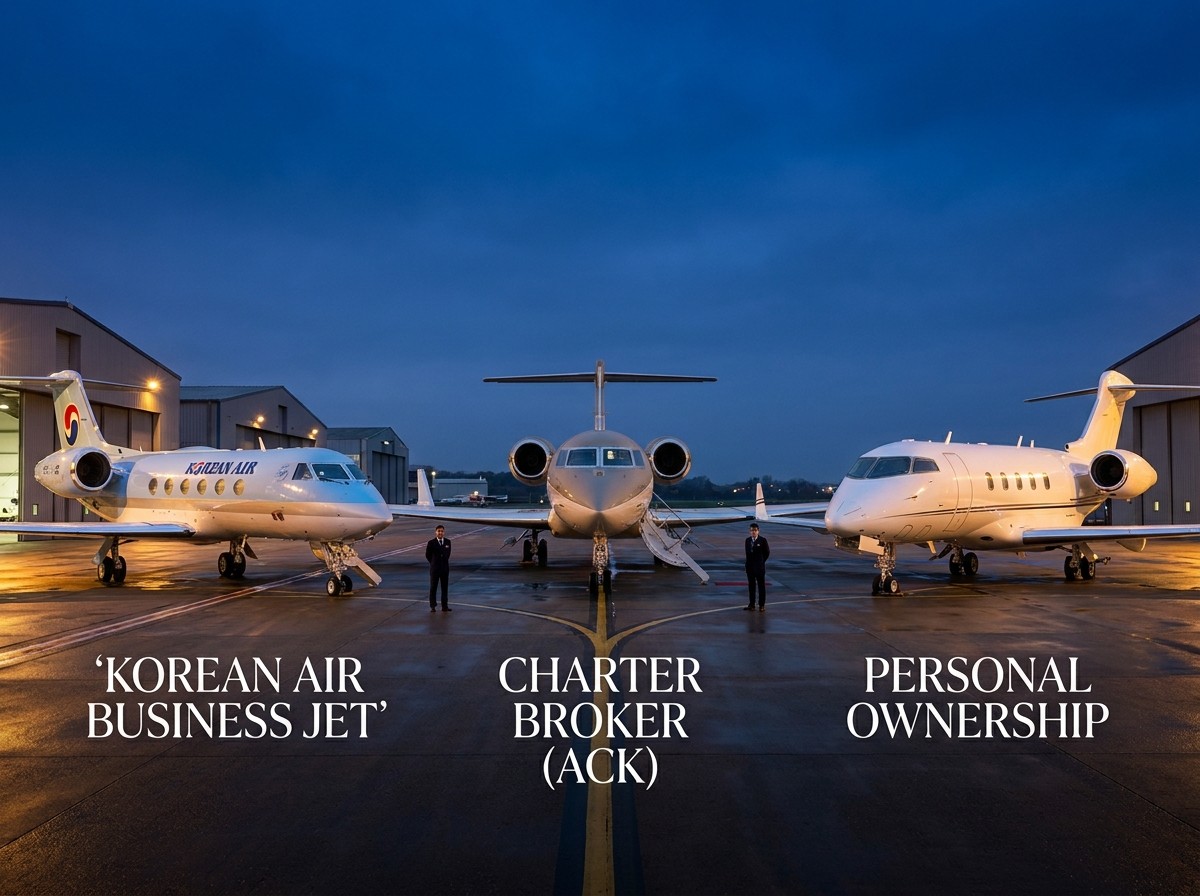
⚡ Three-option advisory — free 5-year simulation
Send annual flight pattern, budget envelope, and priorities. You'll have a five-year simulation comparing carrier business jet, charter broker, and personal ownership inside two weeks. NDA up front.
📧 contact@aircharterkorea.com | 📞 Wonjin Choi +82-10-7723-3177
→ Free three-option advisory
1. The Three Options Korean HNW Buyers Actually Compare
Option | Upfront Capital | Hourly Rate (USD) | Annual Hours Sweet Spot |
|---|---|---|---|
① Korean carrier business jet charter | None (single charter, subject to operating policy) | $7,000–$15,000 (industry estimate) | ~150 hours |
② Charter broker (ACK et al.) | None (single charter) | $3,500–$15,000 (by category) | ~200 hours |
③ Personal aircraft ownership | $15M–$80M (acquisition) | Effective $7,500–$25,000 (operating cost / hour) | 200+ hours |
The conclusion up front: each option fits a different buyer profile. The next sections work through pricing structure, characteristics, and use-case fit for each — using only publicly available data and global market reference points.
2. Option ① Korean Carrier Business Jets — Pricing & Service Profile
What a Korean carrier business jet operation looks like
Major Korean carriers operate dedicated business aviation divisions in parallel with their scheduled commercial operations, managing their own business jets and (in some configurations) managed aircraft on behalf of HNW owners. As AOC-holding Korean operators, they bring local airspace operating familiarity, Korean-language standard service, Gimpo SGBAC access, and Korean cuisine catering depth.
Operating policy note: A carrier's business aviation operating policy — external charter availability, membership structures, managed-aircraft acceptance — can change over time. For current policy and quote accuracy, the carrier's official channels are the correct source. The figures below are global-market industry reference ranges for comparable aircraft categories, not direct operator quotes.
Korean carrier business jet pricing (industry reference range)
Item | Industry Reference Range | Notes |
|---|---|---|
Korean major-carrier business jet hourly rate (industry estimate) | $7,000–$15,000 | Aligned with global charter market for comparable aircraft. Actual quotes via operator official channels. |
ACMI airliner charter (B737 / A330 class) | $30K–$200K round-trip | Global ACMI market average. Varies by route, aircraft, season. |
Korea-region one-way (simulation, business jet category) | Gimpo–Jeju $8K–$15K / Incheon–Tokyo $20K–$45K | Global charter market reference data. |
📌 Methodology note: Every pricing figure on this page comes from industry reference data — global comparable-aircraft market averages drawn from publicly available sources including JetNet, AMSTAT, and Aircraft Bluebook. None of it is sourced from any specific operator's non-public internal pricing or membership pricing. For exact pricing, Korean Air and other Korean operators publish information through their official channels — that's the right source for current quotes.
Korean carrier business jet — user feedback profile
Carrier-operated business jets see less open-internet exposure than the broader charter market — user feedback tends to circulate through corporate executive networks and HNW community channels rather than public review sites. Characteristics typically cited:
Strengths
Korean-carrier credibility: straightforward Korean airspace operating permissions, Korean-language standard service, strong Korean cuisine catering
Gimpo SGBAC convenience: direct access to Korea's business aviation hub
Carrier brand assurance: aviation safety standards in line with the carrier's broader operations, with standardized maintenance and crew protocols
Corporate account fit: standardized account management for large Korean enterprise executive travel programs
Considerations for the buyer's evaluation
Aircraft category breadth: a single-operator pool naturally offers a different breadth of aircraft selection than a 1,500+ operator broker pool. Consistency-first versus variety-first is the buyer's preference call.
Route coverage: Korean carriers typically have deep strengths on Korea-origin Asia, North America, and Europe routes; broader regional coverage (parts of Africa, South America, Middle East interior) is where a broker's multi-operator pool tends to have more matching options.
Pricing model: published-rate single-operator pricing offers predictability and consistency; multi-operator competitive quoting optimizes for route, date, and aircraft-specific best-available pricing. Both are valid; the right choice tracks priorities.
External charter availability: a carrier's business jets — owned or managed — have charter availability determined by operating policy, which is best confirmed through the operator's official channels.
Who Korean carrier business jets suit
HNW buyers prioritizing Korean-carrier brand assurance
Itineraries weighted to Asia (Korea–Japan, Korea–China, Southeast Asia)
Korean cuisine catering and Korean-language service as table stakes
Large-enterprise executive travel programs prioritizing predictability and account-level consistency
3. Option ② Charter Brokers (ACK et al.) — Private Jet Rental Pricing Structure
What a charter broker does
A charter broker doesn't own aircraft — it sources across a global pool of 1,500–2,000+ operators and matches the right aircraft to a specific route, date, and budget. Korea hosts several brokers including ACK, and global incumbents (Air Charter Service, Victor, PrivateFly) cover the larger market. ACK runs as the Victor × Air Charter Service Korea agent, which means direct access to the UK headquarters' global operator network.
Private jet rental rates by category (hourly)
Category | Hourly Rate (USD) | Capacity | Representative Aircraft |
|---|---|---|---|
VLJ (Very Light Jet) | $2,500–$3,500 | 4–5 pax | HondaJet, Citation M2 |
Light | $3,500–$5,000 | 6–7 pax | Phenom 300E, Lear 75 |
Midsize | $5,500–$7,500 | 7–9 pax | Citation Latitude |
Super-midsize | $7,000–$9,500 | 8–10 pax | Challenger 350, G280 |
Heavy | $11,000–$15,000 | 12–16 pax | G650ER, Global 6000 |
Charter rental cost by Korea route — one-way (market reference)
Route | One-Way Pricing (USD) | Recommended Aircraft |
|---|---|---|
Gimpo–Jeju | $6K–$15K | VLJ / Light |
Incheon–Tokyo | $15K–$42K | Light / Midsize |
Incheon–Hong Kong | $35K–$70K | Midsize / Super-midsize |
Incheon–Singapore | $60K–$115K | Super-midsize / Heavy |
Incheon–London | $138K–$450K | Heavy (G650ER class) |
Incheon–LA / New York | $230K–$530K+ | Heavy / Ultra-long-range |
Characteristics of the broker-pool model
Aircraft breadth: 1,500+ operator global pool with matching across every cabin category
Route- and date-optimized pricing: multi-operator competitive quoting surfaces the best available aircraft for each specific itinerary
Empty-leg matching: repositioning flights from other charters at 50–75% discounts (reference: Empty Leg Guide)
Transparent quoting: operator name, tail registration, and broker margin all disclosed (the Victor model that ACK runs)
Broad route coverage: Americas, Europe, Middle East, Africa, South America — wider matching capability through the global operator pool
4. Option ③ Personal Aircraft Ownership — Pricing & Korean Ownership Context
The cost structure of personal aircraft ownership
Personal aircraft ownership has four cost components: (1) acquisition, (2) annual operating cost, (3) aircraft management fees, (4) residual value at sale.
Personal aircraft price by category — new retail (May 2026 market reference)
Category | Representative Aircraft | New Retail | Pre-Owned (5–10 yrs) |
|---|---|---|---|
VLJ | HondaJet Elite II | $5M–$6M | $3M–$4M |
Light | Phenom 300E | $10M–$12M | $6M–$9M |
Midsize | Citation Latitude | $20M–$22M | $12M–$17M |
Super-midsize ★ | Challenger 350 | $27M–$30M | $15M–$22M (Korean buyer favorite entry point) |
Heavy | Gulfstream G650ER | $70M–$78M | $40M–$60M |
Ultra-long-range | Global 7500 | $80M–$90M | $55M–$75M |
Annual operating cost — Korean ownership context (super-midsize basis)
Crew compensation: $400K–$600K
Hangar and parking: $80K–$150K (Gimpo SGBAC basis)
Maintenance and insurance: $300K–$500K
Fuel and navigation (200 hours): $400K–$700K
Aircraft management fees: $200K–$400K
All-in annual: approximately $1.5M–$2.2M at 200 hours
Full decision framework: Ownership vs Charter vs Aircraft Management Guide.
5. Where to Buy a Private Jet — The Aircraft Marketplaces Buyers Actually Use
How Korean HNW buyers source aircraft
A handful of OEMs (Bombardier, Gulfstream, Dassault, Embraer) maintain Korean representation for new aircraft sales. Most Korean buyers, though, source aircraft directly through the global marketplaces and execute the transaction with an aircraft broker or charter broker (ACK among them).
The five aircraft marketplaces that matter
Marketplace | Profile | Used At |
|---|---|---|
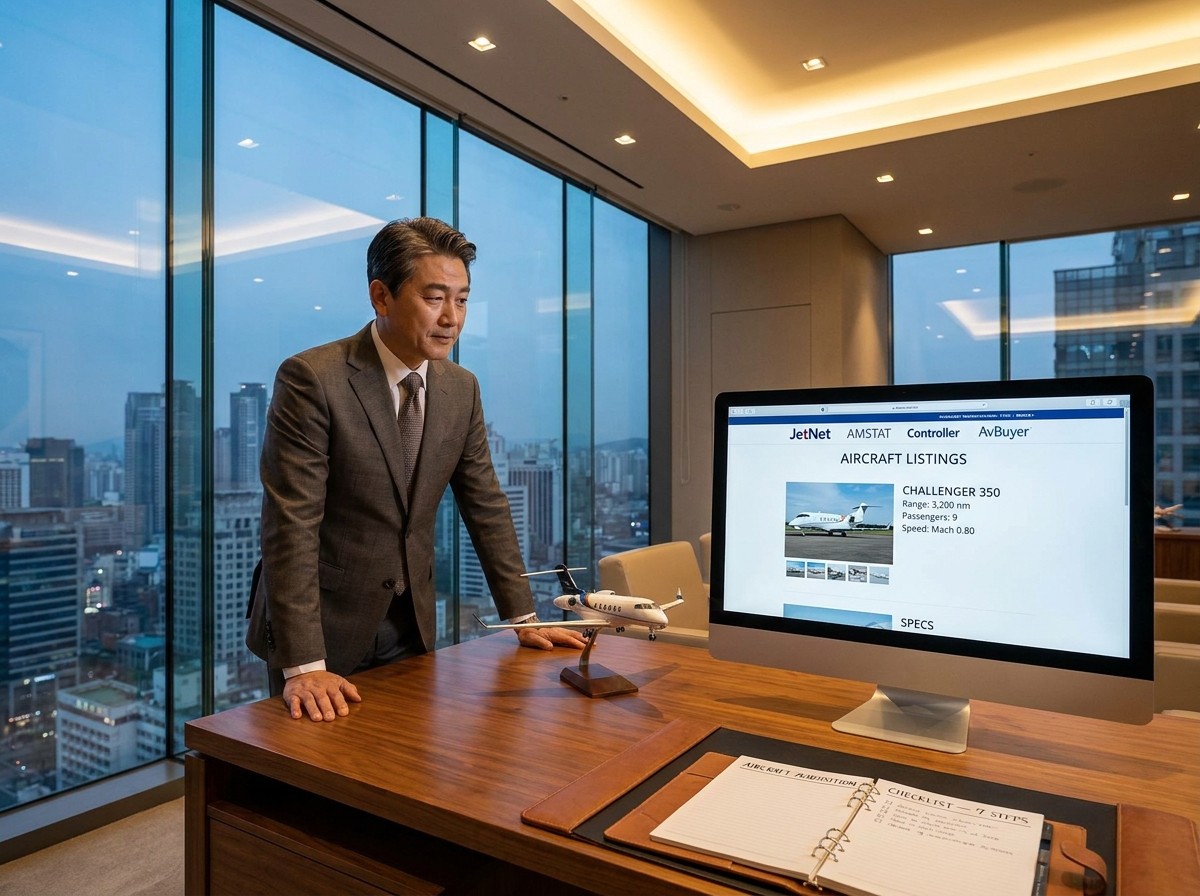
JetNet (jetnet.com) | The largest global database — listings plus valuation analytics | First-pass screening by brokers and buyers |
AMSTAT (amstatcorp.com) | Business jet specialist database with transaction tracking | Market tracking + comparable-transaction analysis |
Controller (controller.com) | Consumer-facing listings with intuitive search UI | Buyer-led direct browsing |
AvBuyer (avbuyer.com) | Europe-weighted listings, global coverage | European inventory search |
Aircraft Bluebook | Industry valuation standard (used for appraisals and insurance) | Verifying transaction value |
The 7-step acquisition process
Specification: aircraft category, passenger capacity, range — defined through advisory
Listing search: JetNet, AMSTAT, Controller for the inventory sweep
Letter of Intent (LOI): formal expression of interest to the seller
Pre-Buy Inspection: the non-negotiable airframe, systems, and records review
Purchase Agreement: contract signed, escrow funds released
Registration and transfer: Korean (HL) or offshore (N, VP-C) registry filing
Import and operational onboarding: Korean import + aircraft management operator pairing
ACK runs end-to-end acquisition advisory across all seven steps, with NDA up front.
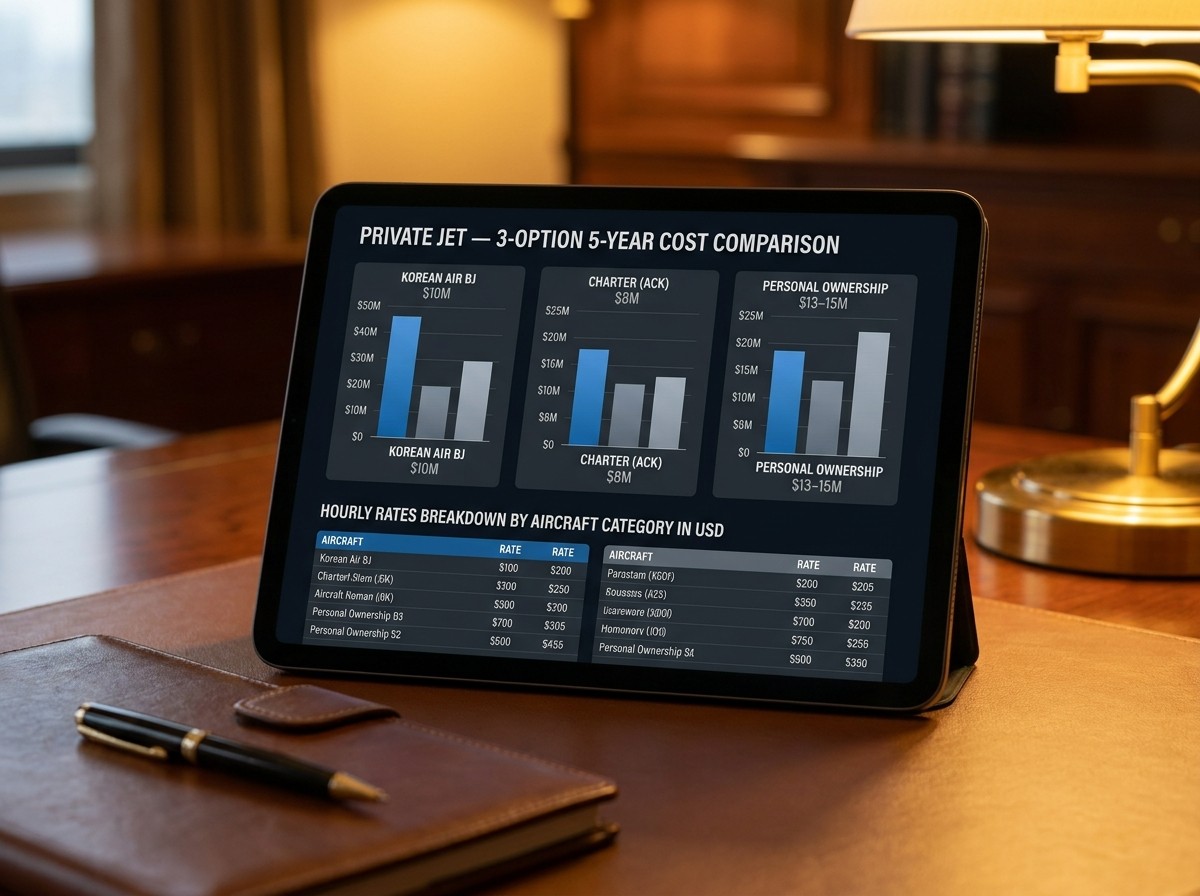
6. Five-Year Cost Comparison Across the Three Options (200 hr/yr basis)
Option | Upfront | 5-Year Operating (USD) | 5-Year Net (USD) |
|---|---|---|---|
① Single-operator business jet charter ($9K–$12K/hr blended) | $0 | $9M–$12M | $9M–$12M |
② Broker-pool charter (multi-operator, $7K–$10K/hr blended) | $0 | $7M–$10M | $7M–$10M |
③ Personal ownership (super-midsize, no charter pool) | $25M | $10M | $15M (less $18M residual) |
③ Personal ownership + charter pool ★ | $25M | $10M − $5M (charter revenue) | $13M (less $17M residual) |
Reading the numbers: at 200 hours, the charter options diverge roughly 20–25% depending on whether the buyer goes single-operator (consistency, predictability) or multi-operator broker pool (route- and date-optimized pricing). Personal ownership sits at $13M–$15M net over five years — meaningfully above pure charter, but that delta buys (a) a consistent cabin, (b) full 24/7 availability, (c) actual family privacy, (d) a real asset on the balance sheet. The crossover where ownership economics catch up with charter happens around 300–400 hours annually. All figures are reference-level estimates from global market data; specific quotes should come from each operator's official channels.
7. Mapping Yourself to the Right Option — Four Priority Lenses
Lens 1 — Annual flight hours
Up to 100 hours: ACK broker-pool charter (most economical, single-flight quoting)
100–200 hours: ACK broker-pool charter, or carrier business jet if Korean-carrier brand assurance is a priority
200–400 hours: personal ownership + charter pool ⭐ (long-term economics plus asset value)
400+ hours: personal sole ownership
Lens 2 — Where you fly
Asia-weighted: Korean carrier business jet or ACK broker-pool charter
Global multi-region (Americas / Europe / Middle East included): ACK broker-pool charter (global operator access) or personal ownership
Lens 3 — Priority
Korean-carrier brand assurance: carrier business jet
Pricing flexibility + aircraft variety: ACK broker-pool charter
Full availability + asset holding: personal ownership
Lens 4 — Net worth
Under $100M: charter (carrier or ACK)
$100M–$500M: personal ownership + charter pool (aircraft at 5–15% of total assets)
$500M+: sole ownership is viable
8. Whichever Option — Incheon VIP Escort Adds On
Carrier business jet, ACK charter, or personal ownership — any of the three needs the same five-minute customs and ground transport workflow at Incheon or Gimpo for the principal and traveling party. BestTurn VIP Airport Escort handles that as an integrated layer.
Service: VIP escort at Incheon and Gimpo for parties of 1–10 + luxury ground transport
Pricing: USD 200–500 per principal (scales with party size and schedule)
Contact: Steve, Escort Lead 📞 +82-10-3721-2853 / service@bestturnaround.com
9. The 5-Step ACK Three-Option Advisory Process
Step 1 — NDA + intake (one meeting, free)
Annual flight pattern, main routes, traveling party size, scheduling, budget envelope, priorities. Confidential engagements run through NDA up front.
Step 2 — Three-option simulation (within two weeks)
Carrier business jet quoting (via the operator's official channel), ACK broker-pool charter quoting, and a personal ownership 5-year simulation — all delivered in one integrated comparison document.
Step 3 — Trial operations
One or two selected options run for six months as a trial. Results reviewed, long-term commitment decided afterward.
Step 4 — Long-term commitment
If personal ownership is chosen: aircraft acquisition advisory (marketplace search → Pre-Buy → contract → import). If charter is chosen: ACK corporate account or 25-hour jet card matched.
Step 5 — Post-engagement concierge (1–3 years)
Operations monitoring, cost reconciliation, operator performance review, option recalibration if needed.
10. Frequently Asked Questions
Q: Can a carrier business jet and ACK charter be used together?
Yes — many HNW buyers do exactly this. Korea-region itineraries (Korea–Japan, Korea–China) on a carrier business jet, Americas and Europe on ACK broker-pool charter. ACK provides integrated concierge across both, with handoffs handled seamlessly inside a single itinerary.
Q: Are carrier ACMI charters viable for group events?
Yes. Carrier ACMI airliner charters (B737, A330 class) handle group transport for wedding party logistics, corporate incentive groups, and large family events at 50–300 passengers. Pricing typically runs $30K–$200K round-trip depending on route and aircraft. Reference: Destination Wedding Charter Guide.
Q: What's the import duty situation when buying an aircraft for Korea?
Civilian aircraft generally enter duty-free (HS code 8802). VAT applies at 10% but is recoverable for business use. The registry choice — Korean (HL) versus offshore U.S. (N) versus Cayman (VP-C) — drives different tax outcomes. Specialist aviation counsel and accounting firm sign-off are non-negotiable here.
Q: Is pre-owned safe?
Roughly 60% of Korean HNW buyers take their first ownership step pre-owned. A 5–10 year old super-midsize runs 30–50% below new retail with comparable safety when maintenance records are clean. The discipline: full Pre-Buy Inspection, complete MX records review, and preference for airframes previously operated by ARG/US Gold operators.
Q: Is ACK competing with Korean carriers?
More complementary than competing. ACK is a broker working across 1,500+ operators globally, and Korean carriers' business jet operations are among those that can be sourced when they fit the engagement. The advisory framework is built around delivering the best option for the buyer, not pushing any particular operator.
Q: Can I find aircraft directly on the marketplaces?
JetNet, Controller, and AvBuyer are open to buyer browsing. What gets opaque without a specialist alongside is (1) verifying actual airframe condition, (2) confirming valuation, (3) navigating registration and import, (4) running Pre-Buy Inspection properly. ACK runs all seven acquisition steps as an integrated advisory.
📞 Three-option advisory — free 5-year simulation
HNW advisory: ACK — Request Advisory | Wonjin Choi 📞 +82-10-7723-3177 | contact@aircharterkorea.com
Incheon VIP escort: BestTurn VIP Escort | Steve 📞 +82-10-3721-2853 | service@bestturnaround.com
🔗 ACK LinkedIn | Wonjin Choi LinkedIn
NDA up front · Two-week simulation turnaround · Aircraft acquisition advisory · 1–3 year post-engagement concierge
Conclusion: All Three Options Exist in This Market. The Right Answer Is the One That Fits.
The buyer working through private aviation in Korea is best served by seeing all three options on the same page before deciding, rather than going deep on one option without ever pricing the others. Korean carrier business jets, charter broker matching across the global operator pool, and personal aircraft ownership all live in this market, and each is optimized for a different flight pattern, budget, and priority profile.
Korean Air business jet pricing reflects the Korean-carrier brand premium. Charter broker private jet rental cost reflects multi-operator optimization. Personal aircraft price reflects the asset on the balance sheet plus full operational freedom. All three can be the right answer — what changes is which one fits the specific buyer.
ACK is the independent advisory firm built to deliver an objective comparison across all three — operated by someone who's worked both inside a Korean carrier's business jet operation and as a global charter broker. Send us annual flight pattern, budget, and priorities, and you'll receive a three-option five-year simulation within two weeks under NDA. Decisions get made well only when the information is complete — this page is the starting line for that.
In the air across every option: Air Charter Korea. On the ground at Incheon: BestTurn. Every stage of the buyer's evaluation, handled.
Private jet booking — the decision made after seeing all three options.

✍️ About the Author
Wonjin Choi | Former Korean Air Business Jet Operations Manager · Former Samsung Electronics Business Jet Account Manager
Victor × Air Charter Service Korea Agent
Founder, Air Charter Korea
This guide draws on official service information from Air Charter Korea, publicly available global aircraft marketplace data (JetNet, AMSTAT, Controller, AvBuyer, Aircraft Bluebook), publicly available global charter broker reference data (Victor, Air Charter Service, VistaJet, NetJets), and global private aviation market pricing reference data current as of May 2026. The guide is provided for general informational purposes only.
Important note: all pricing, policy, and service information related to Korean operators referenced on this page is derived from global comparable-aircraft market average data — it is presented as industry estimate and general reference material, not as a quote of any specific operator's confidential internal pricing or proprietary trade information. All information is intended as market-reference data for the buyer's evaluation process; actual pricing, policy, and service terms may change over time, and accurate quotes, membership availability, and service specifics should be confirmed directly through each operator's official channels. This page does not aim to criticize any specific operator or to function as comparative advertising — it analyzes use-case fit across each option on a neutral basis. Aircraft acquisition and tax treatment require sign-off from specialist aviation counsel and accounting firms.