Private Jet Ownership vs Charter vs Aircraft Management 2026: The Five-Option Decision Framework for Korean HNW Individuals
Published: May 15, 2026 | Read time: 18 minutes | Format: Aircraft ownership decision guide for HNW Korean individuals
🛩️ This page is for:
✔️ HNW individuals and corporate chairs flying 200+ hours of business and personal travel annually
✔️ Anyone evaluating an aircraft purchase but unclear on the Korean aviation-law constraints and tax treatment
✔️ Family offices and corporate structures looking at aircraft management as an entry path
✔️ Executive teams deciding “do we keep chartering, or do we own?”
✔️ Anyone trying to understand why global models like NetJets and VistaJet don’t drop cleanly into the Korean market
This is the integrated decision framework for owners taking 6–12 months to do this properly.
→ Aircraft ownership advisory (Wonjin Choi 📞 +82-10-7723-3177)
Private Jet Ownership vs Charter vs Aircraft Management 2026: The Five-Option Decision Framework for Korean HNW Individuals
Buying a private aircraft in Korea isn’t really a purchase decision — it’s an asset-system decision. Acquisition cost in the $15M–$80M range, annual operating expense between $1.5M and $5M, the constraints Korean aviation law puts on operating structure, tax treatment, and a clear understanding of why the global ownership models (NetJets, VistaJet) don’t drop cleanly into this market — all of it sits inside the same call. The threshold where the conversation becomes serious is 200 annual flight hours and up, but the integrated guidance for working through that decision in the Korean context is basically nonexistent.
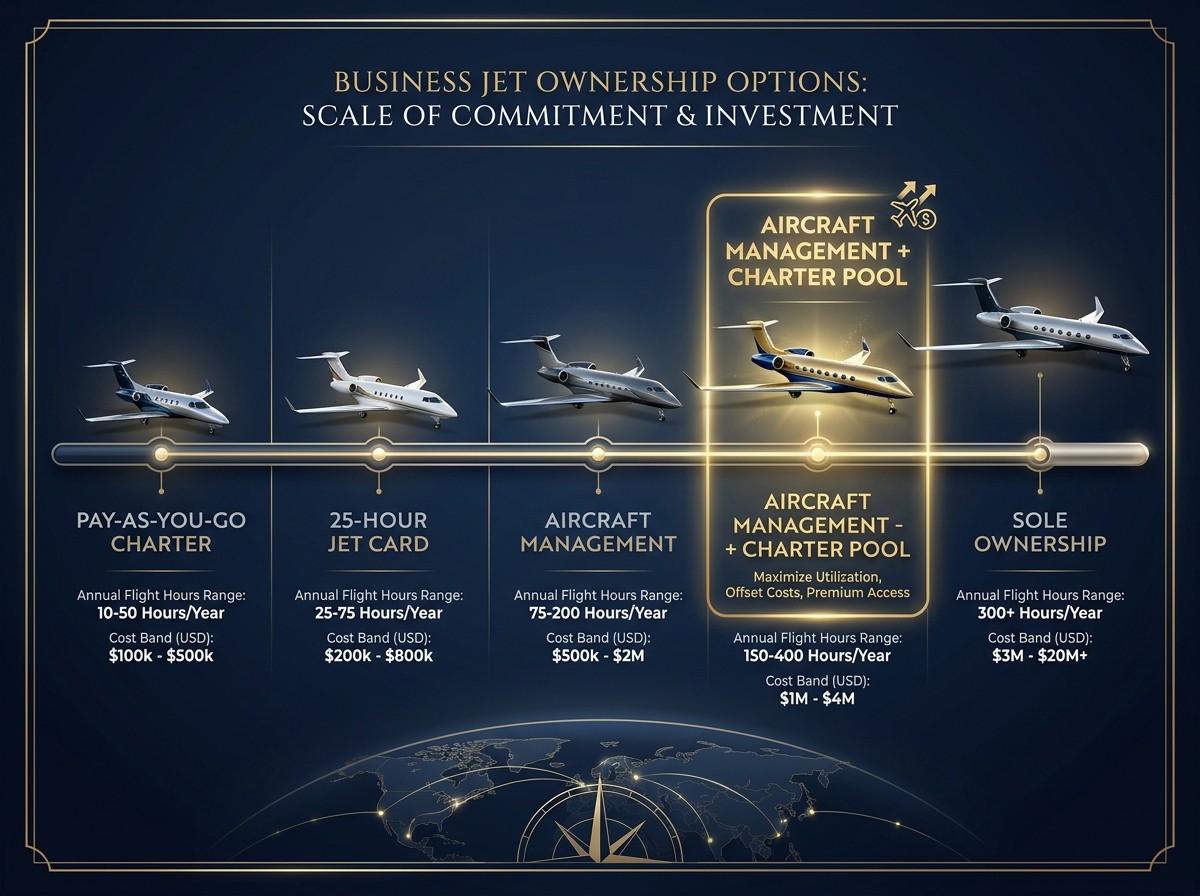
This page is built for the buyer doing the work. Five options walked through end-to-end: (1) pay-as-you-go charter, (2) 25-hour jet card, (3) aircraft management, (4) aircraft management plus charter pool revenue, (5) sole ownership. Each option mapped against acquisition cost, operating cost, charter pool revenue offset where applicable, tax treatment, and five-year simulations. Korean aviation law context — why NetJets-style fractional ownership doesn’t work here, what corporate versus personal title actually changes for tax — covered directly. The framework global HNW buyers use, applied honestly to the Korean market.
Air Charter Korea (ACK) is the independent broker and advisory firm with the deepest portfolio of Korean aircraft ownership work in the market. The operational backbone comes from running business jets at Korean Air and managing the Samsung Electronics corporate aviation account — both jobs that exposed the full mechanics of Korean ownership structures in practice. As the Victor × Air Charter Service Korea agent, we plug into the ACS aircraft management division and the global operator network (ExecuJet, Jet Aviation, Luxaviation) directly, which means the comparables Korean buyers need — global market benchmarks, charter pool revenue references, operator selection — all come through one engagement.

⚡ Aircraft ownership advisory — free decision materials
Send annual flight pattern, budget envelope, and entity structure. You’ll have a five-option five-year simulation inside two weeks. NDA up front, with accounting and aviation legal counsel available to attend the consultation.
📧 contact@aircharterkorea.com | 📞 Wonjin Choi +82-10-7723-3177
→ Free aircraft ownership advisory
1. The Five Options Korean HNW Buyers Need to Evaluate
Option | Upfront Capital | Annual Cost (200 hr basis) | Where It Fits |
|---|---|---|---|
① Pay-as-you-go charter | None | $1M–$2M | ~200 hours |
② 25-hour jet card | $200K–$400K (prepaid) | $800K–$1.5M | 100–200 hours |
③ Aircraft management (managed ownership) | $15M–$30M (aircraft purchase) | $1.5M–$2.2M | 200–400 hours |
④ Managed ownership + charter pool ★ | $15M–$30M (aircraft purchase) | $800K–$1.5M net of charter revenue | 200–400 hours plus pool |
⑤ Sole ownership | $15M–$80M (aircraft purchase) | $1.5M–$5M | 400 hours and up |
The conclusion up front: for the Korean HNW buyer doing 200–400 hours, the right answer is almost always Option ④ — managed ownership with a charter pool. Self-use plus pool-leasing the unused hours brings the effective cost down to roughly half of sole ownership, the operating mechanics (crew, maintenance, insurance, slot filings) all run through the operator, and the owner keeps a real asset. The rest of this page walks through why each of the other options exists and where they fit.
2. Korean Aviation Law — Why the Global Models Don’t Drop In Cleanly
Why NetJets-style fractional ownership doesn’t work in Korea
Fractional ownership — the standard ownership model in the U.S. and Europe through NetJets, Flexjet, and FlyExclusive — splits a single aircraft across 8 to 16 owners in hour-based shares (1/16, 1/8, 1/4). The model effectively doesn’t work in Korea, for three reasons under the Aviation Safety Act and Aviation Business Act:
AOC requirement. Providing aircraft to multiple owners on an hour-share basis qualifies as commercial air transport, which requires an Air Operator Certificate. Holding an AOC isn’t realistic for an individual or small consortium.
Single-owner registration default. Korean aircraft registration is built around a single registered owner. Joint ownership is technically possible but creates operating-liability ambiguity that lawyers will not endorse.
Non-scheduled transport regulation. Korean regulation of non-scheduled commercial transport doesn’t accommodate the U.S. fractional operating template.
The result for the Korean buyer: the entry path is sole ownership (individual or corporate) plus aircraft management. Multi-owner shares don’t open up without an aviation-law amendment.
The four workable models in Korea
Model | Title Holder | Operating Entity | Charter Pool |
|---|---|---|---|
Sole ownership (personal use) | Individual or corporate | Owner direct | Not possible (no AOC) |
Dry lease | Owner | Lessee operator (AOC holder) | Operator runs it |
Aircraft management (wet lease) | Owner | Specialist operator (AOC holder) | Optional |
Managed ownership + charter pool | Owner | Specialist operator | Unused hours leased → revenue |
3. Option ① Pay-as-You-Go Charter — The Default Under 200 Hours
Where it fits: 100–200 annual hours. No capital outlay, single-flight quoting and settlement, zero operating responsibility. More than 70% of HNW buyers in this market start here.
Cost shape: 200 hours at $5,000–$10,000/hour blended average = $1M–$2M annually. The trade-off is the lack of consistency — different airframes, crews, and cabin layouts each trip.
The ceiling: once flight hours cross 200, availability friction, schedule shifts, and the absence of a consistent cabin experience start to compound. That’s the cue to look at the next option.
Reference: Charter Price Comparison Guide | Transparent Pricing Guide
4. Option ② 25-Hour Jet Card — The Middle Ground
Where it fits: 100–200 hours with a premium on schedule certainty. Prepay 25 or 50 hours, lock the hourly rate, and get availability guarantees on call.
How a jet card actually works
Prepay 25 (or 50) hours → locked hourly rate of $8,000–$15,000 depending on cabin category
Cabin category (super-midsize, e.g.) guaranteed; 24–72 hour call-to-departure availability commitment
12–24 month validity; unused balance refundable or rolling forward depending on the program
Cost: $200K–$400K prepaid for the 25 hours. Additional hours buy in at the locked rate, often with a 5–10% incremental discount. Trade-off: capital is committed up front; if usage drops, unused balance can leak value. Reference: Executive Travel ROI Guide
5. Option ③ Aircraft Management — The First Step Into Ownership
What aircraft management actually means
The owner buys and holds the aircraft; everything else — flight operations, maintenance, crew, insurance, hangar, regulatory filings — runs through a specialist operator (Luxaviation, ExecuJet, Jet Aviation are the global incumbents). The owner gets full use rights without the operational responsibility. It’s the model that combines what NetJets and VistaJet can’t deliver (your aircraft, your interior, your crew preferences) with what sole ownership doesn’t deliver (operational simplicity).
Operators serving Korean owners
Domestic operators: Korean Air’s business jet operations division (managing a small number of owner aircraft) plus a handful of smaller operators
Regional operators serving Korean owners from offshore bases: Luxaviation (Singapore base), Jet Aviation (Hong Kong / Singapore), ExecuJet (Hong Kong / Singapore) — managing Korean-owned aircraft from regional bases with the necessary permits for Korean operations
Management fee structure
Monthly fixed: $20K–$40K covering crew, maintenance management, insurance administration
Variable hourly: $2,500–$5,000 per flight hour (fuel, navigation, crew expenses)
All-in annual: super-midsize at 200 hours = roughly $1.5M–$2.2M
6. Option ④ Managed Ownership + Charter Pool ★ The Korean Sweet Spot
How charter pool revenue works
During the hours the owner isn’t flying — typically 100 to 250 hours annually — the management operator leases the aircraft into its commercial charter pool. Revenue from those leased hours splits between the owner and the operator on a negotiated basis, typically 60–75% owner / 25–40% operator.
Charter pool revenue by aircraft category
Aircraft | Charter Rate / Hour | Owner Revenue, 100 Leased Hrs (70% share) | 200 Leased Hrs |
|---|---|---|---|
Light (Phenom 300E) | $4,000–$5,500 | $280K–$385K | $560K–$770K |
Midsize (Citation Latitude) | $5,500–$7,500 | $385K–$525K | $770K–$1.05M |
Super-midsize (Challenger 350) | $7,000–$9,500 | $490K–$665K | $980K–$1.33M |
Heavy (G650ER) | $11,000–$15,000 | $770K–$1.05M | $1.54M–$2.1M |
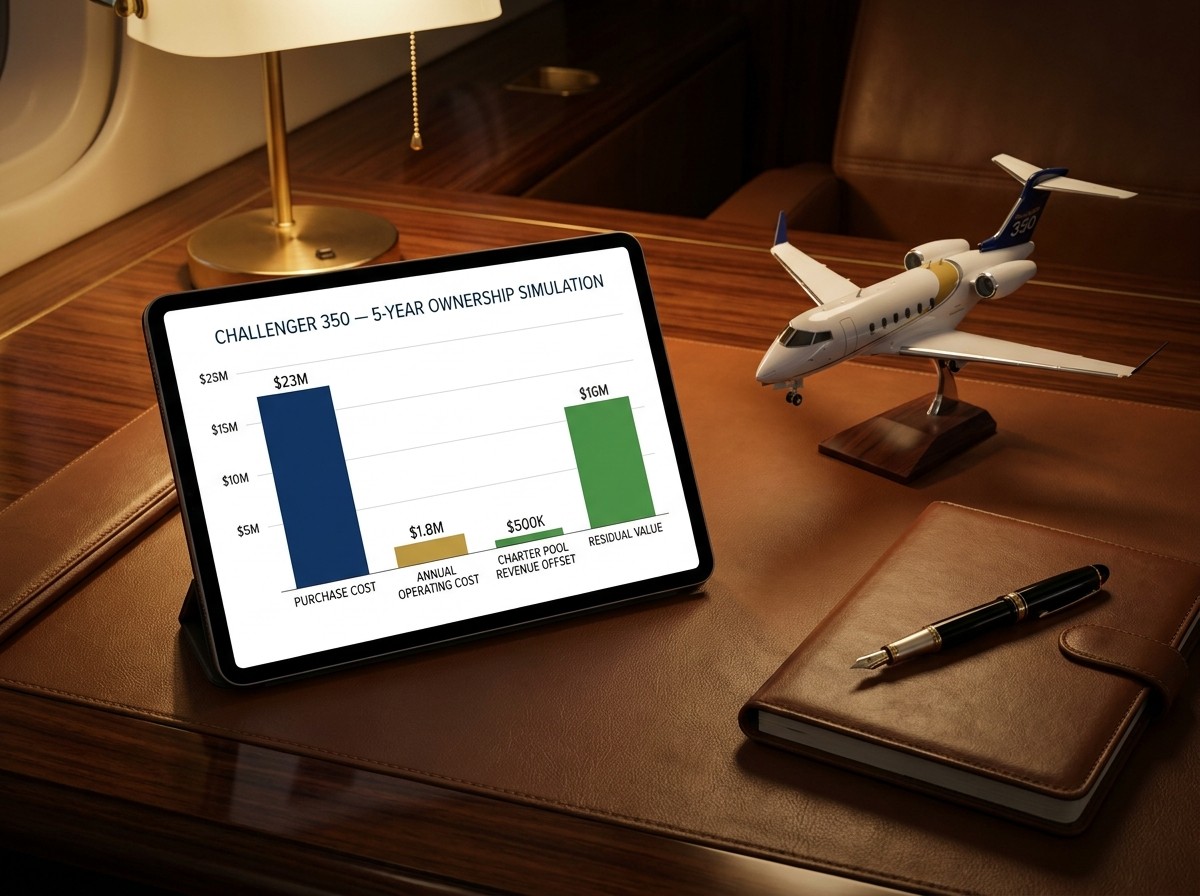
Five-year simulation — super-midsize with charter pool
Line Item | USD (5-year cumulative) |
|---|---|
Aircraft purchase (Challenger 350, new) | $27M–$30M |
Operating cost × 5 years (200 hrs self-use) | $7.5M–$11M |
Charter pool revenue × 5 years (150 hrs/year leased) | −$3.7M to −$5M (revenue) |
Year-5 residual value (30–40% depreciation) | −$16M to −$21M |
Net 5-year cost | $13M–$18M (≈$2.6M–$3.6M per year) |
Same 200 hours of flying via pure charter would run $1.5M–$2M annually, or $7.5M–$10M over five years. So managed ownership plus charter pool comes in roughly $0.5M–$1.5M per year above pure charter. That premium pays for (1) a consistent cabin and crew, (2) actual aircraft privacy for the family, (3) 24/7 availability, (4) the freedom to use the aircraft for family life events on the owner’s own terms, and (5) holding a real asset on the balance sheet.
7. Option ⑤ Sole Ownership — For 400+ Hour Owners
For owners running 400+ hours annually — major group chairs, HNW individuals with deep global business interests, families that want the aircraft fully dedicated to their use — sole ownership without a charter pool is the right fit. Self-use 100% of the time, no operator revenue share.
Annual operating cost: super-midsize $3M–$4M, heavy $4M–$6M, ultra-long-range $5M–$8M. No charter pool revenue offset, but in exchange for complete aircraft availability and the full ownership experience.
Sole-ownership population in Korea: roughly 50–80 aircraft (precise numbers aren’t published). Concentrated among major group chairs, financial sector principals, real estate and biotech HNW.
8. Tax Treatment — Corporate vs Personal Title
Corporate ownership (the standard structure)
Depreciation: straight-line or declining-balance over 5–10 years. Annual book expense.
Operating expense deduction: full deductibility for business-travel use; partial for personal use.
VAT: 10% applies at purchase; recoverable for business-use share.
Charter pool revenue: books as lease income subject to corporate tax.
Personal ownership
Only business-use portion is deductible; personal use runs through the owner’s account
Depreciation deductibility is constrained
Aircraft value enters the estate for inheritance and gift tax purposes
Practical reality: well over 90% of Korean aircraft owners structure through a corporate entity. The combination of tax efficiency, operational liability separation, and clean charter pool revenue accounting all favor the corporate vehicle. The precise treatment requires sign-off from accounting counsel and aviation-specialist legal counsel — broker-level advice doesn’t substitute.
9. Decision Checklist — Mapping Yourself to the Right Option
By annual flight hours
Up to 100 hours: pay-as-you-go charter. Per-flight quoting is the rational choice.
100–200 hours: 25-hour or 50-hour jet card. Price and availability locked.
200–400 hours: managed ownership + charter pool ⭐ the Korean sweet spot.
400+ hours: sole ownership with aircraft management (no charter pool).
By use pattern
Business-travel weighted (many routes, frequent schedule shifts): jet card or managed ownership + charter pool
Family travel and life-event weighted: sole ownership or managed ownership (self-use priority)
Asset holding plus intergenerational transfer: sole ownership under corporate title
By net worth
Under $100M total net worth: charter or jet card — aircraft concentration as a share of total assets should stay measured
$100M–$500M: managed ownership + charter pool — aircraft sits at 5–15% of assets, which is comfortable
$500M+: sole ownership is viable — aircraft concentration drops below 5%
10. The 5-Step ACK Ownership Advisory Process
Step 1 — NDA and first consultation (one meeting, free)
Capture annual flight pattern, use purpose, asset structure, tax structure, and decision priorities. Confidential engagements run through NDA up front.
Step 2 — Five-option simulation (within two weeks)
Full five-year simulation across options ① through ⑤ — purchase, operating costs, charter pool revenue, residual value, and tax effects all integrated. Recommended option (one or two of the five) identified with rationale.
Step 3 — Joint session with accounting and aviation legal counsel
Tax treatment and aviation-law review run jointly with the engagement’s accounting firm and aviation-specialist counsel. Owner-side advisors welcome to attend.
Step 4 — Aircraft sourcing or operator matching
For sole ownership or managed paths: aircraft-sourcing through JetNet, AMSTAT, and Aircraft Bluebook listings; operator matching across Luxaviation, Jet Aviation, and ExecuJet.
Step 5 — Contract execution + 1–3 year post-engagement concierge
Aircraft purchase or management contract executed. ACK provides 1–3 years of post-engagement concierge — charter pool performance monitoring, maintenance scheduling, operating-cost accounting reconciliation.
11. Frequently Asked Questions
Q: What registry should the aircraft sit on?
Korean registration (HL prefix) is the default for Korea-centric operations and registers with MOLIT’s aircraft registry. For owners with heavy international operations, offshore registries — U.S. (N prefix) or Cayman (VP-C prefix) — often deliver better tax, operating, and resale economics. The registry decision is a real piece of the structure. ACK runs registry consultation as part of the advisory.
Q: Is buying pre-owned safe?
Roughly 60% of Korean owners take their first step into ownership through pre-owned aircraft. A 5–10 year old super-midsize runs 30–50% below new retail with comparable safety when maintenance is solid. The discipline that protects the buyer: full Pre-Buy Inspection, clean MX Records review, and a strong preference for airframes previously operated by ARG/US Gold-rated operators.
Q: What about aircraft damage or accident risk on the charter pool side?
Professional operators run at ARG/US Gold or higher safety standards across all flights, with full hull insurance in force throughout. Aircraft in charter pools actually run below average accident statistics versus single-owner-operated aircraft, because the operating crew is institutional. The trade-off is higher utilization — maintenance intervals and cabin wear cycle faster than purely private use.
Q: Where do Korean-owned aircraft typically hangar?
Mostly at Gimpo SGBAC (Seoul Gateway Business Aviation Center). Some at hangars adjacent to the Incheon business lounge. Offshore-registered aircraft typically base in Hong Kong, Singapore, or Guam, with pre-arranged permits for Korean operations. Departing Incheon with the family group, BestTurn VIP Escort handles five-minute customs and luxury ground transport on the same package.
Q: Can NetJets or VistaJet memberships be used from Korea?
NetJets is a U.S./Europe membership and isn’t directly purchasable from Korea — though a U.S.-membered owner can use the aircraft on U.S. or European trips. VistaJet’s Program membership is globally available, including Korea-originating itineraries, but the entry runs $500K–$1M plus locked hourly rates.
Q: How does aircraft resale work?
Standard hold is 5–10 years, then a sale at 30–60% residual value depending on age, hours, and condition. The global pre-owned market — JetNet, Controller, AvBuyer — handles the listings; aircraft brokers handle the transactions. ACK does sale-side advisory and brokerage as a downstream service.
📞 Aircraft ownership advisory — free 5-year simulation
HNW advisory: ACK — Request Advisory | Wonjin Choi 📞 +82-10-7723-3177 | contact@aircharterkorea.com
Incheon VIP escort: BestTurn VIP Escort | Steve 📞 +82-10-3721-2853 | service@bestturnaround.com
🔗 ACK LinkedIn | Wonjin Choi LinkedIn
NDA up front · Two-week simulation turnaround · Joint sessions with accounting and aviation counsel · Post-engagement concierge through sale
Conclusion: Ownership Is a Five-Year System, Not a Single Decision
Aircraft ownership isn’t really a “move from charter to ownership” decision. It’s a five-year operating system — annual operating costs, charter pool revenue, maintenance schedules, tax treatment, and exit timing all need to be designed together up front. Even with the constraints Korean aviation law puts on NetJets-style fractional, the Korean version — managed ownership with charter pool — gets the buyer to roughly the same operating efficiency global HNW owners are accustomed to.
The acquisition number — $15M to $80M — is intimidating in isolation. The actual five-year burden, net of charter pool revenue, sits about 30–50% above pure charter. The premium buys (a) a consistent cabin and crew, (b) 24/7 availability, (c) actual family privacy, and (d) a real asset on the balance sheet. For owners running 200–400 hours a year, managed ownership with a charter pool is the most rational private jet booking architecture in the Korean market.
ACK is the independent advisory firm with the deepest portfolio of Korean aircraft ownership engagements. Send us annual flight pattern, budget, and entity structure; we move through NDA and come back with a five-option five-year simulation within two weeks. Joint sessions with accounting and aviation legal counsel are part of the standard process.
In the air, as an asset on the family’s balance sheet: Air Charter Korea. On the ground at Incheon: BestTurn. Every stage of the ownership cycle, handled.
Private jet booking — engineered as part of an asset operating system.

✍️ About the Author
Wonjin Choi | Former Korean Air Business Jet Operations Manager · Former Samsung Electronics Business Jet Account Manager
Victor × Air Charter Service Korea Agent
Founder, Air Charter Korea
This guide reflects official service information from Air Charter Korea, global aircraft management operator data from NetJets, VistaJet, Luxaviation, Jet Aviation, and ExecuJet, market data from JetNet, AMSTAT, and Aircraft Bluebook, Korean aviation regulation under the Aviation Safety Act and Aviation Business Act, and global private jet market pricing data current as of May 2026. All pricing represents market reference ranges. Actual figures vary by aircraft type, age, and engagement timing. Aviation-law and tax treatment require sign-off from specialist aviation counsel and accounting counsel.