How to Pay for a Private Jet Charter 2026: Deposit, Balance, Corporate Card, Wire Transfer, and VAT Explained
Published: June 6, 2026 | Read time: 15 minutes | Format: Private jet charter payment guide
💳 Executive summary
✔️ Payment structure: 30-50% deposit at signing, balance due 72 hours before departure
✔️ Methods: USD wire transfer (default), corporate card, local-currency remittance all work
✔️ Full prepayment can earn a 1-3% discount
✔️ VAT: international often zero-rated/exempt, domestic may be taxable (tax-advisor guidance recommended)
✔️ Cancellation fees: rise the closer to departure; confirm the policy before contracting
→ Quote and payment guidance (Wonjin Choi 📞 +82-10-7723-3177)
How to Pay for a Private Jet Charter 2026: Deposit, Balance, Corporate Card, Wire Transfer, and VAT Explained
The last thing to clear in a private jet booking, and often the stickiest, is payment. You've checked the price and picked the aircraft, but if it's unclear how the money actually moves, you hesitate. How much is the deposit and when is it due, can you use a corporate card, does it have to be a wire or can you pay in local currency, is there VAT, do you get a refund if you cancel — until those practical questions are settled, moving a large sum feels uncomfortable. This page answers them head-on.
Here's the short version: paying for a private jet is more straightforward and more secure than most people expect. The standard structure is a 30-50% deposit at contract signing with the balance due 72 hours before departure, and while USD wire transfer is the default, corporate card and local-currency remittance work too. You pay in stages rather than risking the whole amount up front, and every line is itemized on the invoice, so you see exactly what you're paying for. Read this through and the entire payment process becomes clear, letting you book with confidence.
This guide covers every practical aspect of private jet payment: deposit and balance timing and percentages, the pros and cons of each payment method, corporate expensing and VAT, FX and wire transfers, cancellation and refund terms, and operator verification for payment security, in order. Guides on pricing and the booking process overall are linked throughout, but this page is a single reference for clearing that last gate, payment, safely.
Air Charter Korea (ACK) is an independent charter broker guiding the entire process transparently, from quote through payment to boarding. Founder Wonjin Choi serves as the Victor × Air Charter Service Korea Agent, applying Victor's transparency model to disclose every payment line — aircraft rental, operator name, broker commission, and taxes — separately.
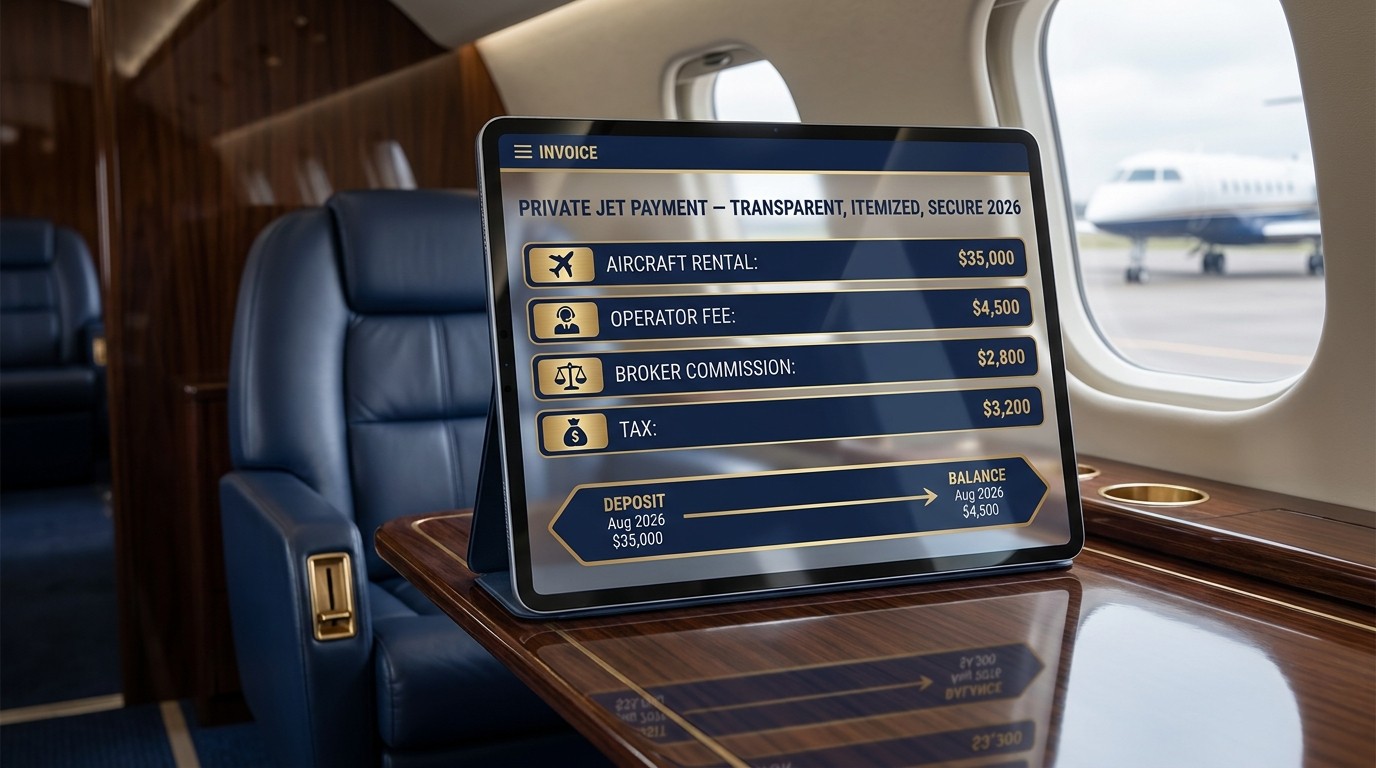
⚡ Worried about payment? Every line is itemized
ACK itemizes aircraft rental, operator name, broker commission, and taxes on the invoice. See exactly what you're paying for, and pay in stages, securely.
📧 contact@aircharterkorea.com | 📞 Wonjin Choi +82-10-7723-3177
→ Free ACK quote and payment guidance
1. Payment Structure: Deposit and Balance
Split payment is the standard
Private jet charter isn't paid as a single lump sum — the standard is a split structure of deposit and balance. This is also the safer arrangement from the client's side. You pay the deposit at signing to lock the aircraft and schedule, then complete the balance as departure approaches.
Timing | Payment | Share |
|---|---|---|
At contract signing | Deposit (locks aircraft, schedule) | 30-50% |
72 hours before departure | Balance in full | Remaining 50-70% |
Urgent charter (within 72 hrs) | Full amount at once at contract | 100% |
Discount for full prepayment
If your schedule is locked and you prepay in full before departure, a 1-3% discount sometimes applies. The savings are larger on big-ticket long-haul routes, so if your dates are certain, prepayment is worth weighing — though you'll want to check the refund terms on prepayment alongside it. For where payment sits in the overall booking process, see the 5-Step Booking Process Guide.
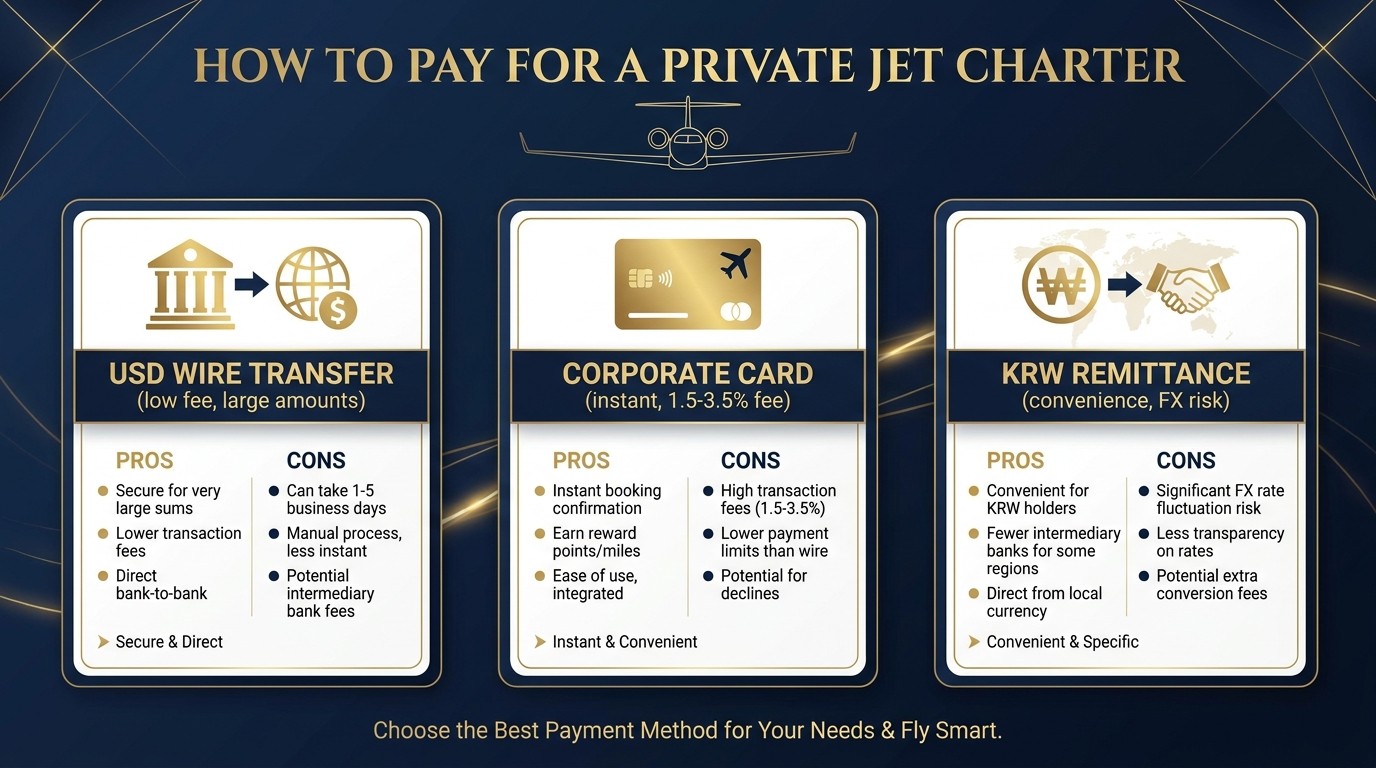
2. Payment Methods: Wire, Corporate Card, Local Currency
Method | Advantage | Watch For |
|---|---|---|
USD wire transfer | Low fees, best for large amounts | 1-2 days to clear, FX applies |
Corporate credit card | Instant, card rewards | 1.5-3.5% fee, check limit |
Local-currency remittance | Local-currency convenience | FX movement risk |
Which method wins
On a large long-haul charter, the card fee (1.5-3.5%) is substantial, so wire transfer wins; on a smaller domestic or short-haul charter, the convenience and rewards of a card are worth it. Pay $50,000 by card, for instance, and the fee alone adds $750-$1,750 — so a wire makes sense there. ACK looks at the amount and timing and helps you weigh card versus wire.
Confirm before using a corporate card
If you're paying by corporate card, confirm your card's international transaction limit and whether a temporary increase is possible in advance. Private jet charges are large single transactions and often exceed standard limits. Requesting a limit increase from your card issuer a few days ahead avoids any hitch on payment day.
3. Corporate Payment and Expensing
Corporate-name payment and invoicing
When a company charters, you can pay in the company's name and receive a formal invoice for accounting. The invoice names the charter details, route, dates, aircraft, and amount, for use in corporate bookkeeping. For business travel, the charter cost is generally booked as travel expense or service fee, deductible where business purpose is established.
Documentation to keep for corporate expensing
Formal invoice: a tax invoice or invoice naming charter details and amount
Trip documentation: purpose, attendees, destinations, business activity
Flight records: route, dates, passenger manifest
Payment proof: wire receipt or card statement
Because charter costs are large, keeping documentation that substantiates business purpose is the safe approach. If a trip is deemed personal use unrelated to business, deduction denial can follow, so document the purpose and activity clearly. For corporate travel deployment, see the How to Fly Private Beginner's Guide; for multi-city trips, the Multi-City Business Itinerary Guide.
4. VAT and Tax Treatment
International vs domestic
Whether VAT applies depends on the route. International charters are often zero-rated or exempt, while domestic charters may be taxable. That's a general tendency, though — the specific treatment depends on flight type, contract structure, business registration, and the operator's tax position.
Type | General Tendency | To Confirm |
|---|---|---|
International charter | Often zero-rated/exempt | Flight type, contract structure |
Domestic charter | May be taxable | Business registration, input credit |
ACK itemizes tax separately on the invoice so you can see clearly what's taxable. That said, exact tax treatment and input-credit eligibility depend on your company's business type and tax policy, so following your tax advisor's or accounting firm's guidance is the safe course. ACK doesn't make the tax determination itself; its role is to provide the documentation and connect aviation-specialist tax counsel when needed.
5. FX and Wire Transfer in Practice
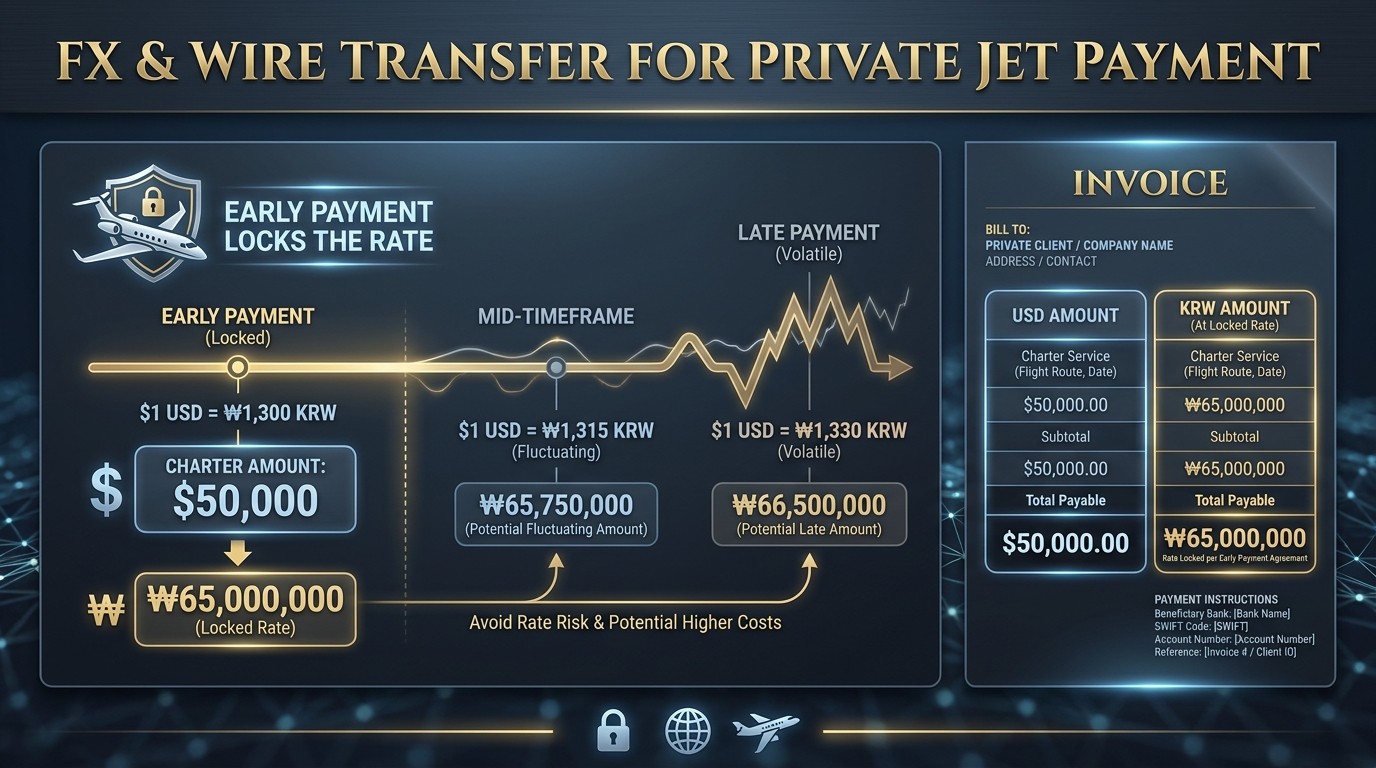
USD pricing and FX movement
Given the global nature of the market, charter cost is often priced in USD. So when you pay in local currency, the final local amount can shift from the quote depending on the payment-date rate. Pay a $50,000 charter at a rate of 1,300 and it's KRW 65M; at 1,350 it's KRW 67.5M — a KRW 2.5M difference.
Reducing FX risk
Pay early: lock the amount by paying when the rate is favorable
Use USD holdings: if you hold a USD account, wire directly without converting
Hedging consultation: for large amounts, discuss forwards with your primary bank
ACK shows both the USD amount and the payment-date local-currency equivalent on the invoice, making FX movement transparent. If FX exposure is a concern, you can discuss payment timing and method together.
6. Cancellation and Refund Terms
Fees by cancellation timing
A charter reserves a specific aircraft and crew for a specific schedule, so fees depend on when you cancel. Generally, the further from departure, the higher the refund; the closer, the larger the fee. The below is a typical pattern — exact terms vary by operator and contract.
Cancellation Timing | Typical Cancellation Fee |
|---|---|
14+ days before departure | Part of deposit or small fee |
7-14 days before | Much of the deposit |
3-7 days before | 50%+ |
Within 72 hours | Full or near-full |
Confirm before contracting
Cancellation and refund terms vary by operator, so confirm them clearly before contracting. ACK states cancellation terms in the contract and explains them upfront, and if your schedule is fluid, prioritizes operators with flexible cancellation terms. It's also worth confirming the compensation terms if the operator cancels for weather or aircraft fault. For safety, insurance, and contract matters, see the Safety, Insurance & Contract Guide.
7. Operator Verification for Secure Payment
Verified operators and split payment
The biggest worry when paying a large sum is something happening to the operator. ACK guards against this two ways. First, it matches only verified operators rated ARG/US Gold or Wyvern Wingman or higher, and names the operator, aircraft tail number, and insurance limits in the contract. Second, it splits payment into deposit and balance completed just before departure, reducing the risk of paying everything up front.
Payment protections named in the contract
Operator information: operator name, aircraft tail number, safety rating
Insurance limits: 100% of aircraft value, USD 100M+ liability
Cancellation and compensation terms: fees and compensation by cause on both sides
Replacement aircraft clause: obligation to provide a substitute on aircraft fault
All of these are disclosed transparently at the quote and contract stage, so you know exactly which aircraft, flown by whom, protected by what insurance, before you pay with confidence.
8. Frequently Asked Questions
Q: If I pay only the deposit and cancel later, do I get it back?
It depends on timing. Far enough from departure (usually 14+ days), you can recover much of the deposit, but the closer to departure, the larger the cancellation fee. Exact refund percentages vary by operator and contract, so confirming the cancellation policy before contracting is important. If your schedule is fluid, ACK prioritizes operators with flexible cancellation terms.
Q: Can an individual pay without a corporate card?
Of course. As an individual you can pay by wire transfer, personal credit card, or local-currency remittance with conversion. A corporate card is just one option for corporate use; individual clients choose whatever's convenient. Note that a personal card also needs a limit check matched to the charter amount.
Q: Can the final amount differ from the quote?
The base charter cost matches the quote, but if actual flight time runs longer than expected (weather routing, say), or there are local airport costs, added catering, or extended wait time, the reconciliation can differ. ACK flags variable items at the quote stage and itemizes everything at reconciliation. FX-driven local-amount movement is also settled at the payment date.
Q: Will I get a receipt or tax invoice after paying?
Yes. After payment, a formal invoice or tax invoice is issued, naming the charter details, route, dates, amount, and tax line items needed for corporate accounting. If you need it in the company's name, just provide the business details.
Q: How do I get quote and payment guidance?
Share your route, dates, and passenger count with ACK, and you'll get the quote along with clear guidance on payment schedule, methods, and cancellation terms. Reach out by email (contact@aircharterkorea.com) or phone (+82-10-7723-3177). Every line is itemized so you see exactly what you're paying for.
📞 Book with confidence through transparent payment
Quote and payment guidance: ACK — Request Quote | Wonjin Choi 📞 +82-10-7723-3177 | contact@aircharterkorea.com
Optional VIP escort: BestTurn VIP Escort | Steve 📞 +82-10-3721-2853 | service@bestturnaround.com
🔗 ACK LinkedIn | Wonjin Choi LinkedIn
Deposit/balance split · Itemized lines · Corporate invoice · Verified operators · Cancellation terms upfront
Conclusion: Private Jet Payment Is Clear and Secure
If private jet payment felt vague, the actual structure is clearer and more secure than expected. The standard is a 30-50% deposit at signing with the balance due 72 hours before departure, so there's no risk of paying everything up front. The default method is USD wire transfer, but corporate card and local-currency remittance work too, and you can weigh which is more favorable by amount. Full prepayment can earn a 1-3% discount.
For corporate use, you receive a formal invoice for accounting, and keeping it with trip documentation supports deductibility. VAT is often zero-rated or exempt on international and may be taxable on domestic, but exact treatment should follow your tax advisor's guidance. Cancellation and refund fees rise the closer to departure, so confirm them before contracting; ACK states all terms in the contract and explains them upfront.
ACK applies Victor's transparency model, itemizing aircraft rental, operator name, broker commission, and taxes separately. It matches only verified operators rated ARG/US Gold or Wyvern Wingman or higher, and names the operator, aircraft tail number, and insurance limits in the contract to secure your payment. See exactly what you're paying for, then proceed with the booking in confidence.
Just share your route, dates, and passengers and you'll get the quote with clear guidance on payment schedule, methods, and cancellation terms. First quote and consultation are free with no obligation, so you can decide after fully reviewing the payment terms. Air Charter Korea handles every step of private jet payment transparently.
Private jet payment: deposit through balance, every line itemized, fully transparent.

✍️ About the Author
Wonjin Choi | Victor × Air Charter Service Korea Agent
Former Korean Air Business Jet Operations Manager · Former Samsung Electronics Business Jet Account Manager
Founder, Air Charter Korea
This guide draws on official service information from Air Charter Korea, ARG/US and Wyvern global aviation safety frameworks, the global charter operating models of Victor and Air Charter Service, the general principles of the Korean Aviation Safety Act, Aviation Business Act, and Value-Added Tax Act, and global business aviation payment practices as of June 2026. All amounts, percentages, and fees represent market reference ranges; actual deposit percentages, balance schedules, card fees, cancellation fees, and VAT application vary by operator policy, contract terms, route, and business type. VAT, corporate expensing, and deductibility content is general information; exact tax treatment should follow your company's accounting policy and your tax advisor's or accounting firm's guidance. Currency-converted amounts vary with the payment-date exchange rate. For exact quotes, payment terms, and contracts, ACK or the relevant operator's official channels are the appropriate source. ARG/US, Wyvern, Victor, and Air Charter Service are registered trademarks of their respective organizations; this guide is provided for general informational purposes and does not reflect any affiliate relationship with the named organizations.