What to Verify Before You Book a Private Jet: Safety, Insurance & Contracts — The 2026 Guide
Published: April 29, 2026 | Updated: April 29, 2026 | Series: 2026 Korea Private Jet Complete Guide | Read time: 16 minutes
Key Takeaway
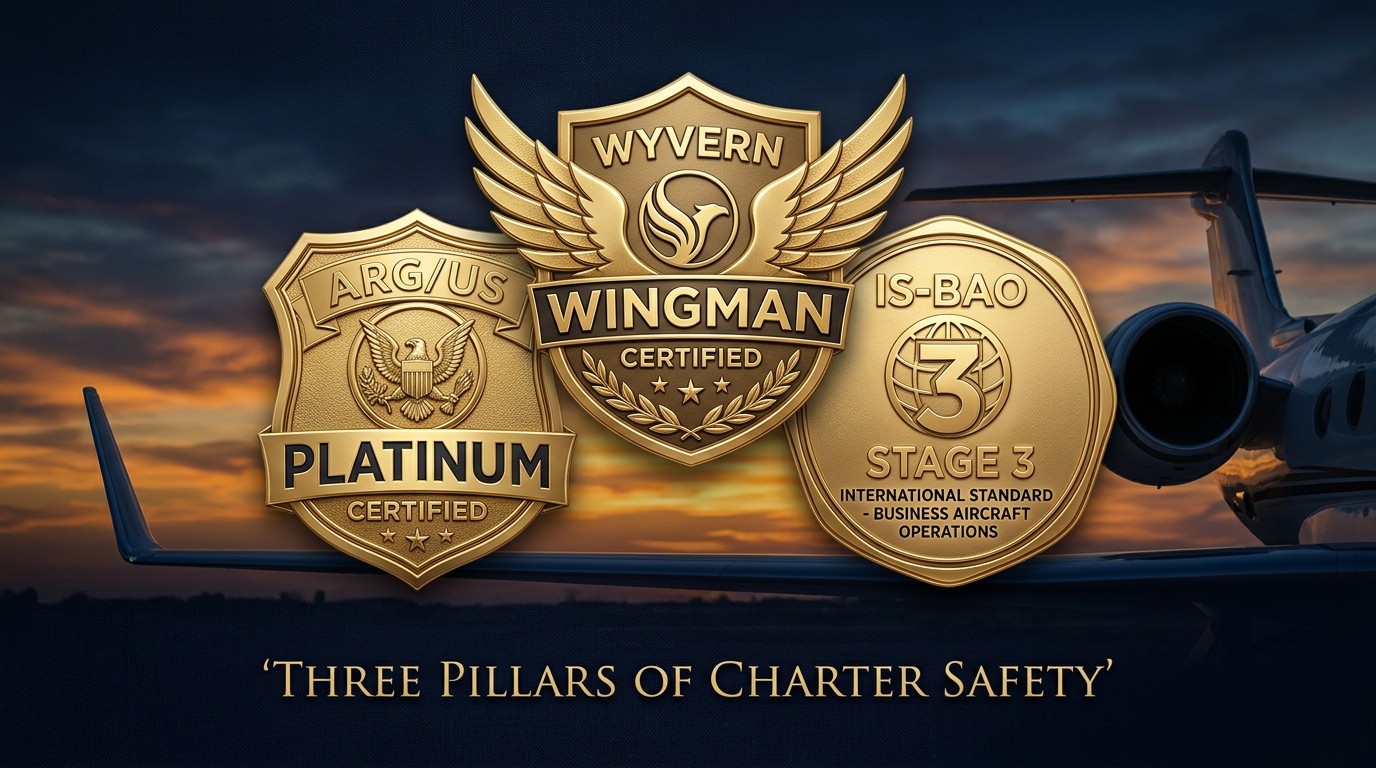
Price is only half the decision when you book a private jet. The other half is safety, insurance, and contract protection. This guide covers the three pillars that protect a six-figure flight: (1) the three global safety certifications — ARG/US, Wyvern, IS-BAO, (2) how to read insurance limits, and (3) the five contract clauses you should never sign without checking. Written from direct operational experience inside Korean Air BizJet, Samsung corporate aviation, and the Victor × Air Charter Service Korea agency. Request a safety-verified quote →
What to Verify Before You Book a Private Jet: Safety, Insurance & Contracts — The 2026 Complete Guide
Search "private jet cost" and you'll find route pricing tables and aircraft catalogs — we've published a thorough one ourselves in our Charter Price Comparison Guide. But signing the cheapest quote that lands in your inbox without looking under the hood is — to be blunt about it — a dangerous way to buy aviation.
A charter booking is a six-figure transaction at the low end and a seven-figure one at the high end, and the people boarding that aircraft are trusting it with their lives. Whether the operator's safety certification is current, whether the insurance limit is sufficient to cover a catastrophic event, whether the contract contains a substitution clause that protects you if the original aircraft goes into unscheduled maintenance — none of that appears on a price comparison chart. And in the Korean market, almost nobody explains it systematically.
This guide fills that gap. The consulting team at Air Charter Korea (ACK) walks through the three pillars that protect a charter flight — safety verification, insurance, and contract terms — drawing on direct operational experience. The person writing managed safety compliance from inside Korean Air's BizJet program, designed corporate aviation insurance structures at Samsung Electronics, and applied global safety standards to the Korean market as the local agent for Victor and Air Charter Service. That cross-industry perspective is the foundation of this guide.
📞 Need a Safety-Verified Quote?
ACK pre-screens every operator against ARG/US, Wyvern, and IS-BAO standards. Operators that don't pass don't appear in your quote.
📧 contact@aircharterkorea.com | 📞 +82-10-7723-3177
→ Request a Free Safety-Verified Quote
1. Why Safety Comes Before Price in Private Jet Booking
The charter industry operates on a fundamentally different structure than commercial aviation. When you fly Korean Air or Asiana, every aircraft operates under a single AOC (Air Operator Certificate) with uniform safety standards enforced across the entire fleet. In the charter market, thousands of small operators each hold their own AOC, each apply their own maintenance philosophy, and each set their own pilot qualification thresholds.
The implication is straightforward: the same aircraft type can have wildly different safety profiles depending on who operates it. As of 2024, there are approximately 15,000 business aviation operators worldwide. Of those, roughly 3,200 hold ARG/US Gold or higher. The remaining 80% either haven't submitted to a third-party safety audit or didn't pass one.
When a quote arrives that's significantly below market, the question that matters isn't "how did they get the price so low?" It's "what did they cut to get there?" Was it positioning efficiency — or was it safety certification, maintenance budget, or insurance coverage? That distinction is the single most important judgment call in charter booking, and it's a point we emphasized in our Quote Transparency Guide.
When I was managing operations at Korean Air BizJet, safety was a non-issue in the sense that it was handled top-down — a single AOC, a single maintenance standard, no operator selection decision required. The moment I moved to Samsung Electronics and started sourcing external charters for the corporate aviation desk, I discovered how dramatically maintenance philosophies diverge between operators. Two G650s, identical on paper, operated by two different companies — one performing manufacturer-recommended maintenance ahead of schedule, the other doing the legal minimum and not a check more. The quote from the latter was cheaper. Of course it was.
That experience is the direct origin of ACK's five-step safety verification protocol. Finding the operator that delivers both price competitiveness and safety standards — that's the reason an independent consultant exists, and it's the first criterion we flagged in our Broker Selection Guide.
Metric | Figure |
|---|---|
Business aviation operators worldwide | ~15,000 |
ARG/US Gold or higher | ~3,200 (~21%) |
Wyvern Wingman | ~800 (~5%) |
IS-BAO Stage 2 or higher | ~1,200 (~8%) |
Triple Crown (all three simultaneously) | <300 (~2%) |
The table tells the story: only the top 2% of global operators hold all three certifications simultaneously. ACK prioritizes that group and requires at least one of the three as a minimum for inclusion in any quote.
2. The Global Safety Standard: ARG/US, Wyvern, IS-BAO
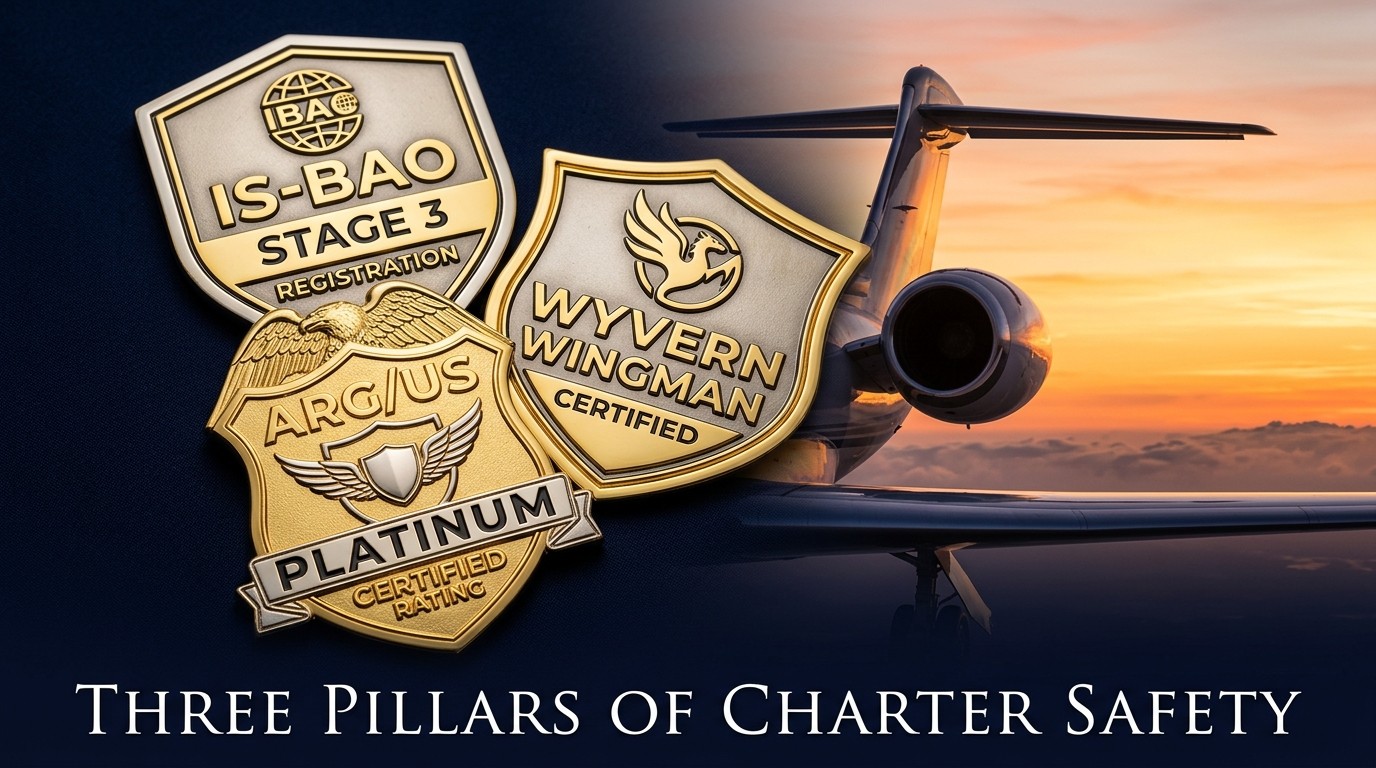
Three independent organizations audit charter operators and assign safety ratings. These ratings function as the "safety currency" of the global charter market — the basis for Fortune 500 corporate aviation policies, insurance underwriting decisions, and the operator selection criteria used by professional brokers including ACK.
ARG/US (Aviation Research Group, United States)
The world's largest aviation safety audit firm, based in the U.S. Operators are rated Registered → Gold → Platinum. The audit evaluates approximately 280 data points: AOC validity, insurance adequacy, pilot qualifications and training history, maintenance records, drug testing programs, and accident/incident history.
Registered: Valid AOC, basic insurance verified. Entry-level threshold.
Gold: Full 280-point deep audit passed. This is the floor most Fortune 500 companies require.
Platinum: Gold criteria plus an on-site physical audit. The most rigorous tier.
Wyvern (United States)
The other half of the "big two" in safety auditing. Operators are rated Registered → Approved → Wingman. Wingman is the industry's gold standard — it requires a functioning Safety Management System (SMS), Flight Data Monitoring (FDM), and a comprehensive on-site audit.
Wingman: The highest tier. SMS + FDM + on-site audit mandatory. ACK's preferred rating.
Approved: Standard audit passed. Comparable to ARG/US Gold.
IS-BAO (International Standard for Business Aircraft Operations)
Built on the ICAO framework by the International Business Aviation Council. Rated Stage 1 → Stage 2 → Stage 3, measuring the maturity of an operator's Safety Management System. Stage 3 indicates a fully internalized SMS — safety isn't a compliance exercise, it's embedded in the organizational culture. Where ARG/US and Wyvern are U.S.-centric, IS-BAO is more widely adopted by operators in Asia, Europe, and the Middle East.
Certifier | HQ | Rating Tiers | Top Tier | Core Audit Focus |
|---|---|---|---|---|
ARG/US | USA | Registered → Gold → Platinum | Platinum | 280 data points + on-site audit |
Wyvern | USA | Registered → Approved → Wingman | Wingman | SMS + FDM + on-site audit |
IS-BAO | International (IBAC) | Stage 1 → Stage 2 → Stage 3 | Stage 3 | SMS maturity + ICAO framework |
🛡️ Did You Know? NetJets — the Berkshire Hathaway subsidiary operating 1,000+ aircraft globally — holds ARG/US Platinum, Wyvern Wingman, and IS-BAO Stage 3 simultaneously. This "Triple Crown" is the highest safety benchmark in private aviation, and ACK prioritizes Triple Crown operators when matching aircraft to client missions in Korea.
3. How ACK Verifies Safety: The Five-Step Pre-Quote Check
Before any quote reaches a client's inbox, every operator ACK considers must clear a five-stage verification process. An operator that fails any stage is excluded from the proposal, regardless of how competitive the price.
① AOC validity
We confirm the operator's Air Operator Certificate is currently issued and maintained by its national civil aviation authority. An AOC is the legal minimum for commercial charter operations — no valid AOC, no legal flight. Operators whose AOC has been suspended, revoked, or issued by a country with insufficient regulatory oversight are automatically disqualified.
② Safety audit rating (ARG/US, Wyvern, IS-BAO)
Minimum one of the three certifications. ACK's preference is ARG/US Gold or higher plus Wyvern Wingman or IS-BAO Stage 2 or higher held simultaneously. A real example: when sourcing a Seoul–Singapore G550 charter, three operators had available aircraft. Operator A held ARG/US Gold + Wyvern Approved. Operator B held IS-BAO Stage 2 only. Operator C held no third-party certification of any kind. Operator C was 20% cheaper. ACK excluded it from the quote without discussion. Only A and B were presented, with safety ratings disclosed on the proposal. That's what "full-market search" means in practice — search everything, but filter out anything that doesn't meet the safety bar.
③ Insurance limits
We verify that hull insurance and third-party liability insurance limits meet or exceed industry benchmarks. ACK's internal floor for third-party liability is $200M. We are the only Korean broker that discloses operator insurance limits on the quote itself. One thing I learned designing the corporate aviation insurance structure at Samsung: the difference between a $50M limit and a $500M limit in annual premium is a few tens of thousands of dollars — the difference in claims capacity in a catastrophic event is ten-fold. That asymmetry should concern any charter client.
④ Pilot qualifications and currency
Valid type rating for the specific aircraft, minimum flight hours (ACK internal standard: captain 5,000+ hours total, first officer 2,500+), and recent training records (simulator check within six months). For context, Korean Air BizJet's internal standard was 10,000+ hours for captains — the industry's most stringent benchmark. ACK applies a standard consistent with the top 10% of global charter operators. Pilot currency matters: a captain who hasn't flown the specific type in six months or more is flagged as a risk factor in our assessment.
⑤ Maintenance history
We review the aircraft's recent maintenance records — C-Check and D-Check compliance, Airworthiness Certificate validity, and manufacturer Service Bulletin implementation status. Service Bulletins are especially important: when the OEM recommends a part replacement or inspection, an operator may legally continue flying without performing it if the bulletin is advisory rather than mandatory. But "legally permissible" and "safe" are not the same sentence. ACK confirms 100% compliance with mandatory Service Bulletins and reviews the implementation rate of recommended ones.
🔧 Did You Know? A C-Check (heavy maintenance) on a business jet occurs roughly every 2–3 years and costs $200K–$500K depending on type. A D-Check (overhaul) runs every 6–10 years and exceeds $1M. Failure to perform these on schedule results in Airworthiness Certificate suspension — the aircraft cannot legally fly. ACK verifies that every aircraft in every quote is within its maintenance cycle.
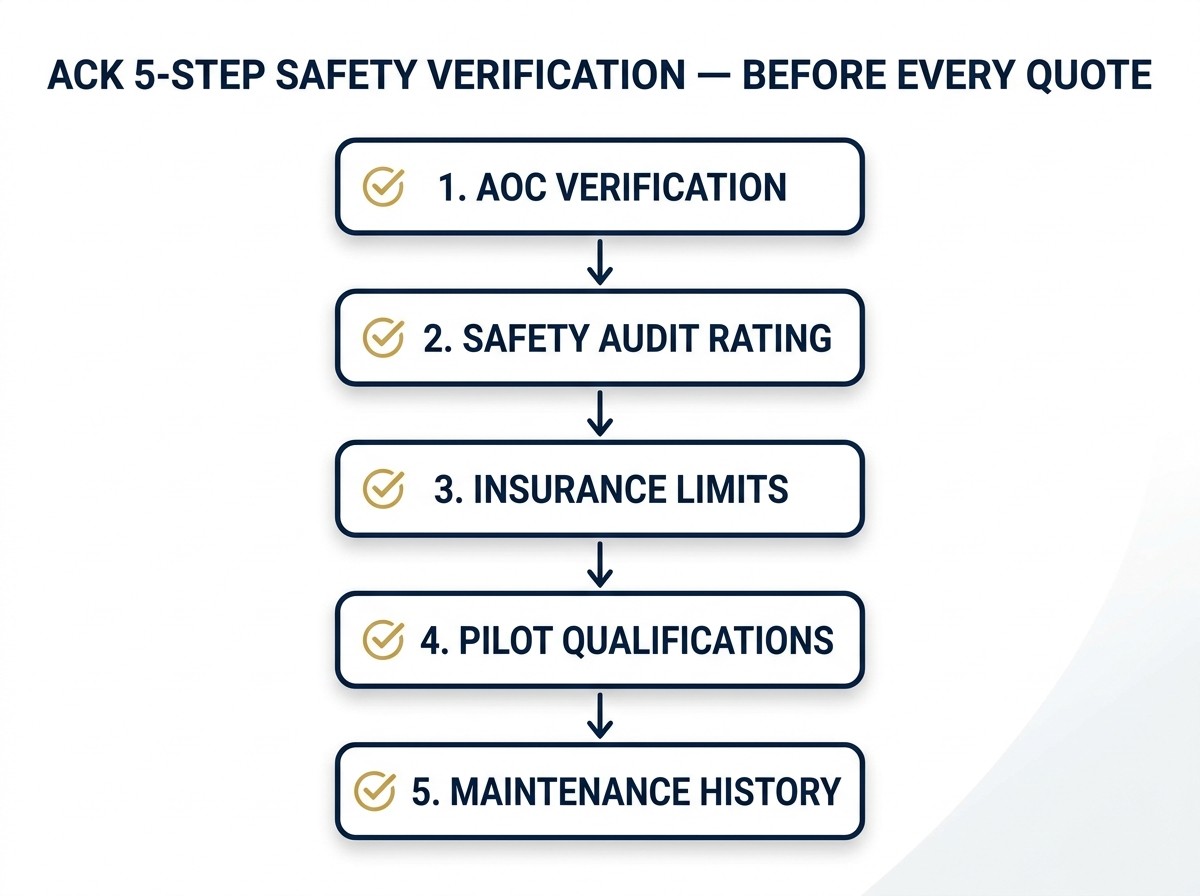
All five steps apply to every ACK quote. As we argued in our Broker Selection Guide, a broker's value isn't "finding the cheapest aircraft." It's "finding the safest aircraft at a competitive price." If all you wanted was the lowest number, you wouldn't need a consultant — you'd need a spreadsheet. When you need safety verified alongside price, that's when an independent advisor earns its place.
4. Charter Insurance: Three Layers Protecting a Six-Figure Flight
When the word "insurance" appears in a charter conversation, most clients' eyes glaze over. But on a flight that costs hundreds of thousands of dollars, insurance is the seatbelt — you hope you never need it, but without it, you lose everything. Working as the Victor × Air Charter Service Korea agent, I saw insurance-limit verification built into the quoting workflow as a standard step. Bringing that same structure to Korea was a conviction, not an option.
Charter aviation insurance has three layers, each protecting a different party. Think of it like auto insurance: hull is your own vehicle damage, third-party liability is the other driver's claim, and passenger liability is your own passengers' injuries.
Layer 1: Hull Insurance
Covers damage to or total loss of the aircraft. Carried by the operator, not the charter client. An operator without hull insurance may be unable to replace the aircraft after a loss event — a signal of financial fragility that should concern any client indirectly.
Layer 2: Third-Party Liability
Covers ground damage and third-party injury resulting from an aviation incident. An operator with a low limit may lack the capacity to settle a major claim. ACK's internal floor is $200M — operators below that threshold don't appear in our quotes.
Layer 3: Passenger Liability
Covers passenger death or injury. Included in the operator's policy, but the limit is what matters. An operator with $100K per-passenger coverage and one with $10M per-passenger coverage offer a 100x difference in protection. ACK discloses the passenger liability limit on every quote and advises clients when supplemental travel insurance is appropriate.
Insurance Layer | What It Covers | Who Carries It | ACK Standard |
|---|---|---|---|
Hull | Aircraft damage / total loss | Operator | Verified in force |
Third-party liability | Ground / third-party injury | Operator | $200M+ minimum |
Passenger liability | Passenger death / injury | Operator (+ client supplemental) | Limit disclosed on quote |
📋 Did You Know? Very few charter brokers globally disclose insurance limits on the quote itself. In Korea, ACK is the only one. This practice was adopted directly from Victor's full-transparency model in the UK market.
5. The Charter Contract: Five Clauses to Check Before You Sign
You've received the quote, selected the operator, and now the charter agreement is in front of you — typically four to eight pages, often in English regardless of the client's native language. This document protects a six-figure transaction. Here are the five clauses that matter most.
Clause 1: Operator name, tail number, and substitution terms
The contract must name the specific operator and specific aircraft (tail number). The critical detail is the substitution clause — if the original aircraft enters unscheduled maintenance, the operator can assign a replacement. That replacement must carry equivalent safety certification and equivalent insurance limits. ACK applies the same five-step verification to any substitute aircraft.
Clause 2: All-in pricing confirmation
Confirm that the contract price includes aircraft rental, repositioning, handling, overflight fees, fuel, taxes, and crew expenses — with no post-flight supplemental charges. As we detailed in our Transparent Pricing Guide, ACK quotes all-in and itemizes every component including broker commission.
Clause 3: Cancellation and refund terms
Cancellation Window | Typical Penalty |
|---|---|
72+ hours before departure | 10–25% |
48 hours | 25–50% |
24 hours | 50–100% |
No-show | 100% |
ACK prioritizes operators with flexible cancellation terms and includes the specific policy on every quote. A quote that omits cancellation terms is a red flag.
Clause 4: Insurance limits and coverage scope
The contract should attach a Certificate of Insurance or, at minimum, state the third-party liability and passenger liability limits. If neither is present, request it before signing.
Clause 5: Force majeure
Defines responsibility allocation when the flight becomes impossible due to weather, airspace closure, pandemic restrictions, or natural disaster. A contract without this clause leaves the client exposed in a dispute.
6. Price vs. Safety: What a Below-Market Quote Actually Means
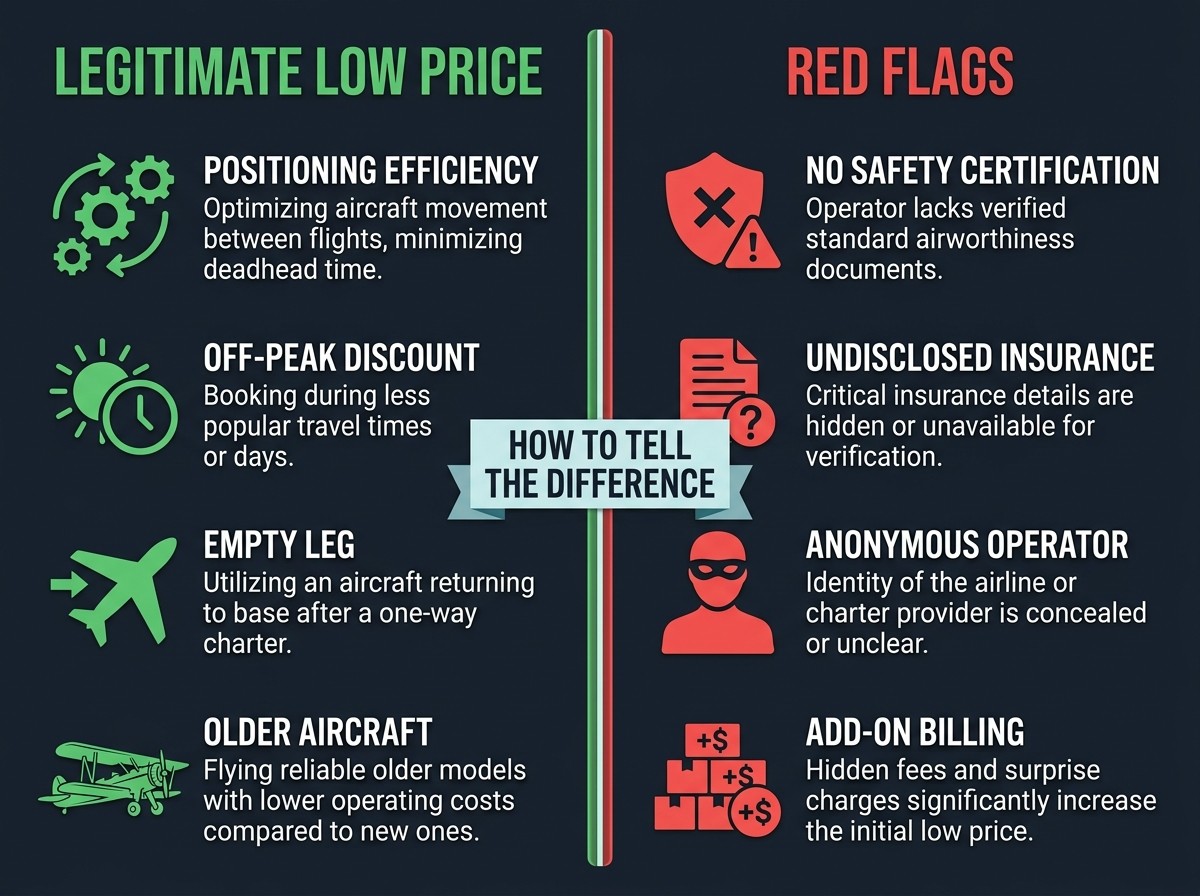
A low price doesn't automatically mean a dangerous flight. Legitimate reasons for below-market pricing include:
Positioning efficiency: The aircraft is already near the departure airport, minimizing deadhead cost.
Off-peak discounts: Low-demand periods where operators cut rates to maintain utilization.
Empty legs: Repositioning flights sold at 50–90% discounts.
Aircraft age: A 10–15-year-old airframe commands lower hourly rates than a factory-fresh one.
But when a quote comes in 30% or more below comparable market pricing, these red flags should trigger immediate verification:
🚩 No ARG/US, Wyvern, or IS-BAO certification of any kind
🚩 Insurance limits not disclosed on the quote
🚩 Operator name or aircraft tail number withheld
🚩 "Base rate only" pricing with post-flight add-ons
ACK's transparent quoting model eliminates all four red flags by design. Every quote includes operator name, tail number, safety rating, insurance limits, all-in pricing, and broker commission as a separate line. Price and safety verified simultaneously — that's the core value proposition. For pricing methodology details, see our Price Comparison Guide; for how to read a charter quote, see our Quote Transparency Guide.
7. Safety Considerations Unique to the Korean Market
Korea has two structural characteristics that make charter safety verification particularly important.
Characteristic 1: Very few domestically registered business jets
South Korea has roughly a dozen registered business jets. The U.S. has about 22,000; Europe has around 4,000. This means the vast majority of charters departing Korea use aircraft registered in Hong Kong, Singapore, Japan, or China — which makes the registering country's regulatory rigor and the operator's home-authority oversight quality a material factor in every booking.
Characteristic 2: Local brokers rarely disclose their safety verification process
Most Korean charter brokers offer generic assurances — "we work with safe operators" — but very few specify whether they screen against ARG/US, Wyvern, or IS-BAO, or describe their verification steps in any detail. ACK is the first Korean broker to publicly document its safety screening process, and this transparency is one reason we're categorized as an independent consulting firm rather than a conventional broker in our Provider Comparison Guide.
✈️ Did You Know? Korean Air BizJet (~$500K membership buy-in, fleet of G650ER and BBJ) operates under its own AOC with internally managed safety standards. On-demand charter, by contrast, can involve a different operator on every flight — which is exactly why per-quote safety verification is non-negotiable. This is the reason ACK runs the five-step check on every single quote.
8. How Leading Global Brokers Handle Safety — and What ACK Adopted
ACK's safety framework draws explicitly from proven global models. Here's what we borrowed and from whom.
Victor (UK) — Full disclosure of operator ratings and insurance
Victor publishes the operator name, tail number, ARG/US and Wyvern ratings, insurance limits, and its own broker margin on every quote. The principle is simple: hiding safety information is incompatible with client trust. ACK is the first consulting firm to apply this principle in Korea, using the same disclosure format on Korean-language proposals.
NetJets — Safety statistics as marketing content
NetJets (Berkshire Hathaway subsidiary, 1,000+ aircraft, $10B+ revenue) publishes accident-free flight hours, average pilot experience, and maintenance investment figures as infographics — making safety data a trust-building marketing asset. ACK is adopting the same approach with transparent safety content, and this guide is the first published result.
Air Charter Service (UK) — Uniform global safety protocol
ACS applies identical safety verification protocols across 30+ offices in 30 countries. ARG/US and Wyvern ratings are prerequisites for broking, not optional filters. This consistency is a core reason Fortune 500 clients use ACS. ACK internalized this protocol during its period as the ACS Korea agent.
Stratos Jet Charters (US) — Safety education content at scale
Stratos built its organic SEO dominance on detailed ARG/US and Wyvern educational content integrated directly into its aircraft catalog pages. Clients can filter by safety rating at the aircraft selection stage. ACK is building the same structure for the Korean market — this guide is the safety education layer.
Global Benchmark | Safety Practice | ACK Adoption Status |
|---|---|---|
Victor | Full disclosure: operator, ratings, insurance, margin | Implemented |
NetJets | Safety statistics as marketing content | In progress |
ACS | Uniform 30-country verification protocol | Applied to Korean market |
Stratos | Safety education content SEO | This guide is the first output |
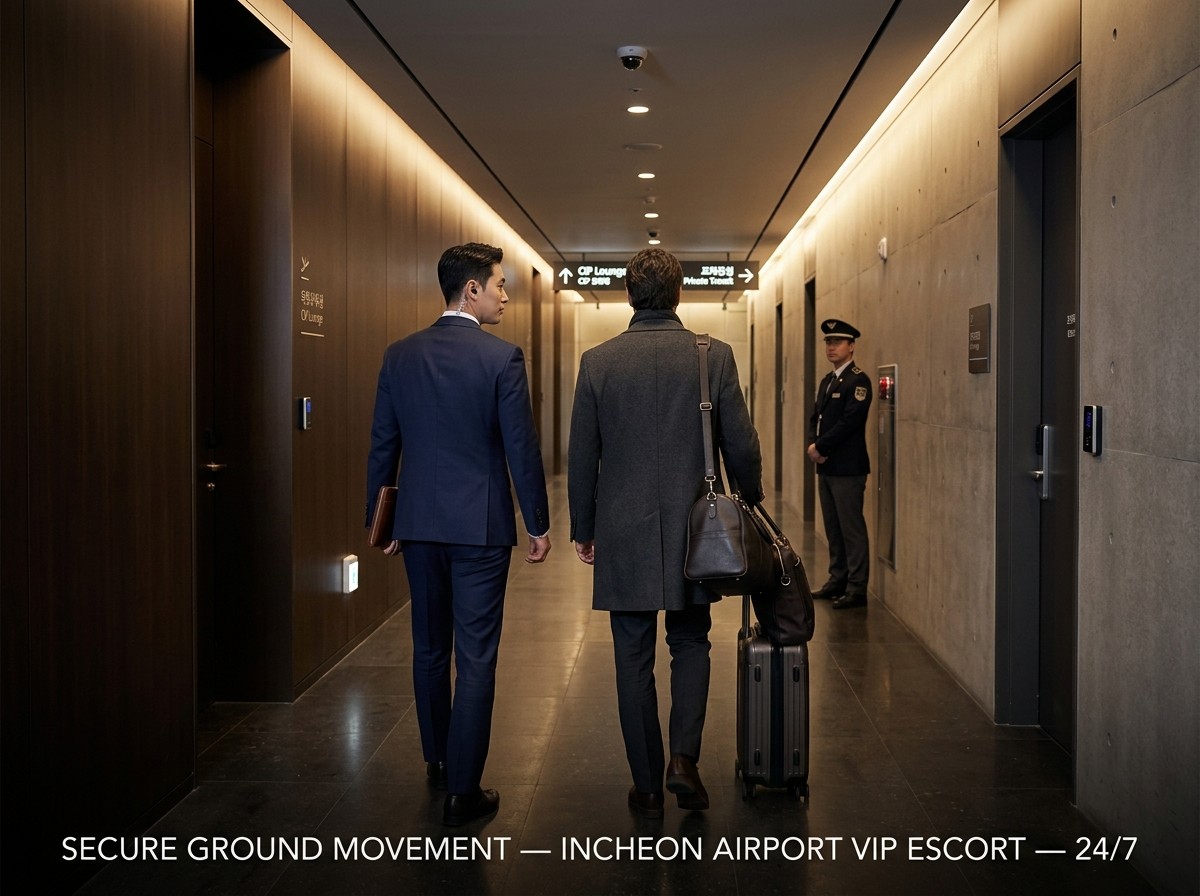
9. Charter Plus VIP Airport Escort: The Last Mile of Safety
Safety in private aviation isn't limited to what happens at altitude. On the ground at Incheon Airport, managing the movement of VIP clients, entertainment artists, and political figures is both a security problem and a privacy problem. BestTurn VIP Airport Escort, ACK's sister operation, addresses both.
Bundle the charter and escort through ACK and schedule changes sync in real time. For clients where safety is the primary concern — government officials, publicly listed company CEOs, globally recognized entertainers — having aircraft operational safety and ground-side security managed as a single integrated pipeline is the decisive value. For full details, see our Incheon Airport VIP Escort Guide. Standalone escort bookings are also available, starting from USD 250, operating 24/7.
10. Frequently Asked Questions
Q: How do I verify a charter operator's safety?
Check for third-party safety audit ratings: ARG/US (Gold or Platinum), Wyvern (Wingman), IS-BAO (Stage 2 or 3). ACK pre-verifies all three on every quote. Operators without at least one certification are excluded.
Q: Does a cheap charter price mean it's unsafe?
Not necessarily — positioning efficiency, off-peak timing, and empty legs are legitimate reasons. But 30%+ below market should trigger verification of certifications, insurance, and maintenance status.
Q: What's the most important contract clause?
Five to check: operator name + tail number (with substitution terms), all-in pricing confirmation, cancellation terms, insurance limits, and force majeure.
Q: What is an AOC?
Air Operator Certificate — the legal authorization from a national aviation authority to conduct commercial charter operations. No valid AOC, no legal flight.
Q: How do I book a charter from Korea?
Contact ACK with your route, dates, and headcount. Safety-verified, all-in quotes within 48 hours. Free first consultation, no membership fee.
Q: What does a charter from Seoul cost?
Jeju: $6K–$15K. Tokyo: $15K–$42K. Singapore: $60K–$115K. London: $138K–$450K. Full breakdown in our Price Comparison Guide.
Q: Can I add VIP escort at Incheon Airport?
Yes. BestTurn and ACK operate under one roof. One booking, automatic schedule sync.
📞 Get a Safety-Verified Quote — Free
Private jet booking · Charter pricing · VIP airport escort at Incheon — any service, 48-hour turnaround.
📧 contact@aircharterkorea.com | 📞 +82-10-7723-3177
🌐 ACK — Request a Quote | BestTurn VIP Escort
24/7 · 365 days · Free consultation · No membership · ARG/US · Wyvern · IS-BAO pre-verified
Conclusion: Price Is Half the Decision — Safety Is the Other Half
Price matters in charter. Nobody's arguing otherwise. But booking on price alone is like buying a car based on the sticker and never checking the brakes or the airbags. The operator's safety certification, the insurance limits behind the policy, the contract clauses that define what happens when something changes — those three things are the real insurance on a six-figure flight.
Air Charter Korea verifies price and safety transparently and simultaneously — the only independent aviation consulting firm in Korea to do so. Every quote includes operator safety rating, insurance limits, and broker commission as separate line items. BestTurn completes the picture on the ground at Incheon.
Safe skies, transparent pricing — a new standard for private aviation in Korea.
✍️ About the Author
Wonjin Choi | Victor × Air Charter Service Korea Agent
Former Korean Air BizJet Operations Manager Manager
Founder, Air Charter Korea
This guide reflects official service information from Air Charter Korea and global/Korean charter safety data current as of April 2026. All pricing represents market reference ranges; actual quotes vary by route, dates, and aircraft availability.