Where to Buy a Private Jet 2026: The 5 Global Marketplaces & 7-Step Acquisition Process for Korean HNW Buyers

Published: May 20, 2026 | Read time: 17 minutes | Format: Aircraft acquisition marketplace and process guide
🛒 This page is for:
✔️ HNW buyers and corporate chairs actively searching for where to buy a private jet
✔️ Anyone evaluating personal aircraft pricing and asking "where does this market actually live?"
✔️ Family offices working through Pre-Buy Inspection, Korean registration, and tax mechanics
✔️ Buyers who want JetNet, AMSTAT, Controller, and AvBuyer explained in plain language
✔️ Korean buyers in the 6–18 month evaluation window for personal aircraft acquisition
This is the integrated walkthrough — five global marketplaces, the seven-step acquisition process, and the Korean import mechanics, in one place.
→ Aircraft acquisition advisory (Wonjin Choi 📞 +82-10-7723-3177)
Where to Buy a Private Jet 2026: The 5 Global Marketplaces & 7-Step Acquisition Process for Korean HNW Buyers
"I want to buy a private jet — where do I actually buy one?" is the first real question for any HNW buyer running an aircraft acquisition seriously. Buying a car in Korea works through BMW Korea or Mercedes-Benz Korea; the aircraft market does not. New aircraft come from OEMs directly — Bombardier, Gulfstream, Dassault, Embraer. Pre-owned aircraft — which is where roughly 60% of Korean buyers actually start — live in the global aircraft marketplaces, found and transacted through specialist brokers.
This page answers the "where" properly. The five global private jet marketplaces the global HNW community actually uses — what each one does, who has access, when each is the right tool. The data points that matter when scanning listings. What a Pre-Buy Inspection actually is and what it costs. Korean (HL) versus U.S. (N) versus offshore (VP-C) registration economics. The Korean import mechanics — VAT, duties, registration filings. And the operating model decision after the aircraft is in country (sole use, aircraft management, charter pool). Seven steps end to end, in one document.
Air Charter Korea (ACK) runs the deepest aircraft acquisition advisory practice serving Korean HNW buyers. The work spans specification through final import, with NDA up front and the first consultation free. Global marketplace data — including the subscription-only platforms like JetNet and AMSTAT that most buyers cannot access directly — comes through the ACK network as part of the engagement.

⚡ Aircraft acquisition advisory — free marketplace search + simulation
Send desired aircraft category, capacity, range, and budget. You'll receive 10–30 filtered candidate aircraft from the five global marketplaces plus a 5-year ownership simulation inside two weeks. NDA up front.
📧 contact@aircharterkorea.com | 📞 Wonjin Choi +82-10-7723-3177
→ Free acquisition advisory
1. The Five Global Private Jet Marketplaces — At a Glance
Marketplace | Type | Access | When It's the Right Tool |
|---|---|---|---|
JetNet (jetnet.com) | Largest global aircraft database + analytics | Subscription (industry professionals) | First-pass screening, valuation comps |
AMSTAT (amstatcorp.com) | Business jet specialist database | Subscription (industry professionals) | Transaction tracking, comparable analysis |
Controller (controller.com) | Consumer-facing listings | Free (open to buyer browsing) | Buyer-led direct search |
AvBuyer (avbuyer.com) | Europe-weighted listings | Free (some membership content) | European inventory search |
Aircraft Bluebook | Industry valuation standard | Subscription (appraisers, brokers) | Verifying transaction value |
How it actually works: Controller and AvBuyer are the two marketplaces a Korean HNW buyer can browse directly. The deeper transactional data — pricing history, ownership chains, maintenance records, comparable transaction analysis — lives in JetNet, AMSTAT, and Aircraft Bluebook, which are subscription-only and run through industry professionals. A serious acquisition runs through all five in parallel; ACK does that work as part of the advisory engagement.
2. JetNet (jetnet.com) — The Global Database Everyone Uses
Why JetNet is the industry baseline
JetNet runs the largest global aircraft database in business aviation — roughly 90,000–110,000 business aircraft and rotorcraft covered. Beyond listings, JetNet tracks per-aircraft operating hours, ownership history, maintenance history, and transaction comparables. The OEMs (Gulfstream, Bombardier, Dassault, Embraer), aircraft brokers, and operators all use JetNet as the market-intelligence baseline.
What JetNet shows the buyer's broker
Listing data: ask price, location, tail registration, manufacture year, total time
Aircraft history: prior owners, operators, maintenance record, incident history
Valuation comps: transaction statistics by type and vintage, pricing trends
Market intelligence: quarterly business jet market reports, demand forecasting
Why most buyers don't subscribe directly
JetNet is subscription-only at approximately $5K–$20K annually depending on scope. For a buyer running a single aircraft acquisition, the subscription doesn't pencil out — the standard path is going through a broker (ACK and similar) who already runs the subscription as part of their day-to-day market intelligence. The data shows up in the engagement; the buyer doesn't carry the platform cost.
3. AMSTAT (amstatcorp.com) — The Business Jet Specialist
What AMSTAT does well
AMSTAT runs a business-aviation-focused database at roughly the scale of JetNet, but its specific strength is depth on business jet transactions, ownership turnover, and maintenance statistics. Most global aircraft brokers and OEM sales teams run AMSTAT alongside JetNet as part of the standard intelligence workflow.
How AMSTAT supports a listing search
Filtering by type within total available inventory (e.g., "60 Challenger 350s on market, filter to the 25 in the 5–10 year window")
Side-by-side comparison: ask price, location, condition, total time
Comparable transaction tracking for fair-value benchmarks
Public-record owner names and inferred sale motivations
As with JetNet, AMSTAT runs through industry professionals — ACK handles the AMSTAT side of the search as part of the engagement.
4. Controller (controller.com) — The Marketplace Buyers Can Actually Browse
Why Controller is the buyer's first stop
Controller is the aircraft marketplace built for direct browsing. Clean UI, filtering by aircraft type, price band, and location, photo and video coverage, full spec sheets attached, seller contact details posted — it's the first page most HNW buyers visit when running their own market screen before engaging a broker.
How to search Controller effectively
Category filter: left menu → Aircraft Type → Jets → Heavy / Super-Mid / Mid
Price band: e.g., $15M–$22M for the 5-year-old super-midsize sweet spot
Vintage: Year 2018–2022 covers the 5–8 year pre-owned window
Total time: 2,000–4,000 hours filter, targeting low-utilization airframes
Location: majority of inventory sits in the U.S., but Europe, Middle East, and Asia inventory is searchable
What Controller doesn't show you
Ask price isn't transaction price: listings are starting positions; actual transactions land 5–15% below ask on average
Full maintenance records aren't published: the deep MX history only surfaces in Pre-Buy
Direct-to-seller contact is risky: approaching the seller without a broker means losing negotiating leverage and increasing fraud exposure on misrepresented listings

5. AvBuyer (avbuyer.com) — Where the European Inventory Lives
AvBuyer is the UK-based marketplace that carries the deepest European inventory — the natural complement to Controller's U.S.-heavy database. European-registered aircraft (G- for the UK, D- for Germany, F- for France, OE- for Austria, and so on) show up here first. The UI runs similarly to Controller; AvBuyer also publishes AvBuyer Magazine as a market intelligence layer.
European inventory — what to know
Strength: EASA maintenance standards — rigorous records discipline. European-operator-managed aircraft typically present with strong maintenance credibility.
Trade-off: bringing a European-registered aircraft into Korea adds an EASA-to-FAA-or-KCASA certification conversion to the timeline.
Pricing: roughly in line with U.S. inventory at face value, but European-registered aircraft can carry different VAT mechanics — needs aviation-counsel review.
6. Aircraft Bluebook — The Valuation Standard
Aircraft Bluebook isn't a listing site — it's the industry valuation reference. U.S. and global aircraft appraisers, insurance underwriters, and aviation lenders all use Bluebook as the fair-value benchmark for any specific aircraft. For the Korean buyer, Bluebook shows up at the Pre-Buy and price-validation stage rather than the initial search.
When Aircraft Bluebook gets pulled into the engagement
Validating ask prices: is the Controller or AvBuyer listing in line with the market
Insurance valuation: what the insurer recognizes as the aircraft's basis
Financing collateral: what an aviation lender uses to size a loan against the aircraft
5-year residual projection: the basis for projecting end-of-hold disposition value
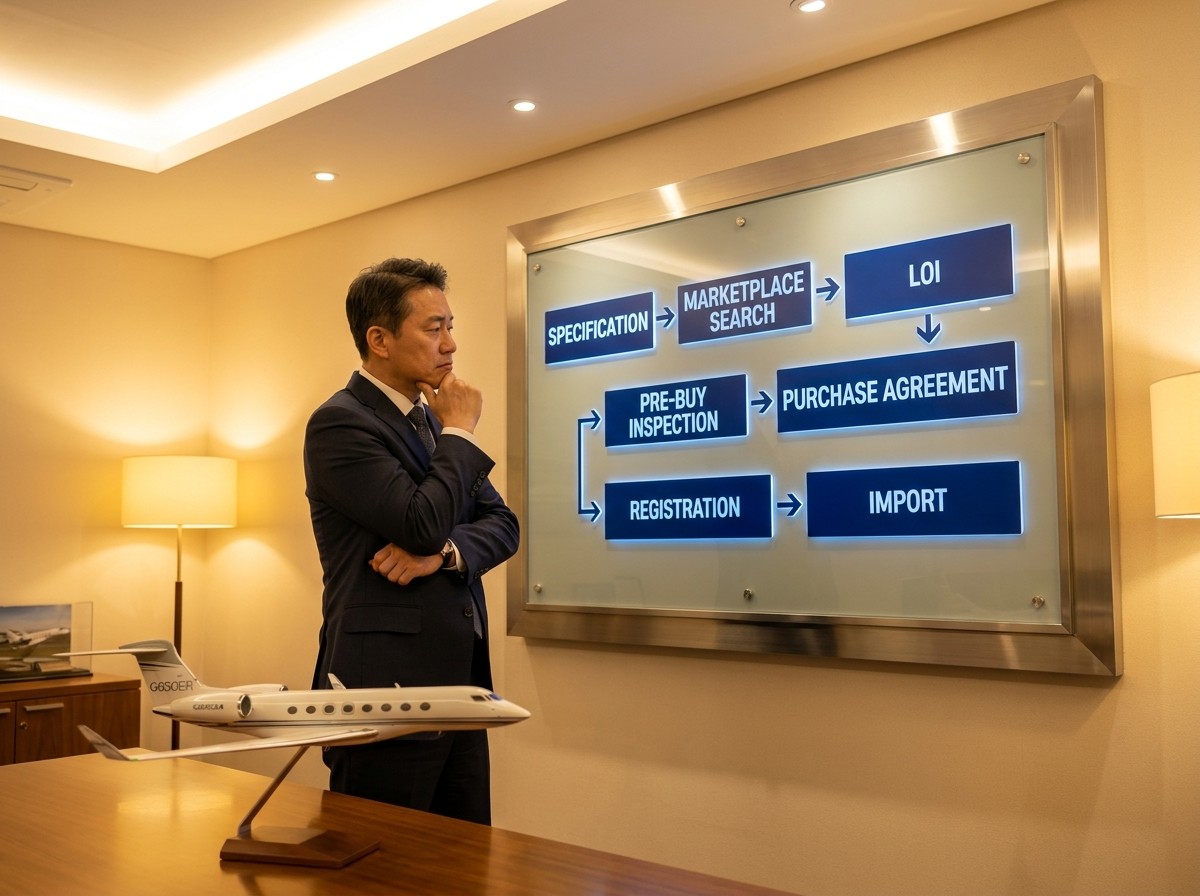
7. The 7-Step Aircraft Acquisition Process for Korean Buyers
Step 1 — Specification (1–2 weeks)
Annual flight pattern, primary routes, passenger capacity, and budget defined into an aircraft category. Specification is the highest-leverage step in the entire process — the wrong category locks in 30–50% of additional 5-year operating cost compared to the right one.
Mission Pattern | Recommended Category | Representative Aircraft |
|---|---|---|
Korea–Japan / Korea–China, 4–6 pax | Light or Midsize | Phenom 300E, Citation Latitude |
Asia-region, 6–8 pax | Super-midsize | Challenger 350, G280 |
Global, 8–14 pax | Heavy | G650ER, Global 6000 |
Ultra-long-range, non-stop | Ultra-long-range | Global 7500, BBJ |
Step 2 — Marketplace search (2–4 weeks)
Cross-referenced search across JetNet, AMSTAT, Controller, and AvBuyer builds a candidate pool of 10–30 aircraft. The ACK advisory side adds the data layer that doesn't show on public listings — ownership chain, prior operator quality, maintenance program participation, inferred sale motivation.
Step 3 — Letter of Intent (1–2 weeks)
One to three top candidates get LOIs. The LOI captures price proposal, Pre-Buy Inspection terms, payment timeline, and any non-disclosure clauses. Seller acceptance opens Purchase Agreement negotiations.
Step 4 — Pre-Buy Inspection (1–2 weeks)
Buyer-funded comprehensive review of airframe, systems, and records. Non-negotiable — it never gets skipped.
Pre-Buy Inspection cost
Light / midsize: $30K–$60K
Super-midsize: $50K–$80K
Heavy / ultra-long-range: $80K–$150K
Pre-Buy Inspection checklist
Engine inspection — borescope, oil analysis, compression testing
Airframe inspection — corrosion, structural integrity, paint
Systems check — avionics, communications, autopilot, oxygen systems
Records review — MX records audited 100%, incident history, parts replacement log
Cabin inspection — interior, seats, lavatory, galley
Documentation — registration certificate, airworthiness, insurance, operating history
Resolving Pre-Buy findings
Findings have three outcomes: (1) seller repairs before delivery, (2) buyer accepts the aircraft with a price adjustment, (3) the deal terminates. In most cases, material findings translate to a 5–15% price reduction off the LOI position.
Step 5 — Purchase Agreement and escrow (1–2 weeks)
Final price agreed, Purchase Agreement signed, payment funded into escrow. Funds release on aircraft delivery; title transfer happens through the registry-filing process.
Step 6 — Registration (2–6 weeks)
Registry | Prefix | Advantages | Considerations |
|---|---|---|---|
Korea | HL- | Domestic operating ease, recoverable VAT | MOLIT registry filing; some global-ops constraints |
United States | N- | Global operational standard, stronger resale | FAA certification, U.S. maintenance discipline |
Cayman | VP-C | Tax efficiency, offshore-operating HNW | CAACI regulation; Korean operations need permits |
Bermuda | VP-B | HNW preference, anonymity layer | BCAA regulation |
Step 7 — Korean import + aircraft management (4–8 weeks)
Aircraft brought into Korea (customs, inspection, hangar assignment), aircraft management operator paired (Luxaviation, Jet Aviation, ExecuJet, or domestic operator), crew onboarded, insurance bound, first revenue/personal flight. Total elapsed: 4–8 weeks.
Detailed operating model decision: Ownership vs Charter vs Aircraft Management Guide.
8. Korean Import — Tax and Legal Mechanics
Customs duties
Civilian aircraft enter Korea under HS code 8802 and are generally duty-free — both new and pre-owned aircraft qualify. Customs filing is still required at the import point.
VAT (10%)
Applies to: 10% of aircraft purchase price
Example: $25M super-midsize → approximately $2.5M VAT
Recovery: recoverable for corporate business use
Watchpoint: offshore registration (N or VP-C) changes the VAT mechanics — aviation-specialist counsel signs this off
Depreciation (corporate ownership)
5–10 year straight-line or declining-balance schedule
Example: $25M aircraft, 10-year straight-line → $2.5M annual book expense
Corporate tax efficiency play — handled by the engagement's accounting firm
Inheritance and gift tax (personal title)
Personal-title aircraft enters the estate base for inheritance and gift tax purposes. For intergenerational wealth transfer planning, corporate-entity ownership with share transfer is typically more efficient than personal title with direct asset transfer. Specialist aviation counsel and inheritance-tax counsel coordinate this work.
9. Seven Data Points to Verify on Every Listing
① Total Time (TT)
Cumulative airframe flight hours. A 5–10 year old super-midsize typically shows 2,000–4,000 hours. Lower TT → higher residual value; higher TT → upcoming maintenance cycle (which means deeper price discounts available).
② Engine time + maintenance program enrollment
Engine hours and enrollment status in JSSI, Honeywell MSP, or Rolls-Royce CorporateCare. Aircraft outside a maintenance program face an unfunded engine overhaul liability ($1M–$3M) at the next cycle — a major financial consideration.
③ Tail registration
N- (U.S.), G- (UK), D- (Germany), HL- (Korea), 9V- (Singapore), and so on. Registry determines maintenance regime, resale liquidity, and import workflow. N-registered aircraft is typically the cleanest path into Korean import.
④ Ownership history
Prior owners, length of ownership, sale motivation. JetNet and AMSTAT expose this. Single-owner long-hold airframes tend to carry consistent maintenance; multi-owner short-hold patterns warrant additional scrutiny.
⑤ Operator history
Aircraft managed by ARG/US Gold-rated operators carry maintenance-credibility premiums. Owner-direct-operated aircraft warrant additional records verification.
⑥ Cabin configuration
Passenger count, seating layout, sleeping configuration, lavatory and galley provisions, Wi-Fi system. Cabin renovation costs $500K–$2M and may be in scope as a post-acquisition project.
⑦ Maintenance records (MX Records)
Full maintenance log. Any major event history (engine overhauls, C-Checks, incidents). 100% audit happens at Pre-Buy.
10. First Flight After Acquisition — Incheon VIP Escort
The first flight after acquisition is a milestone — family and key colleagues onboard together. BestTurn VIP Airport Escort handles the Incheon or Gimpo workflow — 5-minute customs, luxury ground transport, direct-to-aircraft routing.
Service: Family group (1–10) VIP escort at Incheon and Gimpo + luxury ground transport + airside transit
Photography access: First-flight family photography — accompanying photographer can capture the full departure sequence
Pricing: USD 250–500 for the group
Contact: Steve, Escort Lead 📞 +82-10-3721-2853 / service@bestturnaround.com
11. The ACK Aircraft Acquisition Advisory — Five-Step Engagement
Step 1 — NDA + intake (one meeting, free)
Aircraft category, budget envelope, annual flight pattern, and priorities captured. Confidential engagements move through NDA up front.
Step 2 — Global marketplace search + simulation (within two weeks)
Cross-platform search across JetNet, AMSTAT, Controller, AvBuyer. Candidate pool of 10–30 aircraft built; top 3–5 surfaced; 5-year operating simulation delivered.
Step 3 — LOI and negotiation (2–4 weeks)
LOIs to 1–3 top candidates. Seller responses evaluated, Purchase Agreement negotiations led.
Step 4 — Pre-Buy + contract (4–6 weeks)
Pre-Buy run through an ARG/US Gold maintenance facility, findings reviewed, final price set, Purchase Agreement executed, escrow funded.
Step 5 — Registration, import, post-engagement concierge (8–12 weeks + 1–3 years)
Registry filing, Korean import, aircraft management operator paired, first flight delivered, then 1–3 years of post-engagement concierge — charter pool performance monitoring, maintenance scheduling, sale-timing advisory.
12. Frequently Asked Questions
Q: Can I just find an aircraft on Controller and contact the seller directly?
Technically yes — but aircraft transactions don't operate like automobile transactions. Global standard process (LOI, Pre-Buy, Purchase Agreement, registration, import), seller credibility verification, valuation comparables, MX records audit, and legal review are all non-optional. Direct-to-seller without a broker exposes the buyer to (1) ask-price exposure, (2) misrepresented listings, (3) MX records gaps, (4) tax and registration errors at import. ACK handles all of this as standard process.
Q: Is subscribing directly to JetNet or AMSTAT worth it?
For a single acquisition, no — the $5K–$20K annual subscription doesn't pay back. ACK runs the subscriptions as part of standard practice and surfaces the data in the engagement. Direct subscription makes sense for HNW principals running multiple aircraft or aircraft leasing operations.
Q: Pre-owned vs new — which is more rational?
Roughly 60% of Korean HNW buyers take their first entry pre-owned. The case for pre-owned: (1) 30–60% below new retail, (2) verified operating history, (3) immediate availability. The case for new: residual value protection, fully fresh maintenance basis, no incident-history exposure — but a 12–24 month OEM order lead time. The 5–10 year old super-midsize is the most-favored entry point.
Q: Can the seller arrange the Pre-Buy?
Never. The Pre-Buy runs at the buyer's expense, at a buyer-selected facility, with the buyer present or represented. A seller-arranged inspection compromises objectivity. ARG/US Gold or OEM-authorized service centers are the standard.
Q: Has anyone in Korea actually bought aircraft this way?
Yes — the Korean owned-aircraft population sits at approximately 50–80 aircraft (precise figures aren't published). Almost all of these acquisitions came through the global marketplaces (primarily JetNet, AMSTAT, Controller) routed through aircraft brokers. Concentration sits with major group chairs, financial sector principals, real estate, and biotech HNW.
Q: What does the advisory cost?
ACK's first consultation, marketplace search, and simulation are free. The acquisition engagement runs on a transaction fee (1–3% of purchase price), in line with global aircraft brokerage standards. For a single acquisition, working through a broker typically nets the buyer better economics than direct-to-seller — through stronger negotiating leverage, deeper inventory verification, and clean import execution.
Q: How does residual value get protected through ownership?
Four levers: (1) ARG/US Gold-rated managed operations — maintenance discipline preserved, (2) enrollment in engine maintenance programs (JSSI, MSP, CorporateCare) — engine value secured, (3) periodic pre-sale appraisal — 5-year sale-timing tracked against market, (4) cabin renovation timing — interior refresh staged before sale window. ACK's post-engagement concierge runs all four.
📞 Aircraft acquisition advisory — free marketplace search + 5-year simulation
HNW acquisition advisory: ACK — Request Advisory | Wonjin Choi 📞 +82-10-7723-3177 | contact@aircharterkorea.com
Incheon VIP escort: BestTurn VIP Escort | Steve 📞 +82-10-3721-2853 | service@bestturnaround.com
🔗 ACK LinkedIn | Wonjin Choi LinkedIn
NDA up front · Two-week marketplace search + simulation · ARG/US Gold Pre-Buy · 5-year post-engagement concierge
Conclusion: Finding the Aircraft Is 15%. The Rest Is the Process.
"Where do I buy a private jet?" lives in five global marketplaces — JetNet, AMSTAT, Controller, AvBuyer, Aircraft Bluebook. But finding the aircraft is roughly 15% of the actual acquisition. The other 85% is Pre-Buy Inspection, contracts, registration, import, operating model selection, and ongoing residual value protection. The reason aircraft acquisition differs from buying a car is straightforward — an aircraft is a 5-to-10-year operating asset, and managing residual value through the hold is as material as the initial purchase decision.
Personal aircraft pricing isn't just the airframe sticker. The $15M–$80M acquisition number gets paired with VAT ($1.5M–$8M), Pre-Buy ($30K–$150K), import and registration ($50K–$200K), and the first maintenance cycle estimate. This guide assembles all of that — Korean HNW buyer's full acquisition framework — into one document that follows global standard process.
ACK runs end-to-end aircraft acquisition advisory for Korean HNW buyers — specification through sale. Send us desired aircraft category, budget, and priorities; under NDA, you'll receive a global marketplace search and a 5-year ownership simulation within two weeks. First consultation is free, and joint sessions with accounting and aviation legal counsel are standard.
In the air, as an asset: Air Charter Korea. On the ground at Incheon: BestTurn. Aircraft ownership is the start of a 5–10 year asset operating system — the right start is what makes the rest work.
Where to buy a private jet — but the marketplace is just the starting point.
✍️ About the Author
Wonjin Choi | Former Korean Air Business Jet Operations Manager · Former Samsung Electronics Business Jet Account Manager
Victor × Air Charter Service Korea Agent
Founder, Air Charter Korea
This guide draws on official service information from Air Charter Korea, publicly available data from global aircraft marketplaces (JetNet, AMSTAT, Controller, AvBuyer, Aircraft Bluebook), global aviation safety frameworks (ARG/US, Wyvern), Korean Aviation Safety Act, Aviation Business Act, Customs Act, and VAT Act, and global private jet market pricing reference data current as of May 2026. All pricing represents market reference ranges; actual figures vary by aircraft type, vintage, condition, and timing. Aircraft acquisition and tax treatment require specialist aviation counsel and accounting firm sign-off. The global marketplaces named (JetNet, AMSTAT, Controller, AvBuyer, Aircraft Bluebook) are registered trademarks of their respective operators; this guide is provided for general informational purposes and does not reflect any affiliate relationship with the named platforms.