Private Jet Routes from Seoul: Flight Times and Costs 2026

Seoul to Anywhere: The Complete Route-by-Route Guide to Private Jet Charter from South Korea
Route-by-route breakdown of private jet charter from Seoul — domestic, Northeast Asia, Southeast Asia, and intercontinental. Real pricing, aircraft recommendations, and booking logistics from Air Charter Korea.
Every private jet trip begins with the same question: how do I get from here to there — faster, privately, and without the friction of commercial aviation? For travelers departing South Korea, the answer depends on the route. Aircraft selection, pricing, regulatory requirements, and even the choice of departure airport all shift depending on whether you're heading to Jeju for a weekend or London for a board meeting.
This guide breaks down the major route categories for private jet charter from Seoul, with the kind of operational detail and realistic cost benchmarks that most charter websites leave out. If you've read our insider's guide to private jet charter from South Korea and want to drill deeper into specific destinations, this is where to go next.
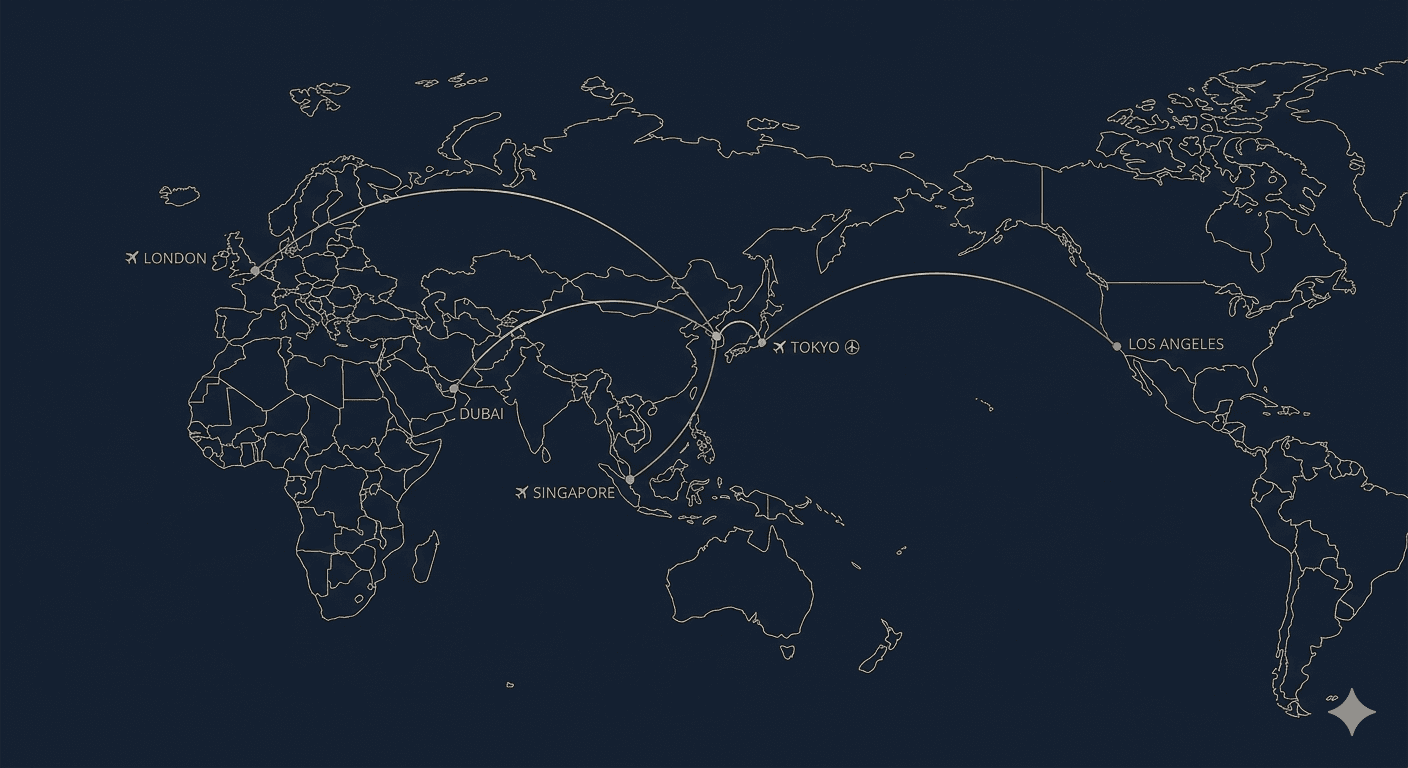
Domestic Routes: Short Flights, Outsized Convenience
Seoul (Gimpo) to Jeju
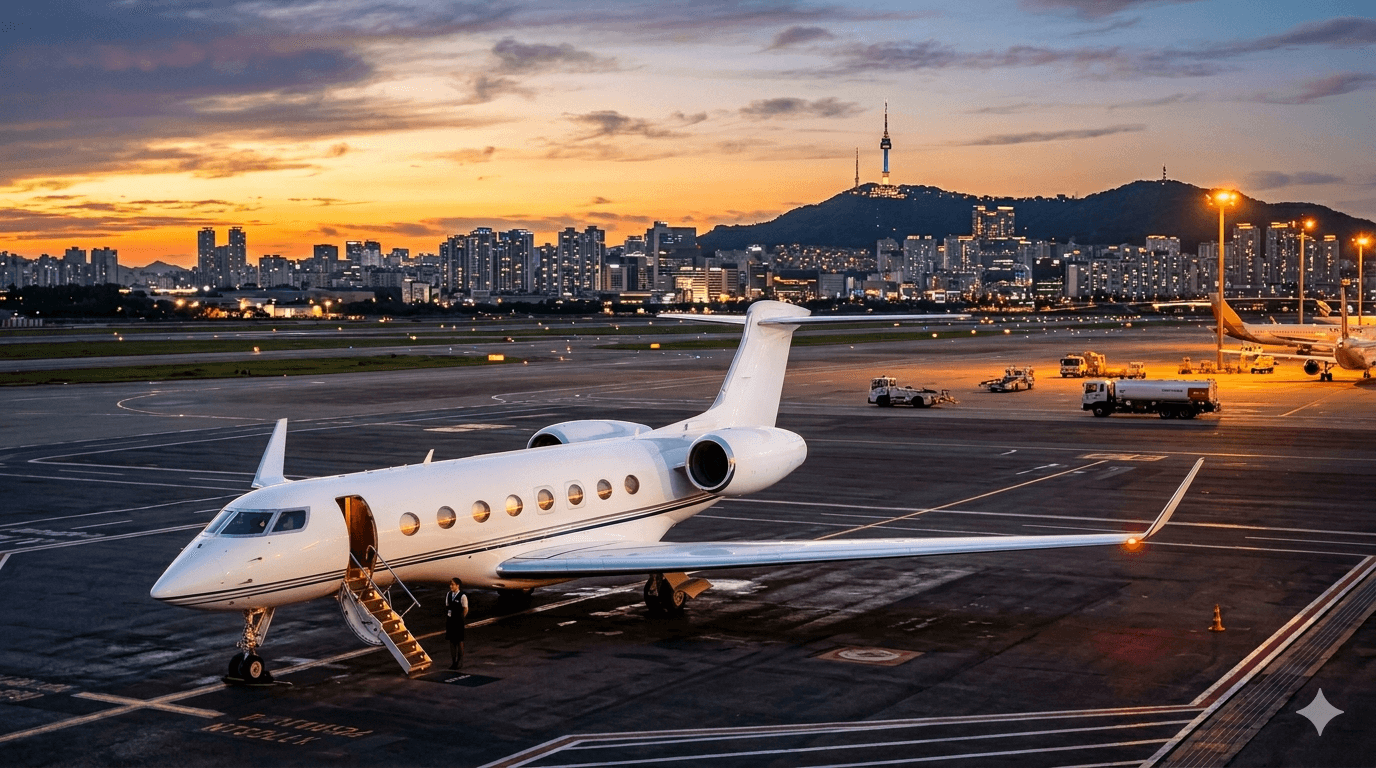
This is the single most popular private jet route in South Korea — and one of the busiest short-haul private corridors in all of Asia. The flight takes approximately 50 minutes, but the real time savings happen on the ground: no two-hour check-in buffer, no gate changes, no baggage carousel. At Gimpo's SGBAC terminal, you arrive 15 minutes before departure and walk directly to your aircraft.
Aircraft recommendation: A very light jet — HondaJet Elite, Cessna Citation M2, or Cirrus Vision Jet — is the most cost-effective option for this distance. Expect one-way pricing between $6,000 and $11,000. If your group exceeds five passengers or you need a more spacious cabin for an in-flight meeting, a light jet in the $9,000–$15,000 range is the next step up. For a deeper comparison of aircraft categories and how to match them to your mission, see our executive jet selection guide.
Who flies this route privately? Corporate groups heading to Jeju for off-sites and incentive retreats. Golf parties — Jeju's courses are world-class, and private charter eliminates the 4 a.m. scramble for early commercial flights. Families looking to maximize a short vacation window. And increasingly, bleisure travelers who combine a business engagement with leisure on the island.
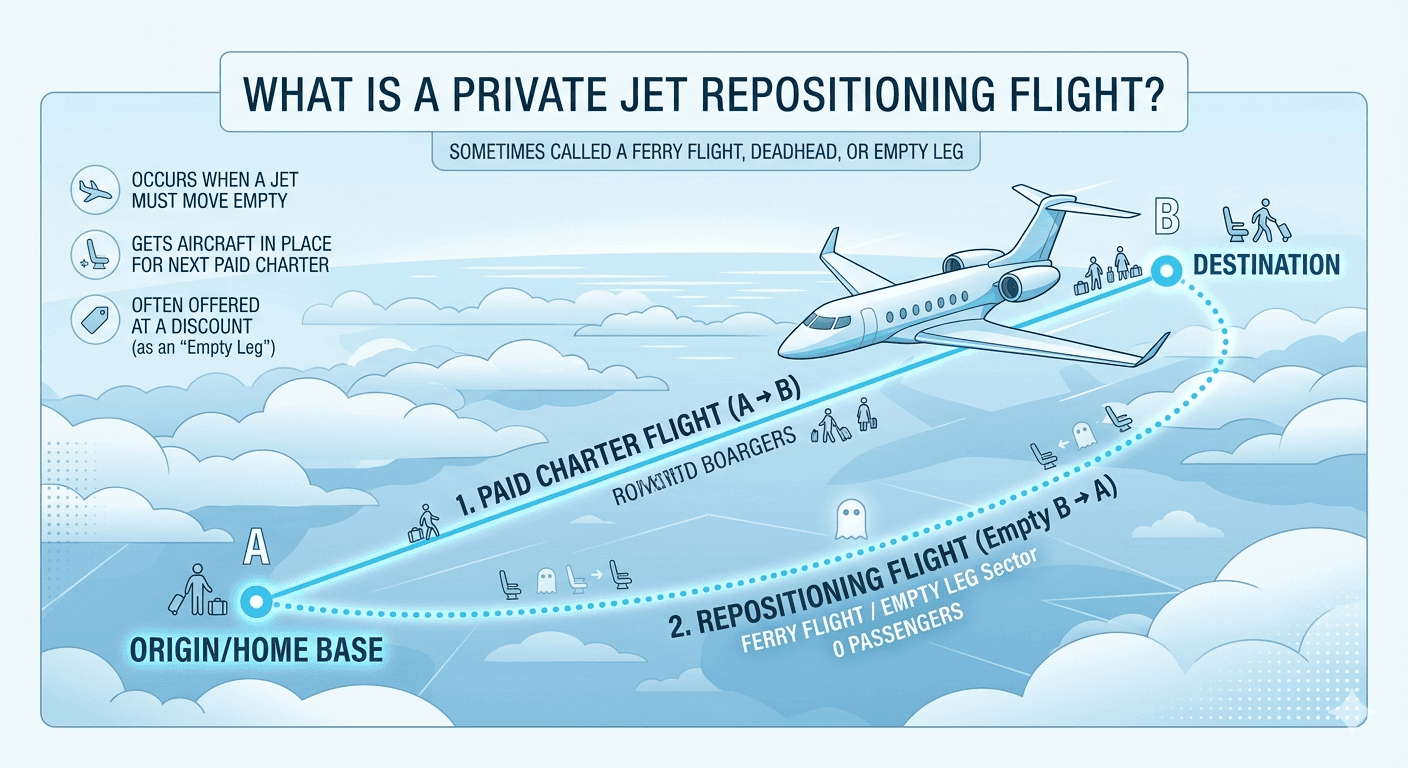
Practical note: Round-trip bookings on this route are especially cost-efficient because the aircraft is already positioned at Jeju for the return leg. On a one-way charter, the jet has to reposition empty — a cost that gets passed through. Book the round trip and you save 25–35%.
Seoul (Gimpo) to Busan / Gimhae
The flight is roughly 45 minutes. This route sees less private jet traffic than Gimpo-Jeju, but demand has been rising from executives who need to visit Busan's shipping, manufacturing, and tech clusters without losing half a day to ground transportation. The KTX high-speed train covers Seoul to Busan in about 2.5 hours — fast, but not fast enough when every hour has a dollar value attached to it.
Aircraft recommendation: VLJ or light jet. Pricing is comparable to the Jeju route.
Northeast Asia: The Bread-and-Butter International Routes
Seoul to Tokyo (Haneda or Narita)
Roughly two hours by private jet. This is the single most requested international route from Korean business travelers, and it perfectly illustrates why private aviation exists: a commercial round trip to Tokyo eats two full days when you factor in airport procedures, fixed departure times, and ground transfers. A private jet turns it into a same-day affair.
Aircraft recommendation: A light jet is the default for groups of six or fewer. The Embraer Phenom 300E and Cessna Citation CJ3+ both handle this route with ease and are well-represented in the Asian charter market. For larger groups or those who want a stand-up cabin, a midsize jet is the upgrade. One-way pricing runs $18,000–$30,000 for light jets, $26,000–$40,000 for midsizes.
Regulatory note: Japan's landing slot system is notoriously tight, especially at Haneda. Your broker needs to secure slots well in advance — last-minute booking for Tokyo is more complicated than most destinations in the region. This is one of many reasons why working with a Korea-based specialist who understands both Korean and Japanese aviation bureaucracies is worth the consulting investment.
Seoul to Shanghai / Beijing
Flight time is approximately 2–2.5 hours. China-bound charters from Korea carry additional complexity around overflight permits and landing permissions that require experienced handling. Lead times of one to two weeks are standard.
Aircraft recommendation: Light to midsize jet, depending on group size. Pricing falls in the same band as the Tokyo route.
Seoul to Taipei
About 2.5 hours. Taiwan has become a popular destination for Korean semiconductor and tech executives. Private charter demand on this corridor has increased notably since 2024. A light jet covers the distance comfortably.
Seoul to Osaka / Kansai
Just under two hours. This route sees strong seasonal demand from golf travelers and food-tourism groups. Kansai's airport is more accommodating for private jets than Haneda, making booking logistics smoother.
Southeast Asia: The Medium-Haul Sweet Spot
Seoul to Bangkok
Approximately 5.5 hours. Bangkok is the most popular Southeast Asian charter destination from Korea, driven by a mix of corporate travel, luxury leisure, and medical tourism. This is where the midsize and super-midsize categories earn their keep — long enough that cabin comfort matters, but not so far that you need a heavy jet.
Aircraft recommendation: A super-midsize jet — Bombardier Challenger 350 or Gulfstream G280 — is the ideal match. These aircraft offer near-heavy-jet cabin comfort at a materially lower hourly rate. One-way pricing ranges from $45,000 to $80,000 depending on the specific aircraft and availability. For cost structure details, our pricing guide for business travel to Korea provides a broader framework.
Seoul to Singapore
Around 6 hours. Singapore is a critical financial hub, and this route sees steady year-round demand from Korean banks, funds, and multinationals with APAC headquarters there. Range-wise, most super-midsize jets cover it nonstop, but fuel reserves should be confirmed at the quoting stage. Heavy jets offer guaranteed nonstop capability with ample margin.
One-way estimate: $60,000–$110,000.
Seoul to Ho Chi Minh City / Hanoi
About 5 hours. Vietnam has become South Korea's most significant manufacturing partner in Southeast Asia, and corporate charter demand reflects it. Samsung, LG, and their supplier networks generate consistent private aviation traffic on this corridor.
Seoul to Manila / Cebu
Approximately 4 hours. A growing route for both business (outsourcing sector) and leisure (beach resorts, diving). Light-to-midsize jets handle it efficiently.
Long-Haul: Crossing Oceans from Seoul
This is where aircraft selection becomes genuinely consequential. Choosing the wrong category on a 10-plus-hour route means either an unnecessary fuel stop (adding hours and cost) or paying for capability you don't need.
Seoul to Dubai
Roughly 9 hours nonstop on a heavy jet. The UAE corridor is significant for Korean construction and energy firms, as well as high-net-worth leisure travelers. Only heavy jets — G650ER, Global 7500, Falcon 8X — cover this distance nonstop from Seoul.
One-way estimate: $110,000–$220,000. The range depends heavily on specific aircraft availability and whether repositioning is required.
Seoul to London
About 11–12 hours nonstop, if the aircraft can access a direct routing. Here's where the Russian airspace question becomes material: a route through Russian airspace can shave 3–5 hours off the journey compared to southern alternatives. As of 2026, select operators are able to secure Russian overflight clearance for private jets — a development that has meaningfully changed the economics of this route. Ask your broker explicitly about routing options.
One-way estimate: $220,000–$440,000. This is the route where the round-trip discount matters most — booking both legs can save $100,000 or more by eliminating repositioning.
Seoul to Los Angeles / New York
LA is roughly 11 hours nonstop on a Global 7500 or G650ER. New York pushes the envelope at 13–14 hours and may require a tech stop in Anchorage or a Pacific routing depending on winds and aircraft type. Very few aircraft have the range to make Seoul–JFK nonstop under all conditions.
One-way estimate: $300,000–$520,000 for the West Coast. East Coast adds $50,000–$100,000.
Who flies these routes privately? C-suite executives who need to arrive ready for a board meeting, not jet-lagged from 14 hours in a commercial seat. Global corporations with leadership teams that measure time in deal-outcome terms. And occasionally, entertainment industry clients — our case study on large-scale tour logistics illustrates the scale of planning involved.
Specialty Routes and Use Cases
Air Ambulance / Medical Evacuation
Private jet charter for medical transport is a category unto itself. Speed is the dominant variable — every hour matters. Air Charter Korea coordinates medical evacuation flights with dedicated air ambulance operators who equip aircraft with ICU-grade medical equipment and onboard medical personnel. These missions require expedited permit processing and priority slot allocation, which is where a broker's relationships with aviation authorities become critical.
Heavy-Lift Cargo Charter
Not all private aviation involves passengers. Korean industry — particularly semiconductor manufacturing, automotive, and shipbuilding — regularly requires time-critical cargo flights for oversized or sensitive equipment. Our heavy-lift cargo guide details the aircraft types and logistics involved.
Pet-Friendly Private Charter
Traveling with animals on commercial airlines is stressful at best and dangerous at worst, particularly for brachycephalic breeds. Private charter eliminates the cargo hold entirely — your pet flies in the cabin with you. We've written extensively about the logistics of pet travel on private jets, including quarantine considerations for international destinations.
ESG-Aligned Charter Solutions
For corporations with sustainability commitments, the carbon footprint of private aviation is a legitimate concern. Green corridor programs and ESG consulting can help companies offset emissions, select newer and more fuel-efficient aircraft, and align their travel policies with published sustainability targets.
Why the Departure Airport Matters
Most international private flights from Korea depart from one of two airports, and the choice isn't arbitrary.
Gimpo International Airport (RKSS)
Gimpo is the preferred departure point for domestic flights and short-haul international routes. Its proximity to central Seoul — roughly 25 minutes by car — and its purpose-built business aviation terminal (SGBAC) make it the most efficient option for anything that doesn't require an ultra-long runway. The SGBAC experience is radically different from a commercial terminal: dedicated CIQ, private lounges, and a car-to-cabin walk measured in meters, not terminal corridors.
Incheon International Airport (RKSI)
Long-haul international flights on heavy jets typically originate at Incheon, where runway length and 24-hour operations accommodate the larger aircraft used on intercontinental routes. The drive from central Seoul to Incheon takes 50–70 minutes, which adds ground time — a trade-off against the operational requirements of heavy-jet departures.
The UAM Bridge
Looking ahead, the convergence of Urban Air Mobility and private aviation promises to compress the Seoul-to-airport leg from an hour-plus drive to a 15-minute eVTOL hop. When that infrastructure comes online, the total door-to-door time equation for private jet travel from Korea will improve dramatically.
How Air Charter Korea Approaches Route Planning
At Air Charter Korea, we operate on a principle that most charter brokers don't: independence. We are not locked into an exclusive agreement with any single operator or fleet. Instead, we maintain strategic partnerships with multiple global aviation companies — including Air Charter Service, the world's largest charter brokerage, and Victor, a leading charter platform — so that every quote we present reflects the broadest possible market.
For every route inquiry, we deliver a minimum of three competitive quotations, each with a different aircraft option and operator. This isn't a policy buried in fine print — it's the foundation of our consulting model. We believe the only way to guarantee the best conditions for our clients is to ensure they're choosing from a genuinely competitive field.
Our team's expertise was built at Korea's top airline, managing air transportation and private jet charter operations before founding ACK. That operational background — combined with our global network — means we understand both the regulatory intricacies of Korean airspace and the commercial realities of the international charter market.
If you're evaluating a specific route, start a conversation with our team. We'll scope the mission, present options, and let the numbers speak for themselves.
Frequently Asked Questions
What is the fastest route from Seoul for a same-day international business trip?
Seoul to Tokyo (Haneda) is the most practical same-day round-trip by private jet — roughly two hours each way with minimal time lost to airport procedures. Seoul to Osaka, Shanghai, and Taipei are also feasible for same-day returns depending on meeting schedules.
Can I charter a one-way flight and find an empty leg for the return?
It's possible but not guaranteed. Empty legs depend on other clients' bookings and repositioning schedules. We monitor availability continuously and will flag relevant options, but planning both legs as a round-trip charter is the most reliable approach — and often the most cost-effective.
Do I need a visa or special documentation for private jet travel?
Private jet passengers clear the same immigration and customs requirements as commercial travelers. The difference is where and how: at Gimpo SGBAC, CIQ processing is dedicated and fast. Your broker handles landing permits and overflight clearances; you handle your passport and any destination-country visa requirements.
How does pricing change between peak and off-peak seasons?
Peak periods — Lunar New Year, Chuseok, summer holidays, and major K-pop tour windows — tighten aircraft availability, which pushes pricing up. The increase varies by route and aircraft category but can run 15–30% above off-peak rates. Booking two to four weeks ahead during peak windows is strongly recommended.