When the Gear Can't Miss the Shot — The 2026 Film & Production Charter Guide for Overseas Location Shoots

A day on a location shoot moves in six figures. Cast and crew day rates, equipment rentals, location fees, local production costs — lose a day of the schedule and the damage dwarfs any airfare. Yet those six-figure schedules collapse, surprisingly often, at the most mundane point in the journey: the moment a camera case disappears from a checked-baggage carousel, the shoot stops.
With K-content productions now shooting all over the world, global production companies charter jets for gear and crew not as a luxury but as insurance — insurance on the equipment, and insurance on the schedule. This guide covers how film and production charter actually works — equipment logistics, direct flights to remote locations, and customs (the ATA Carnet) — from a practical perspective on private jet charter from Korea.

Quick Summary
Topic | Key Point |
|---|---|
The essence | Production charter = insurance on gear and schedule (a lost day costs six figures). |
Gear risk | Checked-equipment loss halts the shoot — charter keeps gear on the crew's aircraft. |
Remote locations | Deserts, steppe, islands — fly gear straight to strips airlines never serve. |
Customs | ATA Carnet temporary-import rules still apply — faster, never waived. |
Big crews | 20+ crew or artist tours: see the group charter guide. |
Booking | Air Charter Korea quotes from your equipment list, with competing operators. |
Why Productions Charter — Three Risk Calculations
1. Gear risk — some things don't belong on a carousel
Cinema camera bodies, lens sets, lighting, grip, drones — production equipment travels as dozens of hard cases. Checking them on airlines stacks loss, delay and damage risk, and every connection multiplies the odds. One irreplaceable case arriving a day late leaves an entire set burning six figures while it waits. On a charter, the gear flies on the same aircraft as the crew — never out of sight for a moment.
2. Schedule risk — one cancellation topples the location dominoes
A location shoot is a row of dominoes set date by date: filming permits, location rentals, local crews, cast availability. One airline cancellation pushes the whole row, and the recalculation costs are hard to bound. With a charter, the aircraft waits when the shoot runs long and leaves early when it wraps — the flying follows the schedule, not the other way around.
3. Access risk — the best frames have no airport
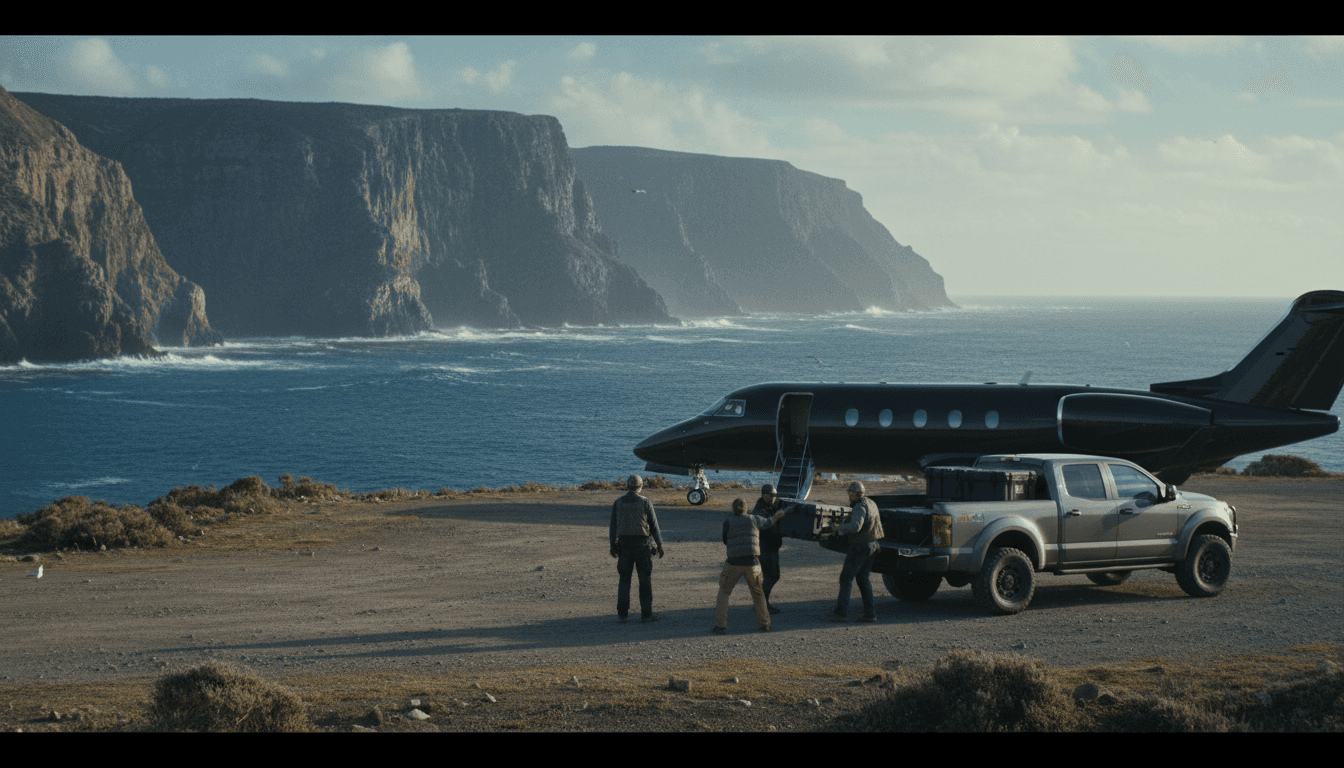
The shots directors want are usually beyond the route map — Mongolian steppe, deserts, remote coastlines, islands. What takes a scheduled flight plus two days overland, a charter folds into one direct flight to the nearest strip. See how remote-strip operations work in our Mongolia route guide.
Gear Logistics — the Case List Chooses the Aircraft
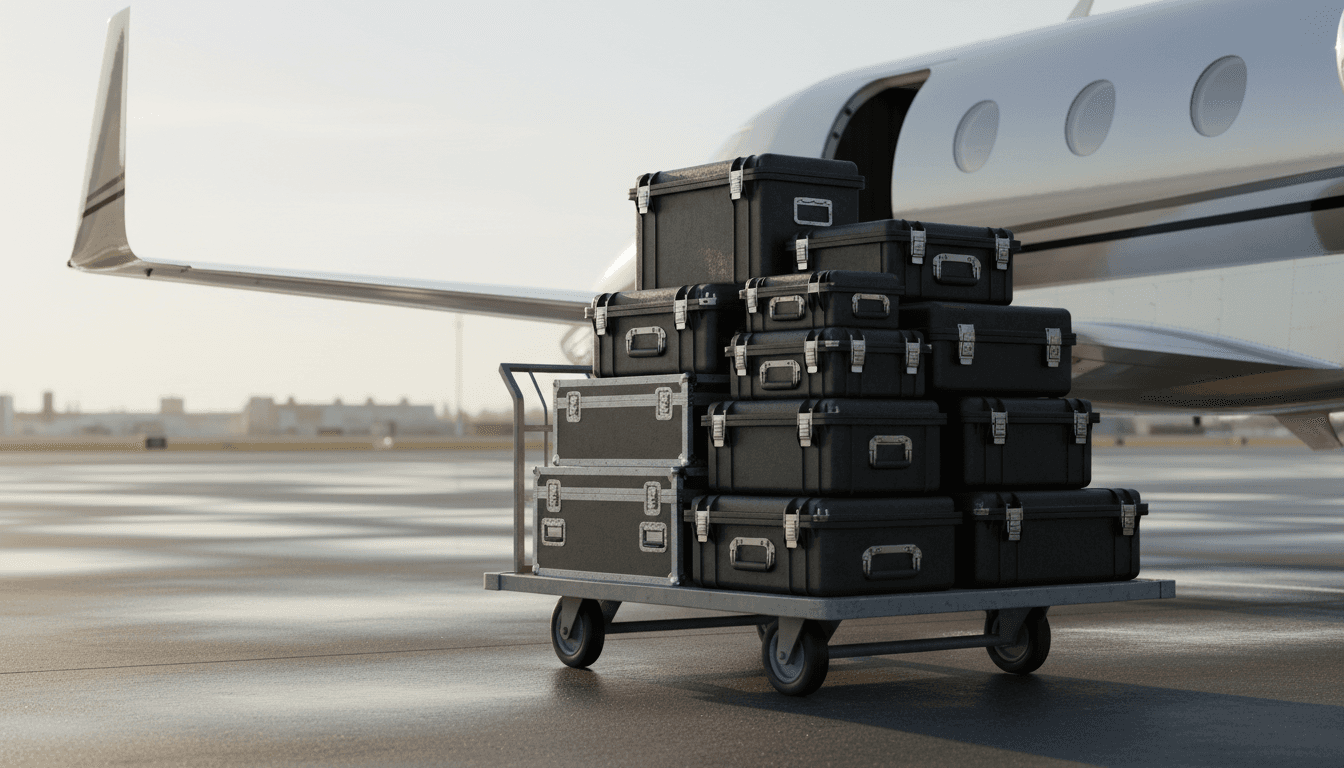
A production charter quote starts not with headcount but with the equipment list. Case counts, dimensions and weights drive the compartment-volume and weight-and-balance math that selects the aircraft — the "it's an aircraft question, not a rules question" principle from our luggage guide, turned into the whole job. As a rough feel: midsize to super-mid handles 6–8 crew with 20–30 cases; beyond that, large-cabin or a cargo combination comes into play (approximate, confirmed at quote stage).
Did you know?
Professional film equipment usually crosses borders on an ATA Carnet (temporary-import document). Charter doesn't waive customs — but at a private terminal, a thirty-case carnet inspection happens without carousels or crowds, along a flow pre-arranged with the ops team. It's the "procedures relocate, not disappear" principle from our immigration guide.
The Cabin as a Flying Pre-Production Room
Flight time is often the only window when everyone is in one room. Director, DP and ADs run storyboard reviews, shot-order changes and location briefings in the cabin, and the team lands ready to set up. On satellite-Wi-Fi aircraft, a video check-in with the local production is realistic too — see our inflight Wi-Fi guide. And the rest and privacy of cast and director aren't perks here — condition before the camera rolls is the product.

Airlines vs Production Charter
A realistic comparison for overseas location work. Details vary by schedule, equipment and route, confirmed at quote stage.
Factor | Airlines | Production Charter |
|---|---|---|
Equipment custody | Checked — loss/delay/damage risk, worse with connections | Same aircraft as the crew, always in sight |
Cancellation impact | Location dominoes topple; recovery costs balloon | The flying follows the shooting schedule |
Remote locations | Hub connection plus days overland | Direct to the nearest airstrip |
Crew condition | Arrive drained from transfers and queues | Rest and brief onboard, set up on arrival |
Security & privacy | Public airports — casting and schedule leaks | Private terminal, manifest stays private |
The nature of the cost | Cheap tickets, uninsured delay risk | A bigger airfare that insures a six-figure schedule |

Pre-Quote Checklist for Production Charters
1. Equipment list first — case counts, dimensions and weights start the quote. The more precise the list, the sharper the aircraft match and price.
2. Declare batteries and drones early — aviation dangerous-goods rules apply to charters too. Share quantities and capacities at booking.
3. Build carnet lead time — ATA Carnet issuance and destination-customs coordination run smoothest when arranged with the ops team in advance.
4. Verify the location strip — runway length and surface decide the aircraft. Share location coordinates at quote stage.
5. Over 20 people? Go group charter — large crews and artist tours belong on BBJ/ACMI solutions; see the group charter guide.
Estimate costs with the private jet cost calculator, and browse flight times in the routes from Seoul guide.
Frequently Asked Questions (FAQ)
How much filming equipment can a charter carry? Whatever the aircraft's compartment allows. As a rough feel, midsize to super-mid handles 6–8 crew with 20–30 cases; share the equipment list for an exact answer at quote stage.
Can we bring drones and lithium batteries? Aviation dangerous-goods rules apply to charters too. Declare quantities and capacities at booking and the ops team arranges compliant stowage.
How does customs (the carnet) work? ATA Carnet temporary-import procedures apply exactly as on airlines — just faster, along a pre-arranged private-terminal flow.
What if the shoot runs long and the return slips? That's charter's core advantage — the flying follows the schedule. Change terms vary by contract; confirm flexibility at quote stage.
We're a crew of 25 — possible? At that scale, BBJ/ACMI group charter is the right tool. See the group charter guide or ask us directly.
Conclusion — Not Airfare. A Premium on the Schedule.
The production-charter math is simple: if a set day costs six figures, the flight that protects it is insurance, not expense. Gear on the crew's own aircraft, flying that follows the shooting schedule, locations reached by their nearest strip — this is the logistics standard for the era of K-content shooting worldwide. Air Charter Korea is an independent consultancy tied to no single operator — we verify equipment loads and location runways, and present at least three competing quotes from vetted operators.
Have an overseas shoot on the calendar? Send the equipment list with your dates below, and we'll return a production-ready quote — cargo hold included in the math.
✈️ Request a Private Jet Charter Quote — Air Charter Korea
Just send your equipment list — we'll quote with cargo capacity, remote strips and carnet flow all factored in.
📞 Wonjin Choi +82-10-7723-3177 | ✉️ contact@aircharterkorea.com
🛬 Incheon Airport VIP Concierge — BestTurn
Cast or executives flying commercial? Add immigration escort, lounge and baggage concierge as an optional service.
📞 Steve (Team Lead) +82-10-3721-2853 | ✉️ service@bestturnaround.com | See VIP Concierge
Author · Wonjin Choi — Former Korean Air Business Jet Operations Manager · Former Samsung Electronics Business Jet Account Manager
Profile: LinkedIn | Air Charter Korea Company Page
Published · July 24, 2026