Private Jet Operating Cost 2026: The Complete Breakdown of Super-Midsize Annual Expenses, Savings Strategies & 5-Year Simulation
Published: May 22, 2026 | Read time: 18 minutes | Format: Aircraft ownership operating cost analysis
💼 This page is for:
✔️ Buyers 6–18 months into ownership evaluation asking "what does this cost every year"
✔️ Existing owners looking to reduce next year's operating expenses
✔️ Family offices needing a 5-year operating simulation on super-midsize or heavy aircraft
✔️ Anyone who wants private jet operating cost, maintenance reserves, management fees, and fuel optimization on the same page
✔️ Buyers wondering how "private jet" pricing actually differs from "commercial aircraft"
This page breaks down 5-year ownership operating cost by category — and how to manage each one.
→ ACK operating cost simulation (Wonjin Choi 📞 +82-10-7723-3177)
Private Jet Operating Cost 2026: The Complete Breakdown of Super-Midsize Annual Expenses, Savings Strategies & 5-Year Simulation
The first question an HNW buyer asks before acquiring an aircraft isn't "what's the purchase price?" — that gets answered the moment a listing comes up. The real question is the one that shapes the next five to ten years: "what does it cost to operate every year, and how do I manage that?" Aircraft acquisition differs from buying a car in one fundamental way — the five-year operating cost runs higher than the purchase price for most owners. A $25M super-midsize aircraft generates $7.5M–$11M of operating cost over five years — roughly 30–45% of the airframe value itself.
What's been missing in the Korean market is a single document that breaks operating cost down by category, calibrated to actual Korean operating conditions — Gimpo SGBAC infrastructure, Korean maintenance ecosystems, the flight patterns Korean principals actually run. Global reference materials (NetJets and VistaJet operating-cost whitepapers) are calibrated to U.S. and European conditions; domestic content tends to fragment into isolated pricing data points. The result is that the most consequential dataset in an ownership decision often arrives last in the evaluation.
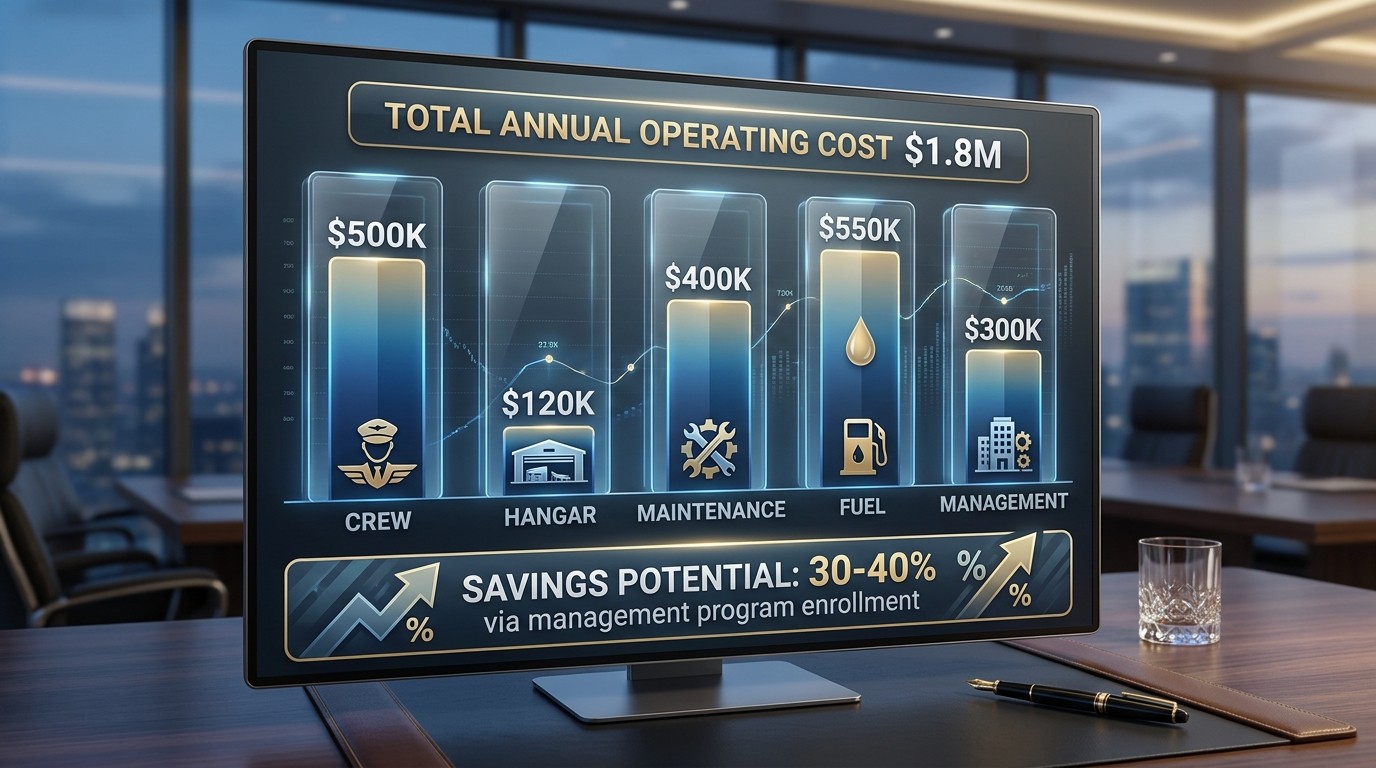
This page fills that gap. The standard assumption: super-midsize aircraft (Challenger 350 or G280 class), operated at 200 hours annually from Korea. Under that standard case, we break operating cost into the five categories that matter — crew compensation, hangar and parking, maintenance and insurance, fuel and navigation, aircraft management fees — and analyze each line item: how much, why, and where the operator-level discretion lives. Then we layer in the savings strategies that owners actually use in years one through three to reduce annual operating cost by 30–40%. Finally, a 5-year cumulative simulation comparing three operating models — ownership, charter, and ownership with charter pool registration — gives buyers the math to pick the model that fits.
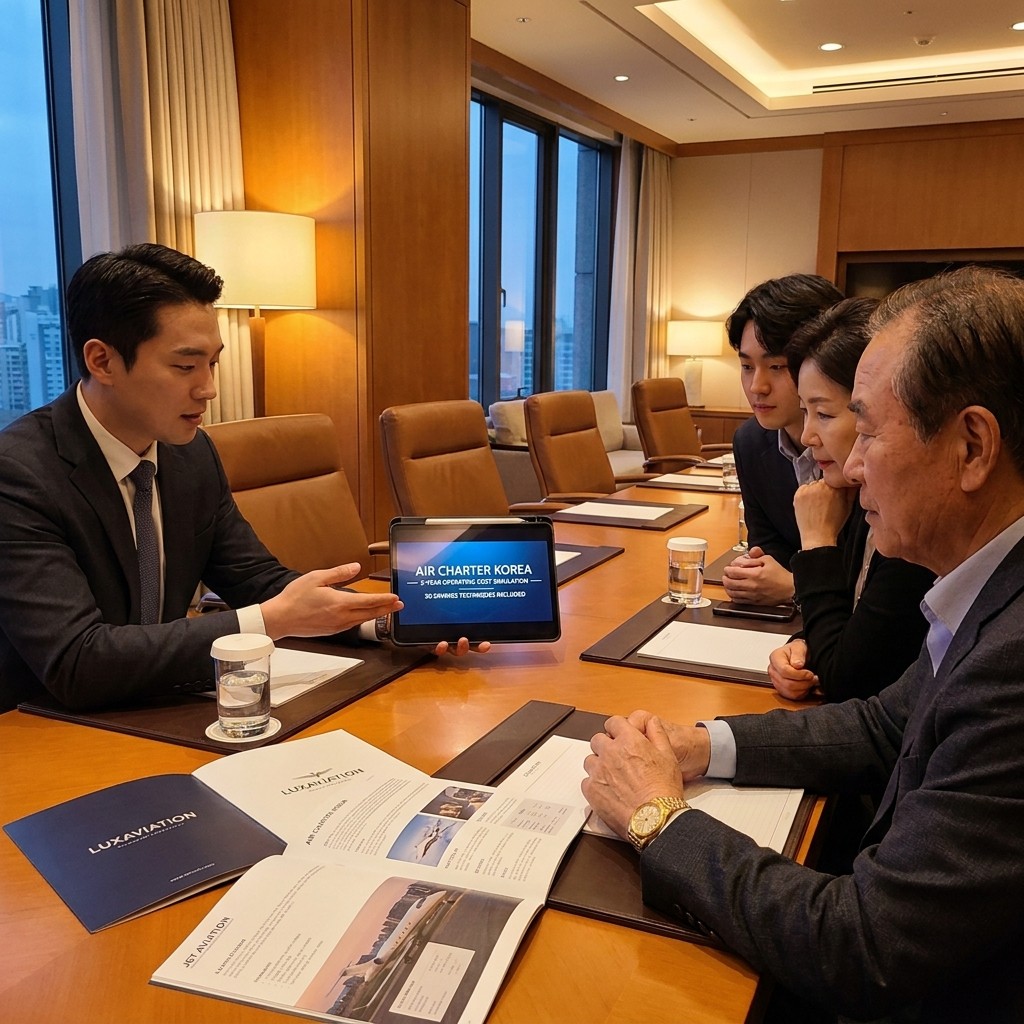
Air Charter Korea (ACK)'s founder Wonjin Choi — Former Korean Air Business Jet Operations Manager — compiled this from the inside view of how business aviation actually runs in Korea, combined with operating data from Aircraft Management firms, maintenance providers, and charter pools globally. ACK works the full vertical: from single-flight private jet charter and pricing through aircraft acquisition into 5-year operating cost advisory, for the same Korean HNW principals across all stages.

⚡ ACK operating cost simulation — free 5-year analysis
Send target aircraft category, projected annual flight hours, and hangar preference. You'll receive a five-category annual operating cost breakdown, 5-year cumulative simulation, and 30 line-item savings strategies within two weeks. NDA up front.
📧 contact@aircharterkorea.com | 📞 Wonjin Choi +82-10-7723-3177
→ Free operating cost simulation
1. Super-Midsize Annual Operating Cost — Five Categories at a Glance
Category | Annual (USD) | % of Total | Variability |
|---|---|---|---|
① Crew compensation | $400K–$600K | 25–30% | Fixed (independent of flight hours) |
② Hangar and parking | $80K–$150K | 5–8% | Fixed |
③ Maintenance and insurance | $300K–$500K | 20–25% | Semi-fixed (partial flight-hour exposure) |
④ Fuel and navigation (200hr) | $400K–$700K | 25–30% | Variable (flight-hour proportional) |
⑤ Aircraft management fees | $200K–$400K | 10–20% | Fixed or hourly-based |
Total annual operating (super-mid, 200hr) | $1.5M–$2.2M | 100% | ±15% variance |
Critical observation: roughly 50% of total cost (crew + hangar + management) is fixed — it bills the same whether the aircraft flies 1 hour or 300 hours a year. At under 100 flight hours, the effective hourly rate sits 2× above the charter market rate; the breakeven against charter only starts forming above 200 flight hours annually. We'll work through each category below.
2. ① Crew Compensation — The Largest Fixed Line Item
Standard super-midsize crew composition
Super-midsize (Challenger 350, G280 class) operates with a three-person crew: Captain (PIC), First Officer (SIC), and Cabin Attendant. Heavy aircraft (G650ER and above) typically add a second cabin attendant for four crew total.
Position | Compensation Range (USD) | Requirements |
|---|---|---|
Captain (PIC) | $180K–$280K | ATPL, type rating, 4,000+ hours |
First Officer (SIC) | $120K–$180K | CPL/ATPL, type rating, 1,500+ hours |
Cabin Attendant | $60K–$120K | Business aviation cabin certification, multilingual |
Super-midsize 3-crew annual | $360K–$580K | + benefits and training $40K–$80K |
Direct employment vs management outsourcing
Owner direct employment
Strengths: dedicated crew, consistent security and family privacy handling, 24-hour call response
Weaknesses: recruitment, training, benefits, and rotational crew sit entirely on the owner. Compensation accrues even during maintenance downtime.
Annual crew cost: approximately $500K–$700K (3 crew + rotation + benefits)
Aircraft management outsourcing
Strengths: 15–25% lower crew costs through pooled recruitment. Management firm handles hiring, training, and rotation. Maintenance downtime doesn't fully accrue crew cost.
Weaknesses: crew may be shared across multiple aircraft — dedicated assignment is an additional charge.
Annual crew cost: approximately $400K–$550K (15–20% reduction)
Crew cost savings playbook ★
Aircraft management outsourcing: 15–25% savings versus direct employment
Charter pool offset: when the aircraft operates on charter, crew costs are partially recovered through charter revenue
Korean national crew: 15–20% lower compensation than expatriate crew, with no separate translation costs
Contract cabin attendant model: for super-midsize at under 100 annual hours, contract cabin attendant arrangements save $30K–$50K annually
3. ② Hangar and Parking — The Reality of Korean Infrastructure
Korean hangar options
Airport | Hangar Availability | Annual Hangar Fee (Super-Mid) | Profile |
|---|---|---|---|
Gimpo SGBAC (Seoul Gateway) | Korean business aviation standard | $100K–$150K | ~70% of Korean HNW owners. 30-minute access to central Seoul. |
Incheon Airport | Limited | $60K–$100K | International route advantage |
Cheongju Airport | Available | $40K–$70K | Outer Seoul — 30-min reposition flight, meaningful savings |
Indoor vs outdoor parking | Selectable | Indoor +30–50% premium | Weather exposure; direct impact on aircraft residual value |
Hangar selection decision points
Access time: SGBAC is 30 minutes from Gangnam or Yeouido; Cheongju is 90 minutes to 2 hours. High-frequency users default to SGBAC.
Indoor storage: Korean weather (summer heat, winter wind and snow) makes indoor storage materially better for interior, paint, and avionics. Residual value impact is real.
FBO ancillary services: SGBAC handles catering, crew lounge, VIP lounge, and passenger area in one location. Outer airports add separate costs.
Hangar cost savings playbook ★
Frequency-based allocation: under 100 annual hours, splitting between SGBAC for active use and outer-airport storage saves $40K–$60K annually
Multi-year contracts: 3+ year hangar contracts unlock 5–10% rate concessions
Outdoor with aircraft cover: some residual-value trade-off, but outdoor parking with full aircraft cover saves $30K–$50K annually
Detailed Korean airport business aviation infrastructure: Korea Airport Private Jet Guide.
4. ③ Maintenance and Insurance — The Residual Value Foundation
What maintenance cost is actually made of
Aircraft maintenance cost has four moving parts: (1) scheduled maintenance (A-Check, B-Check, C-Check, D-Check), (2) unscheduled work (parts replacement, systems repair), (3) engine overhauls, (4) insurance premiums.
Maintenance Type | Interval | Super-Midsize Event Cost (USD) | Annualized |
|---|---|---|---|
A-Check (line maintenance) | 200–600 hours | $15K–$30K | $30K–$60K |
C-Check (heavy maintenance) | 12–24 months | $100K–$250K | $50K–$125K |
Engine overhaul | 5,000–7,500 hours | $1M–$3M | $100K–$200K |
Unscheduled (average) | Continuous | Variable | $50K–$100K |
Insurance (Hull + Liability) | Annual | $70K–$150K | $70K–$150K |
Total annual maintenance and insurance | $300K–$635K | Average $400K |
Why engine maintenance programs are non-negotiable
A single engine overhaul on a super-midsize runs $1M–$3M. It hits once every 5–7 years and lands directly on residual value. The professional way to manage this risk is through an engine maintenance program — operators set aside a per-hour amount during the operating life, and the program covers the overhaul when it comes due. It functions essentially as engine insurance.
Maintenance Program | Coverage | Per-Hour Accrual (USD) | Scope |
|---|---|---|---|
JSSI | All aircraft types | $300–$700/hour | Engine + airframe + systems |
Honeywell MSP | Honeywell engines | $250–$500/hour | Engine + APU |
Rolls-Royce CorporateCare | Rolls-Royce engines | $300–$600/hour | Engine + parts replacement |
Pratt & Whitney ESP | P&W engines | $250–$450/hour | Engine |
Maintenance cost savings playbook ★
Maintenance program enrollment (essential): JSSI, MSP, or CorporateCare depending on engine type. Saves 10–15% on average maintenance cost, eliminates catastrophic event exposure, and adds approximately 20% to residual value at sale.
Digital maintenance records from day one: from Pre-Buy Inspection forward, all maintenance records digitized. Adds 5–10% to disposition value.
OEM-authorized service centers: Gulfstream, Bombardier, Dassault factory-authorized facilities preserve residual value.
C-Check timing negotiation: off-season slots (year-end, summer-end) unlock 10–15% concessions on maintenance pricing.
5. ④ Fuel and Navigation — The Variable Cost Center
Super-midsize per-hour fuel consumption
A Challenger 350 burns approximately 240–280 gallons of jet fuel per hour. With global average jet fuel pricing around $5–$7 per gallon as of May 2026, that's an hourly fuel cost of roughly $1,200–$1,960.
Item | Per Hour (USD) | 200-Hour Annual |
|---|---|---|
Fuel | $1,200–$1,960 | $240K–$392K |
Navigation (Eurocontrol, FAA) | $200–$500 | $40K–$100K |
Landing fees (200 landings assumed) | $500–$1,500/landing | $100K–$200K |
Other (overflight, communications) | $50–$150 | $10K–$30K |
Total fuel and navigation | $1,950–$4,110 | $400K–$700K |
Fuel cost savings playbook ★
Aircraft management global fuel agreements: Luxaviation, Jet Aviation, ExecuJet and similar firms negotiate annual volume contracts running into thousands of tons. Per-gallon pricing runs 10–20% below spot rates. Automatic when outsourcing management.
Fuel-efficient flight planning: direct routings, avoiding half-empty repositioning legs, optimized altitude and speed profiles — 5–10% fuel burn reduction.
SAF (Sustainable Aviation Fuel) consideration: 2–3× the price of conventional jet fuel, but increasingly relevant for corporate-owned aircraft with ESG reporting requirements. Some EU operations now mandate minimum SAF blends.
Landing fee management: outer airports (Incheon, Cheongju) instead of premium SGBAC saves $300–$600 per landing.
6. ⑤ Aircraft Management Fees — What Outsourcing Actually Covers
What aircraft management firms handle
About 85% of Korean HNW principals outsource operations to aircraft management firms. The standard scope:
Crew management: hiring, training, benefits, rotation
Maintenance management: A-Check, C-Check scheduling + service center matching + program administration
Flight operations: ATC permits, flight planning, navigation communications
Fuel and navigation: cost optimization through volume agreements
Insurance management: Hull and Liability policy renewal + claims handling
Charter pool operations (optional): registering the aircraft into the charter market during owner non-use periods to generate revenue
Accounting and tax: operating cost reconciliation, VAT, depreciation
Major global aircraft management firms
Firm | Managed Fleet | Annual Fee (Super-Mid, USD) | Profile |
|---|---|---|---|
Luxaviation (ExecuJet) | ~250 aircraft | $250K–$400K | Global #1, strong Asia footprint |
Jet Aviation | ~300 aircraft | $280K–$420K | FBO + MX + management + charter full stack |
TAG Aviation | ~180 aircraft | $240K–$380K | European depth |
Gama Aviation | ~200 aircraft | $220K–$360K | Middle East + Asia bases |
Korean domestic operators (KCASA AOC) | ~10–30 aircraft | $180K–$300K | Korean-language service, local aviation law fluency |
Management fee savings playbook ★
Charter pool integration: management + charter pool bundled lets management fees get partially offset against charter revenue. Heavy charter utilization can effectively zero out the management line.
Fixed vs hourly fee structure: under 200 annual hours, fixed-fee structures price better; above 300 hours, hourly-fee structures become more favorable.
Korean operator consideration: domestic Korean AOC operators run 10–25% below global pricing, with Korean-language service and local maintenance infrastructure as bonuses.
3-year contract negotiation: multi-year commitments unlock 5–10% rate reductions versus annual contracts.
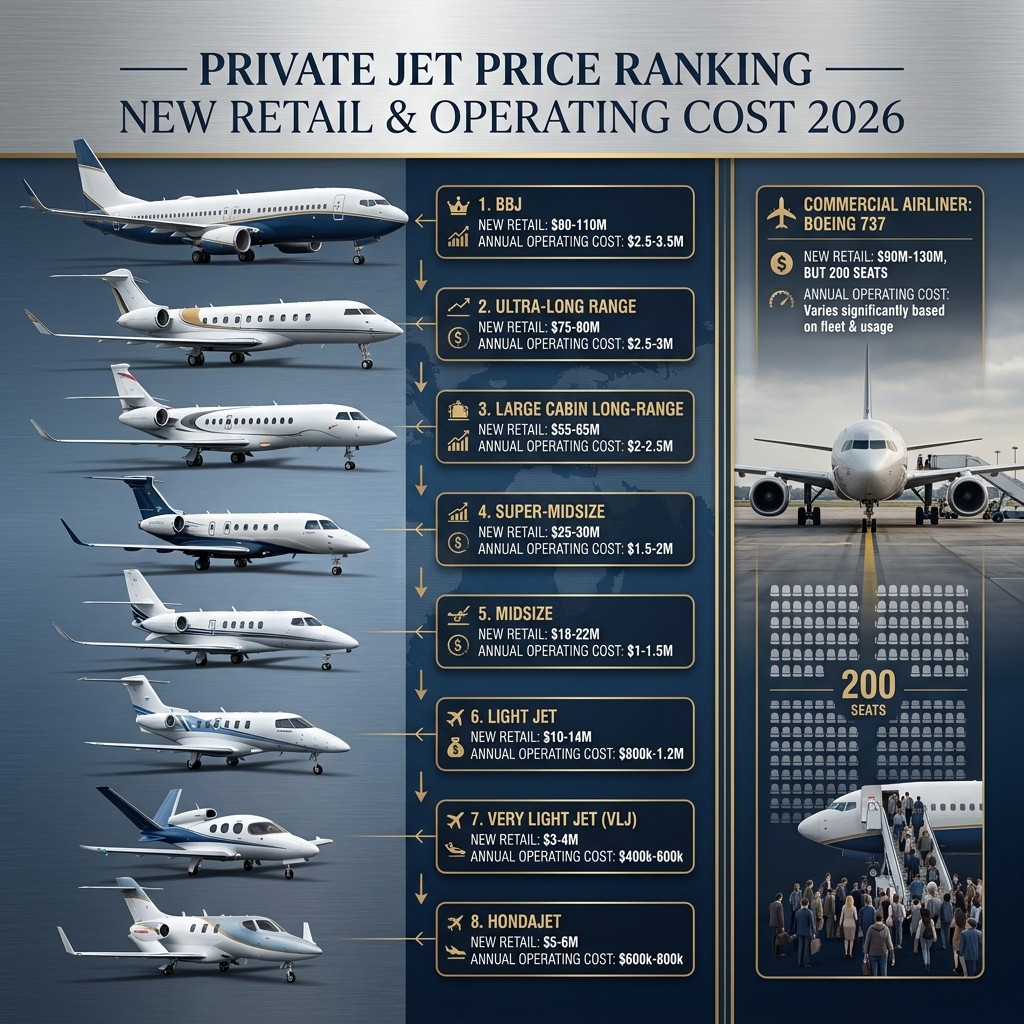
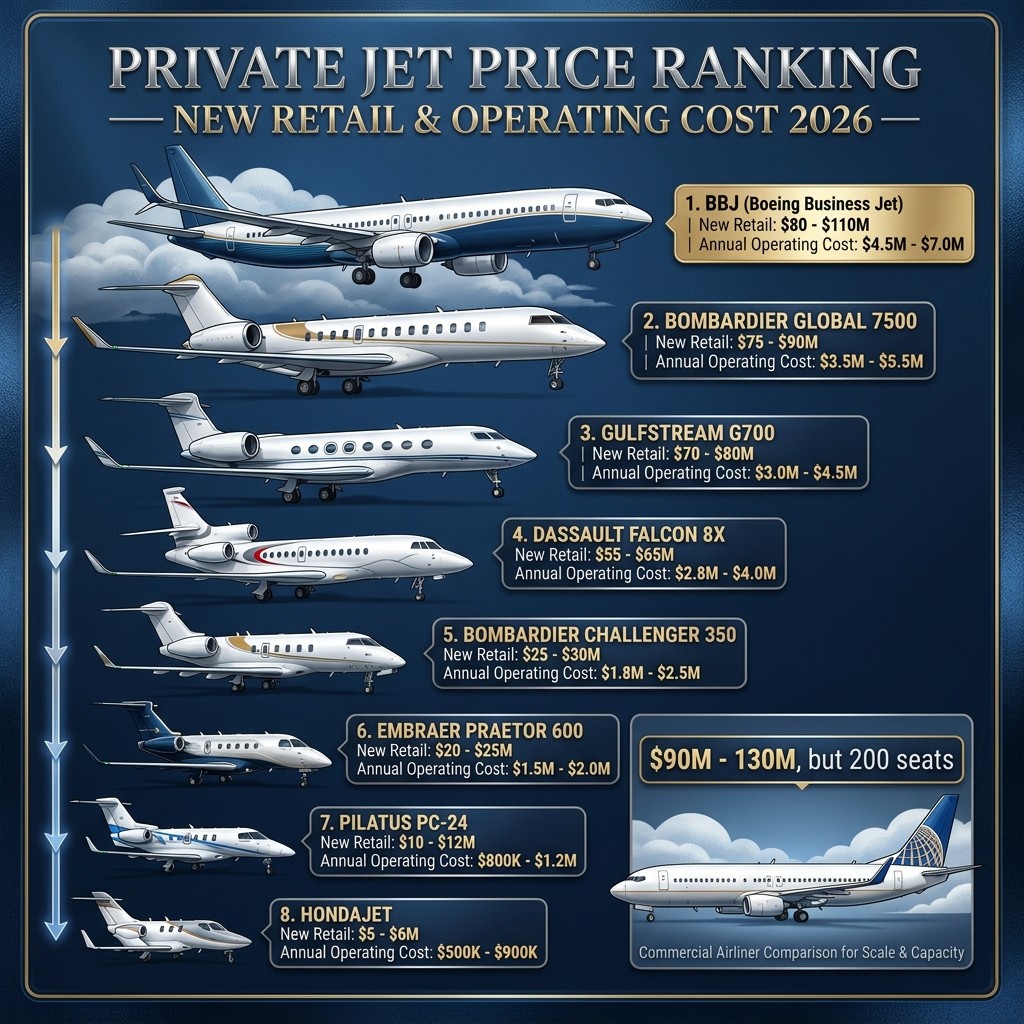
7. Private Jet Price Ranking — Aircraft Cost Hierarchy
New retail price and operating cost ranking
Rank | Aircraft | New Retail (USD) | Annual Operating (200hr) |
|---|---|---|---|
1 | BBJ (Boeing 737 BBJ MAX) | $80M–$110M | $5M–$7M |
2 | Global 7500 / Falcon 10X | $80M–$90M | $4M–$5M |
3 | Gulfstream G650ER | $70M–$78M | $3.5M–$4.5M |
4 | Gulfstream G600 / Falcon 8X | $50M–$60M | $2.8M–$3.5M |
5 | Challenger 350 / G280 (super-midsize) | $27M–$30M | $1.5M–$2.2M (Korean favorite) |
6 | Citation Latitude / Praetor 600 | $20M–$22M | $1.2M–$1.7M |
7 | Phenom 300E | $10M–$12M | $800K–$1.1M |
8 | HondaJet Elite II | $5M–$6M | $550K–$750K |
Why super-midsize is the Korean HNW entry point
About 60% of Korean HNW first-time owners enter through a 5–10 year old pre-owned super-midsize (Challenger 350 or G280) priced at $15M–$22M with $1.5M–$2.0M annual operating. From the buyer's perspective, that's the cleanest balance between asset deployment and operational efficiency at the entry level. New versus pre-owned analysis: Where to Buy a Private Jet Guide.
8. Private Jet vs Commercial Aircraft — The Economics Side by Side
Same category of asset, completely different economic model
Search "aircraft price" and you get the Boeing 737 (commercial airliner) at $90M–$130M next to a super-midsize business jet at $27M–$30M. They're both aircraft, but the 4× pricing difference reflects fundamentally different operating models.
Comparison | Commercial Airliner (B737 MAX) | Private Jet (Challenger 350) |
|---|---|---|
New retail | $90M–$130M | $27M–$30M |
Capacity | 160–200 passengers | 8–10 passengers |
Cost per seat | $500K–$700K | $3M–$4M |
Hourly operating cost | $5K–$15K | $7K–$10K |
Per-seat hourly | $30–$80 | $800–$1,200 |
Operating model | Scheduled routes (revenue recovery) | On-demand (private use) |
Availability | Published schedule | 24–72 hour call |
Why the per-seat premium exists
Per seat, private jet operating cost runs 20–30× commercial. The reason HNW principals consider that math worthwhile isn't seat purchase — it's purchasing four different things:
Time freedom: 24–72 hour call-to-departure. The schedule doesn't dictate the aircraft; the aircraft accommodates the schedule.
Private space: the entire aircraft is dedicated to one party — no exposure to photography, recording, or third-party observation. Security, privacy, and family atmosphere all protected.
Point-to-point routing: aircraft can reach airports commercial carriers don't serve (Incheon–Jeju, Incheon–Nagoya, Gimpo–Fukuoka) — direct, no connections.
Productivity recovery: 5-minute customs, no security screening, full work environment during the flight — the time itself becomes recoverable value.
Commercial business class versus private jet ROI analysis: Executive Travel ROI Guide.
9. Ownership vs Charter vs Charter Pool — 5-Year Cumulative Simulation
Scenario: Super-midsize, 200 hours per year, 5-year hold
Operating Model | Upfront | 5-Year Operating | 5-Year Residual | 5-Year Net |
|---|---|---|---|---|
① Single charter | $0 | $8M–$10M | $0 | $8M–$10M |
② Annual program 200hr | $0 | $13M–$19M | $0 | $13M–$19M |
③ Personal ownership (no charter pool) | $25M (pre-owned super-mid) | $7.5M–$11M | -$18M to -$21M | $11.5M–$18M |
④ Personal ownership + charter pool ★ | $25M | $7.5M–$11M − $2M–$3.5M (charter revenue) | -$17M to -$20M | $10M–$15M |
Reading the simulation
Pure economics at 200 hours: ① single charter wins on net cost ($8M–$10M). No capital deployed; trade-off is weaker schedule freedom.
Best ownership configuration: ④ ownership + charter pool ($10M–$15M). Charter revenue partially offsets operating cost while preserving asset value and 24-hour availability.
Annual program at premium: ② at $13M–$19M sits above pure charter, but delivers ownership-grade availability without the capital deployment.
Crossover: above 300 annual flight hours, ownership + charter pool becomes economically superior to charter.
Detailed ownership decision framework: Ownership vs Charter vs Aircraft Management Guide.
10. Closing the Loop — Incheon VIP Escort for Owned Aircraft
Every departure and arrival on an owned aircraft — principals, family, executive teams — runs through Incheon or Gimpo. The 5-minute customs and direct-to-aircraft routing is non-negotiable. BestTurn VIP Airport Escort handles the integrated ground layer for owned-aircraft families.
Regular use package: for owners with 5–10 monthly touches, structured packages at USD 150–300 per touch
Family photography access: first flight, milestone events — accompanying family photographer can capture the full departure and arrival sequence
Contact: Steve, Escort Lead 📞 +82-10-3721-2853 / service@bestturnaround.com
11. The ACK Operating Cost Advisory — Five-Step Engagement
Step 1 — Flight pattern + ownership intake (one meeting, free)
Projected flight hours, primary routes, hangar preference, management firm intent, charter pool consideration captured. NDA up front.
Step 2 — Five-category breakdown + 5-year simulation (within two weeks)
Crew, hangar, maintenance, fuel, management — each category itemized. Plus 5-year cumulative simulation across ownership, charter, and ownership-plus-charter-pool scenarios delivered as integrated documentation.
Step 3 — Operator matching + maintenance program enrollment
Three to five aircraft management firm candidates short-listed. JSSI, MSP, or CorporateCare maintenance program enrollment structured.
Step 4 — Year-one operating monitoring
First-year actual operating cost benchmarked against simulation. Variances reviewed; category-level adjustments or operator reselection considered.
Step 5 — Years 2–5 ongoing concierge
Scheduled maintenance calendar management, charter pool revenue oversight, sale-timing advisory, next-aircraft acquisition planning.
12. Frequently Asked Questions
Q: Does operating at under 100 hours reduce total cost?
No — and this is the most common misconception. About 50% of total cost (crew, hangar, management) is fixed regardless of flight hours. Operating at 100 hours pushes the effective hourly rate to $10K–$15K, sitting 1.5–2× above charter spot rates of $7K–$9.5K. Ownership economics only start working above 200 annual hours and tip favorably above 300.
Q: How does charter pool registration work?
During periods of owner non-use, the aircraft management firm registers the aircraft into the global charter market. When charter requests match, the operator runs the flight; net revenue flows back to the owner after the management firm takes its fee. Super-midsize at 100–300 charter hours annually generates $300K–$700K for the owner. Owner priority is preserved — charter pool only operates during non-use windows.
Q: Is VAT recoverable on aircraft purchase in Korea?
Corporate ownership with documented business use can recover VAT (10% of purchase price). A $25M aircraft generates $2.5M VAT, recoverable in this configuration. Registry choice (Korean HL vs offshore N or VP-C) materially changes the recovery mechanics. Aviation-specialist counsel and accounting firm sign-off non-negotiable here.
Q: What determines 5-year residual value?
Five drivers: (1) total time — lower TT means stronger residual, (2) maintenance program enrollment — adds approximately 20% to residual at sale, (3) digital records — adds 5–10%, (4) interior condition — last renovation timing matters, (5) market conditions — Aircraft Bluebook valuation as the basis. Super-midsize typically retains 60–80% of purchase price at 5-year sale.
Q: When should the engine maintenance program be enrolled?
Immediately post-acquisition, right after the Pre-Buy Inspection findings are reviewed. Enrollment costs rise with age — JSSI enrollment immediately at acquisition runs $10K–$30K; waiting until year five pushes it to $50K–$100K, and the program may not accept the aircraft at all. ACK handles enrollment as part of acquisition advisory.
Q: How many hours per year do Korean HNW owners typically fly?
Korean HNW-owned aircraft average 150–250 annual hours. The transition pattern is consistent: principals starting with single charter typically convert to ownership consideration once annual flying crosses 150 hours. Above 200 hours, ownership economics start matching charter; above 300, ownership wins clearly.
Q: Can aircraft be transferred to next generation without sale?
Yes. Personal-title ownership puts the aircraft into the estate base — Korean inheritance and gift tax can hit 50% at scale. Corporate-title ownership with share transfer is typically more efficient for intergenerational wealth transfer. Specialist aviation counsel and inheritance-tax counsel coordinate this. Aircraft ownership is part of family wealth management, not a standalone transportation decision.
📞 Operating cost simulation — free 5-year analysis
HNW advisory: ACK — Request Advisory | Wonjin Choi 📞 +82-10-7723-3177 | contact@aircharterkorea.com
Incheon VIP escort: BestTurn VIP Escort | Steve 📞 +82-10-3721-2853 | service@bestturnaround.com
🔗 ACK LinkedIn | Wonjin Choi LinkedIn
NDA up front · 2-week five-category analysis + 5-year simulation · Operator matching · Maintenance program enrollment · 1–3 year post-acquisition concierge
Conclusion: Acquisition Is the Start; the Real Decision Is Five Years of Operating
Private jet operating cost isn't really about "how much" — it's about "how do I manage it." Super-midsize at $1.5M–$2.2M annually is the standard-case average; with disciplined savings strategy, the number drops 30–40%; without that discipline, it can run 30–50% over the average. Over five years the gap between disciplined and undisciplined operations runs $3M–$5M. That difference is as material as the acquisition decision itself.
Whether the aircraft is a BBJ at the top of the price ranking at $80M–$110M or a super-midsize at the Korean HNW entry point at $25M, the heart of the ownership decision sits not on the purchase price but on five years of operating discipline. The reason private jet per-seat economics run above commercial — that the value purchased isn't a seat but time, dedicated space, point-to-point routing, and productivity — flows directly into how operating cost gets thought about as a system rather than a series of bills.
ACK provides integrated advisory across the full Korean HNW ownership cycle — acquisition through five years of operation through sale. Send target aircraft category, projected flight hours, and hangar preference; under NDA, you'll receive a five-category simulation, 5-year cumulative operating breakdown, and 30 line-item savings strategies within two weeks. First consultation is free, and joint sessions with accounting and aviation counsel are standard.
In the air, an owned asset: Air Charter Korea. On the ground at Incheon: BestTurn. Aircraft ownership isn't the moment of purchase — it's the operating system that runs for the next 5–10 years. The right setup at the start is what makes everything that follows work.
Private jet operating cost — acquisition is the start, not the end. The five years that follow are where the real decision gets made.
✍️ About the Author
Wonjin Choi | Former Korean Air Business Jet Operations Manager · Former Samsung Electronics Business Jet Account Manager
Victor × Air Charter Service Korea Agent
Founder, Air Charter Korea
This guide draws on official service information from Air Charter Korea, publicly available data from JSSI, Honeywell MSP, Rolls-Royce CorporateCare, and Pratt & Whitney ESP maintenance programs, publicly available data from Luxaviation, Jet Aviation, TAG Aviation, and Gama Aviation, ARG/US and Wyvern global aviation safety frameworks, Korean Aviation Safety Act, Aviation Business Act, Customs Act, and VAT Act, and global private jet market reference pricing as of May 2026. The guide is provided for general informational purposes. All pricing represents market reference ranges; actual quotes and operating costs vary by aircraft, vintage, operator policy, and fuel market conditions. Aviation-specialist counsel and accounting firm sign-off are essential for tax treatment, registration, and ownership structuring. JSSI, MSP, CorporateCare, ESP, Luxaviation, and Jet Aviation are registered trademarks of their respective operators; this guide is provided for general informational purposes and does not reflect any affiliate relationship with the named operators.