Private Jet Prices 2026: What the Top 15 Aircraft Really Cost
Published: June 1, 2026 | Read time: 18 minutes | Format: Private jet price ranking and Korean ownership total cost reference
💰 Executive summary
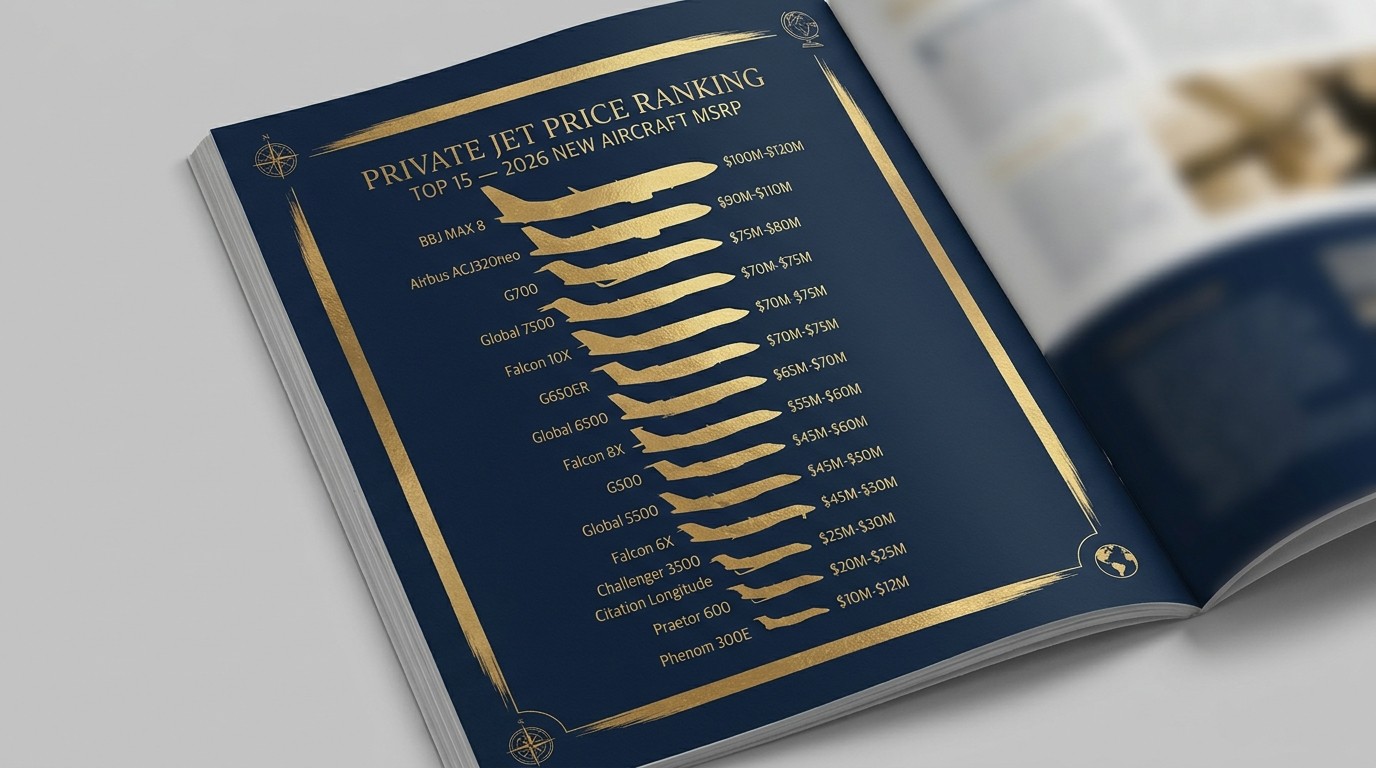
✔️ New aircraft price ranking, Top 15: from BBJ MAX 8 ($100M-$120M) down to Phenom 300E ($10M-$12M)
✔️ Pre-owned (5-10 year): typically 30-50% below new MSRP
✔️ Korean ownership total annual operating cost, super-midsize basis: roughly $1.5M-$2.2M
✔️ Gimpo SGBAC hangar lease: $80K-$220K/year depending on aircraft size
✔️ Korean registration timeline: 3-6 months; foreign registration adds operational filings
✔️ This is the single-page reference for price information and the Korean ownership decision
→ Private jet pricing advisory (Wonjin Choi 📞 +82-10-7723-3177)
Private Jet Price List 2026: Top 15 Business Aircraft Ranked from $10M to $120M, with Korean Ownership Total Cost Analysis
Anyone working through a first private jet purchase decision quickly hits the same problem: the price information that’s actually out there is fragmented. You can find numbers for specific aircraft, but rarely in one place, rarely with the distinction between MSRP and pre-owned market pricing, and almost never with the Korean-specific overlay of hangar economics, registration paths, and annual operating cost. This page fills that gap. The 15 most-traded business jets are ranked by MSRP in USD, from the Boeing BBJ MAX 8 at $100M-$120M down to the Embraer Phenom 300E at $10M-$12M. Pre-owned discounts for 5-10 year airframes are mapped against new MSRP, and the Korean ownership total cost layer — registration, hangar, crew, maintenance, fuel, insurance — is built out alongside.
A few things to understand before reading the numbers. Private jet pricing actually has three layers, and the right answer changes depending on which layer you’re looking at. First is sticker price: the figure OEMs publish for new aircraft, configured to standard interiors. Second is transaction price: pre-owned 5-10 year aircraft trade 30-50% below new MSRP, with the range varying by maintenance history, remaining useful life, and interior condition. Third is total cost of ownership (TCO): registration and acquisition taxes, hangar lease, annual operating cost (crew, maintenance, fuel, management), and insurance, all rolled into the annual run-rate. For super-midsize aircraft, TCO lands in the $1.5M-$2.2M range. The ranking on this page covers all three layers.
What’s covered: aircraft category structure across the six tiers, Top 15 new MSRP rankings in USD, category-by-category aircraft detail, new versus pre-owned pricing dynamics, Korean ownership total cost (registration, hangar, operating, insurance), ownership-versus-charter breakeven analysis by annual flight hours, the four ownership patterns by price tier, and ACK’s 12-month acquisition consulting process. Whether you’re considering your first aircraft purchase, comparing ownership against charter, or just trying to understand where the Korean market sits, this page consolidates the information into a single reference.
Air Charter Korea (ACK) runs a single consulting channel across the full acquisition spectrum, from initial pricing review through ownership operation and charter matching. Founder Wonjin Choi serves as the Victor × Air Charter Service Korea Agent, integrating global OEM price intelligence with Korean market registration, hangar, and operating economics. The pricing on this page is grounded in OEM published data combined with actual market transaction patterns seen through ACK’s operator network.
⚡ Private jet pricing advisory: free pre-review
Share your aircraft category interest, budget range, and projected annual flight hours. ACK will provide a free pre-review covering new versus pre-owned price comparison, Korean ownership total cost estimate, and ownership-versus-charter decision simulation.
📧 contact@aircharterkorea.com | 📞 Wonjin Choi +82-10-7723-3177
→ Free ACK pricing advisory
1. Aircraft Categories: How the Six Tiers Define the Market
The six price tiers
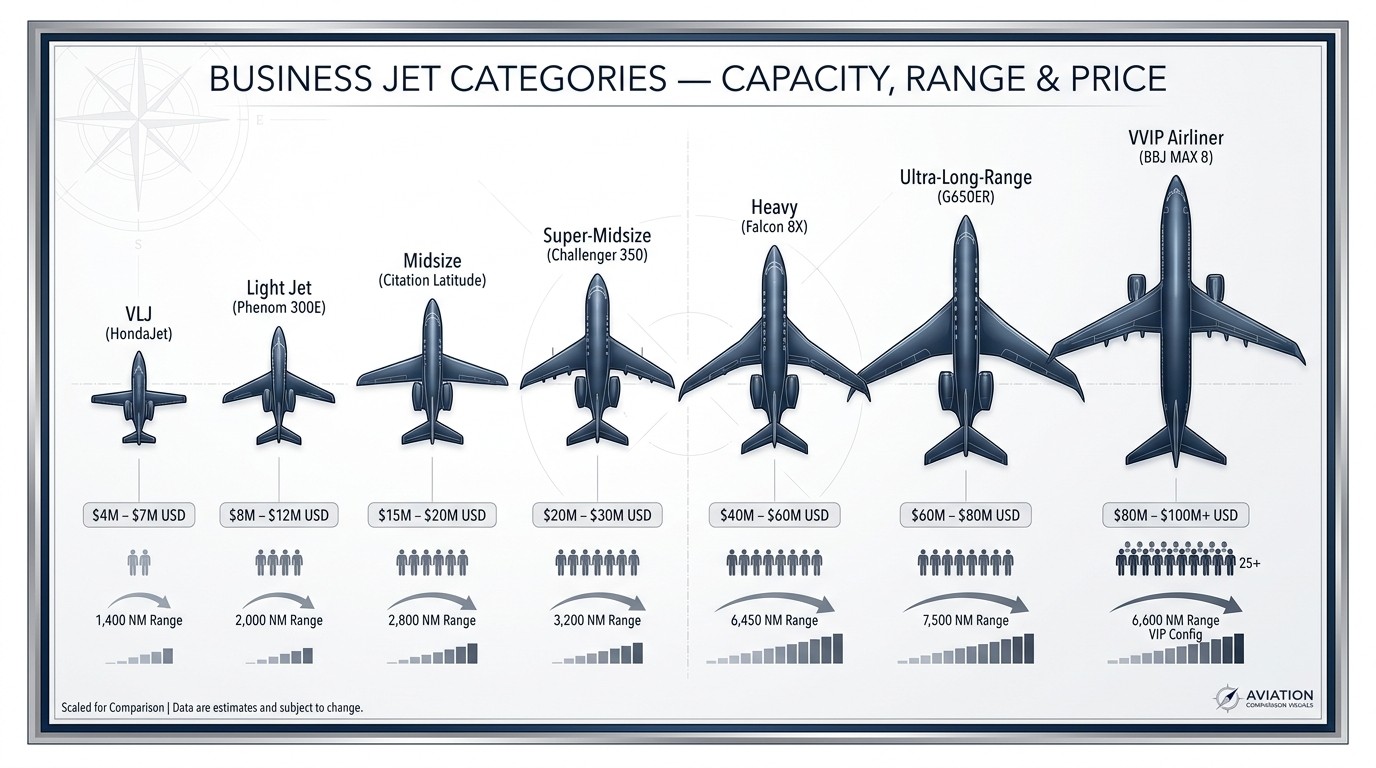
Business aircraft sort into six categories defined by capacity, range, and cabin dimensions. Price varies within categories depending on OEM and model, but the category structure sets the overall price architecture of the market.
Category | Representative Aircraft | New MSRP | Capacity / Range |
|---|---|---|---|
VLJ (Very Light Jet) | HondaJet, Phenom 100 | $5M-$6M | 4-5 pax / ~2,200 km |
Light Jet | Phenom 300E, Citation CJ3+ | $10M-$12M | 6-8 pax / ~3,600 km |
Midsize | Citation Latitude, Praetor 600 | $20M-$22M | 8-9 pax / ~5,500 km |
Super-Midsize | Challenger 350, Citation Longitude | $27M-$30M | 8-10 pax / ~5,900 km |
Heavy | Falcon 7X, Global 6500 | $56M-$78M | 12-16 pax / ~11,000 km |
Ultra-Long-Range | G650ER, Global 7500, G700 | $75M-$85M | 14-19 pax / ~14,000 km |
VVIP Airliner | BBJ MAX 8, ACJ TwoTwenty, Lineage 1000E | $80M-$120M | 19-50 pax / converted airliner |
Choosing the right category
Three variables drive category selection: passenger count (how many people you typically fly together), range (the furthest non-stop sector you need), and cabin space (whether you need a conference setup or sleeping quarters). From Korea, the working rules of thumb are: light jet for short-haul (Japan, China), super-midsize for medium-haul (Southeast Asia), ultra-long-range for trans-Pacific or Eurasian long-haul, and VVIP airliner for 25-plus passenger groups.
For the technical specs of 15 popular models, see the Business Jet Aircraft Catalog; for VVIP airliner use cases, the Group Charter Guide covers BBJ, ACJ, and ACMI airliner deployment.
2. Top 15 New MSRP Ranking (USD)
Rank | Aircraft | OEM | Category | New MSRP |
|---|---|---|---|---|
1 | Boeing BBJ MAX 8 | Boeing | VVIP Airliner | $100M-$120M |
2 | Airbus ACJ TwoTwenty | Airbus | VVIP Airliner | $90M-$110M |
3 | Embraer Lineage 1000E | Embraer | VVIP Airliner | $80M-$90M |
4 | Gulfstream G700 | Gulfstream | Ultra-Long-Range | $78M-$85M |
5 | Bombardier Global 7500 | Bombardier | Ultra-Long-Range | $75M-$80M |
6 | Gulfstream G650ER | Gulfstream | Ultra-Long-Range | $70M-$78M |
7 | Dassault Falcon 8X | Dassault | Heavy | $60M-$65M |
8 | Bombardier Global 6500 | Bombardier | Heavy | $56M-$62M |
9 | Gulfstream G500 / G600 | Gulfstream | Heavy | $48M-$58M |
10 | Dassault Falcon 7X | Dassault | Heavy | $40M-$50M |
11 | Bombardier Challenger 650 | Bombardier | Heavy | $32M-$38M |
12 | Cessna Citation Longitude | Textron | Super-Midsize | $27M-$30M |
13 | Bombardier Challenger 350 | Bombardier | Super-Midsize | $26M-$28M |
14 | Embraer Praetor 600 | Embraer | Midsize | $20M-$22M |
15 | Embraer Phenom 300E | Embraer | Light Jet | $10M-$12M |
Reading the ranking
The pricing above reflects OEM new MSRP. Actual delivery prices vary with interior specification, options, currency exchange rates, and delivery timing. VVIP airliners like the BBJ MAX 8 and ACJ TwoTwenty often add $20M-$40M in interior completion costs during the conversion process, pushing total delivered pricing to $130M-$160M for fully specified examples. Light jets and midsize aircraft, by contrast, typically deliver close to MSRP since OEM standard interiors handle most use cases without modification.
3. Category-by-Category Aircraft Detail
VVIP airliner: Boeing BBJ MAX 8 and Airbus ACJ TwoTwenty
The top price tier of the market, built from commercial airliners — the 737 MAX and A220-100 — converted to business jet specification. The BBJ MAX 8 typically configures 25-30 passengers, with range of approximately 11,600 km enabling Korea-to-East Coast US and Korea-to-Europe non-stop operations. Cabins include living rooms, bedrooms, conference rooms, dining areas, and shower facilities, and the aircraft are used for multi-generational family travel, government and diplomatic missions, and large corporate executive group movements. The ACJ TwoTwenty, built on the newer A220-100, brings improved fuel efficiency and lower operating cost; with 18-19 passenger capacity in a cabin with more usable volume than its size class would suggest, it offers strong interior design flexibility.
Ultra-long-range: Gulfstream G700, Global 7500, G650ER
The most-flown personal business jet category. The Gulfstream G700, in service since 2022, offers approximately 13,890 km range and the longest cabin in class at 17.5 meters. The Global 7500 reaches roughly 14,260 km, enabling Korea-to-New York, Korea-to-London, and Korea-to-Sydney non-stop with a distinctive 4-zone cabin layout. The G650ER, in production since 2014 and the segment’s best-seller, offers ~13,890 km range with a deep pre-owned market — 5-10 year examples trade at $40M-$55M. For Korean principals running regular trans-Pacific or Eurasian long-haul, these are the three reference aircraft.
Heavy: Falcon 8X, Global 6500, G500/G600
One tier below ultra-long-range on capability (roughly 11,000-12,000 km), but with comparable cabin volume and design flexibility. The Falcon 8X uses a distinctive three-engine configuration for short-runway capability and fuel efficiency. The Global 6500 is the smaller sibling of the 7500, offering ~12,200 km range and 13-passenger standard configuration. The G500 and G600 represent Gulfstream’s mid-generation aircraft, with strong range performance relative to price. The right category when Korea-Americas or Korea-Europe non-stop matters but ultra-long-range pricing is heavier than needed.
Super-midsize and midsize: Citation Longitude, Challenger 350, Praetor 600
The most efficient category for Korea-Southeast Asia, Korea-India, and US transcontinental operations. The Challenger 350 is the segment best-seller, with ~5,900 km range and standard 8-10 passenger seating; it’s one of the most-flown business jets in the US. The Citation Longitude is the newer super-midsize with a wider cabin and ~6,500 km range. The Embraer Praetor 600, classified as midsize, offers ~7,500 km range that puts it close to super-midsize on capability — a class-leading range-to-price ratio.
Light jet: Phenom 300E
The entry tier’s best-seller, and the most-flown light jet globally. Capacity of 6-8 passengers, range of approximately 3,650 km, covering Korea-to-Japan, Korea-to-eastern-China, Korea-to-Taiwan, and Korea-to-northern-Vietnam non-stop. The first-aircraft choice for principals with regular short-haul leisure and short-distance business travel out of Korea. For detailed pricing analysis on this aircraft, see the Light Jet Charter Cost Guide.
4. New vs Pre-Owned: Where the 30-50% Discount Lives
Pre-owned discount by vintage
Aircraft | New MSRP | 5-10 Year Pre-Owned | 10-15 Year Pre-Owned |
|---|---|---|---|
G650ER | $70M-$78M | $40M-$55M | $25M-$35M |
Global 7500 | $75M-$80M | $50M-$60M | Newer model, N/A |
Falcon 8X | $60M-$65M | $35M-$48M | $22M-$30M |
Global 6500 | $56M-$62M | $30M-$45M | $18M-$25M |
Challenger 350 | $26M-$28M | $15M-$20M | $8M-$12M |
Phenom 300E | $10M-$12M | $6M-$8M | $3M-$5M |
Diligence essentials on pre-owned
Pre-owned aircraft offer real value, but the pre-purchase diligence cycle is non-negotiable. Pre-Buy Inspection (PBI) examines maintenance history, remaining useful life on calendar and cycle limits, engine condition, interior wear, and avionics upgrade history. PBI costs run $30K-$60K on light jets, $50K-$80K on super-midsize, and $80K-$150K on heavy aircraft. It’s the standard process before close on any used aircraft acquisition. For marketplace screening and PBI procedure detail, see the Private Jet Marketplace Buying Guide.
When new vs pre-owned makes sense
New favors: Latest interior and avionics, 10+ year holding plan, full OEM warranty coverage
Pre-owned favors: 30-50% savings, immediate delivery (vs new aircraft 2-5 year wait), savings deployable to interior refurbishment
Sweet spot: 5-7 year aircraft balance pre-owned price advantage with remaining useful life, especially after passing PBI
5. Korean Ownership Total Cost: Registration Through Annual Operations
Korean vs foreign registration
The first ownership decision is which jurisdiction the aircraft registers in. Korean registration (HL- prefix) follows the Korean Aviation Safety Act and requires aircraft registration certificate, airworthiness certificate, radio station permit, and insurance, with the full process taking 3-6 months. Foreign registration (US N-, Cayman VP-C-, Bermuda VP-B-) simplifies registration and tax treatment but requires Korean aviation authority notification at each operation. Major global operators (NetJets, VistaJet) and management firms (ExecuJet, Jet Aviation) use the foreign-registered, Korea-based model as their standard structure.
Gimpo SGBAC hangar lease
Aircraft Category | Gimpo SGBAC Annual | Incheon Annual (5-10% lower) |
|---|---|---|
VLJ | $50K-$80K | $45K-$75K |
Light Jet | $60K-$100K | $55K-$95K |
Midsize | $80K-$120K | $75K-$115K |
Super-Midsize | $100K-$150K | $95K-$140K |
Heavy | $150K-$220K | $140K-$210K |
Ultra-Long-Range | $180K-$280K | $170K-$265K |
More than half of Korean privately held aircraft hangar at Gimpo SGBAC. The 30-minute drive from Gangnam is the key differentiator versus Incheon. Incheon offers 5-10% lower hangar fees but adds 100-130 minutes of ground transit from Gangnam. For airport-by-airport detail, see the Gimpo SGBAC Guide and the Incheon Long-Haul Guide.
Total annual operating cost — super-midsize basis
Line Item | Annual Cost | Detail |
|---|---|---|
Crew compensation | $400K-$600K | 2 captains, 2 first officers, 1-2 cabin attendants |
Hangar lease | $80K-$150K | Gimpo SGBAC super-midsize rate |
Maintenance (scheduled + unscheduled) | $300K-$500K | A/B/C/D check cycles plus parts replacement |
Fuel | $400K-$700K | 300-500 annual flight hours basis |
Management, insurance, and other | $200K-$400K | Management firm contract plus Hull/Liability insurance |
Total annual operating cost | $1.5M-$2.2M | Super-midsize average |
Heavy and ultra-long-range aircraft run $2.5M-$4M annually; light jets sit around $1M. For the detailed annual operating cost line-item analysis, see the Maintenance & Operating Cost Guide.
6. Ownership vs Charter: The Annual Flight Hours Test
Annual Flight Hours | Rational Structure | Annual Cost Estimate |
|---|---|---|
Under 50 | On-demand charter (10-20 trips) | $200K-$500K |
50-150 | 25-50 hour jet card | $300K-$1M |
150-250 | 100 hour jet card or annual program | $1M-$2M |
250-400 (breakeven zone) | Ownership consideration or aircraft management | $1.5M-$3M (operating) |
400+ | Ownership or management most rational | $2M-$4M (operating) |
What the breakeven actually means
The 250-400 hour band is where ownership starts winning the hourly cost comparison against charter. The catch: hourly cost isn’t the only variable. Ownership commits to capital ($10M-$120M), operational responsibility (management firm or direct operation), and residual value risk (depreciation at exit). Inside that 250-400 band, the practical alternatives to direct ownership include aircraft management (the ExecuJet and Jet Aviation model), fractional ownership (NetJets), and annual programs — each of which captures part of the ownership economics without the full capital and operational commitment. For detailed analysis, see the Ownership vs Charter Guide and the Executive Travel ROI Guide.
7. Ownership Patterns by Price Tier
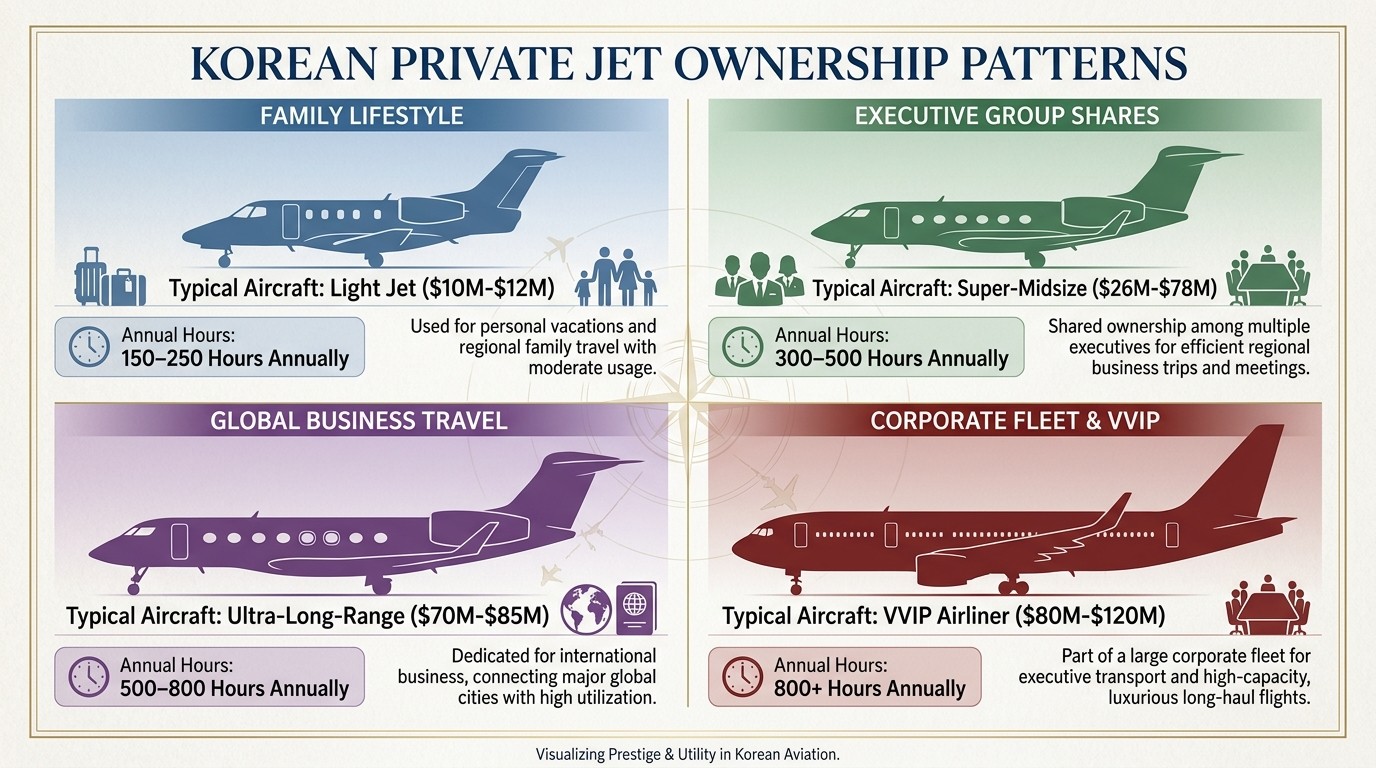
Pattern ① Light jet ($10M-$12M) — family leisure and short-haul business
The most common first-aircraft pattern in Korea. Families running regular Gimpo-Jeju, Gimpo-Tokyo, and Gimpo-Fukuoka trips, with primary business travel staying within Japan and China short-haul. Annual flight hours of 150-250 hit the ownership economics threshold; the standard structure is Gimpo SGBAC hangar with management firm operations.
Pattern ② Super-midsize/heavy ($26M-$78M) — executive and corporate
The pattern for executives or corporate ownership running 300-500 annual flight hours. Korea-Southeast Asia, Korea-India, Korea-Australia medium-haul forms the operational core, with the Challenger 350 and Falcon 8X among the most-flown models. Corporate ownership typically structures through aircraft management rather than direct operation, with global firms like ExecuJet and Jet Aviation providing operating services in the Korean market.
Pattern ③ Ultra-long-range ($70M-$85M) — global executive and trans-Pacific routes
Principals running Korea-Americas and Korea-Europe long-haul at 100+ annual hours. The G650ER, Global 7500, and G700 represent the top of the Korean ownership market, with Incheon hangar as standard. Global IPO roadshows, M&A meetings, and executive overseas travel make up the core use cases.
Pattern ④ VVIP airliner ($80M-$120M) — large group travel
25-50 passenger group movements for families, corporations, and government missions. Korean private ownership in this segment remains rare outside government aircraft and a small set of family/corporate holdings. The BBJ MAX 8 and ACJ TwoTwenty do appear regularly in temporary charter for K-pop world tours, sports team travel, and multi-generational family trips. For group charter use cases, see the Group Charter Guide.
8. ACK Acquisition Consulting: The 12-Month Standard Process
Stage-by-stage timeline
Months 1-2: Flight hour simulation, category selection, new versus pre-owned comparison
Months 2-4: Marketplace screening, 5-10 candidate aircraft shortlist for Pre-Buy Inspection
Months 4-6: Pre-Buy Inspection on final 1-2 candidates, price negotiation, Letter of Intent execution
Months 6-9: Purchase agreement, payment, registration (Korean or foreign), insurance binding, hangar contract
Months 9-12: Aircraft delivery, management firm selection, crew hiring, first operation
For the full 12-month roadmap, see the 12-Month Acquisition Roadmap; for marketplace screening procedure, see the Marketplace Buying Guide.
Built-in client protections
NDA upfront: Purchase consideration information stays protected from external exposure
Independent market analysis: No OEM or operator bias in evaluation
PBI partner matching: Globally certified maintenance firms running inspections
Aviation counsel and accounting: Specialist legal and tax firms for purchase agreement, registration, and tax structuring
Management firm matching: Comparison across ExecuJet, Jet Aviation, and other firms operating in the Korean market
9. Frequently Asked Questions
Q: Why do private jet prices vary so much across sources?
There are actually three different prices: OEM new MSRP, actual delivered price (after interior options and currency timing), and pre-owned market price. OEM MSRP is the base figure; interior specification, options, exchange rates, and delivery slot timing all shift the actual delivered number. VVIP airliner conversions add $20M-$40M in interior completion costs, which is why total program pricing for a fully specified BBJ or ACJ often differs from the headline MSRP by 20-30%. Pre-owned pricing then layers maintenance history, remaining useful life, and interior condition on top, so two identical-model pre-owned aircraft can trade 30-50% apart. ACK consultation reconciles OEM data with actual market transactions to deliver a realistic buy-side range.
Q: How significant are Korean ownership taxes?
Korean registration triggers acquisition tax and registration tax at purchase, with annual property tax thereafter. Foreign registration (US N-, Cayman VP-C-, Bermuda VP-B-) avoids Korean acquisition tax but requires operational notification to Korean aviation authorities per flight. For corporate ownership, depreciation handling, operating expense treatment, and VAT recovery introduce additional variables that warrant specialist aviation accounting counsel. ACK matches clients with aviation-specialist accounting firms familiar with both jurisdictions.
Q: Which aircraft are most commonly owned in Korea?
Korean private ownership concentrates in three categories: light jet (Phenom 300E), super-midsize (Challenger 350), and ultra-long-range (G650ER, Global 7500). Light jet is the typical first acquisition; super-midsize fits the executive corporate operation pattern; ultra-long-range serves principals running regular Korea-Americas or Korea-Europe long-haul. VVIP airliners (BBJ, ACJ) remain rare in Korean private ownership outside government aircraft and select corporate/family holdings.
Q: Where do I find pre-owned aircraft inventory?
The global pre-owned marketplaces — JetNet, Controller, AvBuyer, and GlobalAir — are the standard reference points, with each OEM (Gulfstream, Bombardier, Embraer) also running certified pre-owned programs. ACK monitors all four marketplaces monthly and surfaces new listings matching client criteria as they appear once purchase intent is confirmed. For marketplace usage detail, see the Marketplace Buying Guide.
Q: What are new aircraft delivery wait times?
It varies by model, but in-demand aircraft (G650ER, Global 7500, G700, Falcon 8X) carry OEM backlogs of 2-5 years for new deliveries. Embraer Phenom 300E and other light jets run shorter, typically 1-2 years. BBJ and ACJ airliner conversions need 3-5 years (commercial aircraft delivery plus interior completion). For faster delivery, the pre-owned marketplace offers immediately available alternatives.
Q: Can ownership generate charter revenue?
Yes, through aircraft management charter programs. The owner places the aircraft into a charter pool during periods of non-use, generating revenue that offsets a portion of ownership cost. For a super-midsize aircraft, annual charter revenue typically runs $300K-$800K, offsetting 20-40% of ownership operating cost. ExecuJet and Jet Aviation operate this model globally, and the same structure works in the Korean market. For deeper analysis, see the Ownership vs Charter Guide.
Q: How tight is Gimpo SGBAC hangar availability?
Gimpo SGBAC houses more than half of Korean privately held aircraft, and slot availability requires advance reservation for new ownership. The standard lock-in window is 6-12 months ahead, with heavy and ultra-long-range slots particularly constrained. Incheon offers more slot availability but adds 100-130 minutes of ground transit from Gangnam. ACK verifies hangar slot availability at both airports and aligns the contract timing to the acquisition schedule.
📞 Private jet pricing advisory: free pre-review
Aircraft purchase consideration: ACK — Request Quote | Wonjin Choi 📞 +82-10-7723-3177 | contact@aircharterkorea.com
Optional VIP escort: BestTurn VIP Escort | Steve 📞 +82-10-3721-2853 | service@bestturnaround.com
🔗 ACK LinkedIn | Wonjin Choi LinkedIn
Category selection · New vs pre-owned analysis · Korean ownership cost simulation · Management firm matching
Conclusion: Private Jet Pricing Is About Total Cost of Ownership, Not Sticker Price
The most common mistake in evaluating private jet pricing is anchoring on OEM new MSRP. The BBJ MAX 8 at $100M or the G650ER at $70M is a starting point, not the decision metric. Real evaluation requires layering in new versus pre-owned (30-50% discount), Korean versus foreign registration, hangar lease ($80K-$280K annually), total annual operating cost ($1.5M-$4M), and insurance and tax treatment. The Top 15 ranking on this page organizes the MSRP layer, but read it alongside the Korean ownership total cost analysis to understand actual capital commitment and annual run-rate.
The ownership-versus-charter breakeven sits at 250-400 annual flight hours. Below that band, on-demand charter or jet card structures are more efficient; above it, ownership or aircraft management makes sense. The decision can’t be reduced to hourly cost alone, though. Ownership carries capital commitment, operational responsibility, residual value risk, and depreciation exposure on exit. ACK runs simulation models across all these variables to support the decision, and the 12-month acquisition consulting process covers everything from evaluation through delivery in a single channel.
Share your aircraft category interest, budget range, and projected annual flight hours and ACK will deliver a free pre-review within 24-48 hours of NDA execution: new versus pre-owned price comparison, Korean ownership total cost estimate, and ownership-versus-charter simulation. First consultation is free; formal acquisition consulting runs the 12-month standard process — from evaluation, Pre-Buy Inspection, purchase agreement, registration, and delivery through operational start.
Private jet pricing isn’t just an acquisition cost — it’s the starting point for 10-15 years of operations. Building from the MSRP ranking through Korean ownership total cost in a single, consistent view is what this page is for, and Air Charter Korea takes the decision from there.
Private jet price ranking, Top 15: from BBJ at $100M down to Phenom 300E at $10M, with Korean ownership cost on the same page.

✍️ About the Author
Wonjin Choi | Former Korean Air Business Jet Operations Manager · Former Samsung Electronics Business Jet Account Manager
Victor × Air Charter Service Korea Agent
Founder, Air Charter Korea
This guide draws on official published specifications and pricing data from Boeing, Airbus, Gulfstream, Bombardier, Dassault Aviation, Embraer, and Textron Aviation, market transaction data from JetNet, Controller, AvBuyer, and GlobalAir, official service information from Air Charter Korea, ARG/US and Wyvern global aviation safety frameworks, the Korean Aviation Safety Act and Aviation Business Act, and global business aviation market reference pricing as of June 2026. All new MSRP, pre-owned market pricing, and annual operating cost figures represent market reference ranges; actual purchase prices, transaction terms, interior specifications, and operating costs vary by OEM policy, aircraft condition, currency rates, delivery timing, and operating structure. For accurate quotes, acquisition review, Korean registration procedures, and tax structuring, consultation with ACK alongside aviation-specialist legal and accounting firms is the appropriate source. Boeing BBJ, Airbus ACJ, Gulfstream G650ER/G700/G500/G600, Bombardier Global/Challenger, Dassault Falcon, Embraer Phenom/Praetor/Lineage, Cessna Citation, and other aircraft model names, along with ARG/US, Wyvern, Victor, Air Charter Service, NetJets, VistaJet, ExecuJet, Jet Aviation, JetNet, Controller, AvBuyer, and GlobalAir, are registered trademarks of their respective OEMs and organizations; this guide is provided for general informational purposes and does not reflect any affiliate relationship with the named OEMs, operators, or marketplaces.